Sunday, February 26, 2023

Sequoia and Andreessen Horowitz invested more in fintech than any other sector in 2022

Welcome to The Interchange! If you received this in your inbox, thank you for signing up and your vote of confidence. If you’re reading this as a post on our site, sign up here so you can receive it directly in the future. Every week, I’ll take a look at the hottest fintech news of the previous week. This will include everything from funding rounds to trends to an analysis of a particular space to hot takes on a particular company or phenomenon. There’s a lot of fintech news out there and it’s my job to stay on top of it — and make sense of it — so you can stay in the know. — Mary Ann

Storied venture firms Sequoia Capital and Andreessen Horowitz (a16z) invested more in fintech than any other category in 2022, according to research from CB Insights. I’m not going to lie — upon learning this, my fintech-loving ears perked up.

Sequoia apparently was fairly active overall last year despite the global downturn, with over 100 investments. And fintech represented nearly a quarter of the firm’s deals.

We saw a similar trend at a16z. According to CB Insights, of the 206 deals that a16z participated in last year, almost a quarter went to fintech companies — more than any other industry. Sixty percent of these fintech investments closed in the first half of 2022, with the remainder closing in the second half of the year.

Sequoia backed 25 companies in the financial services space last year. Its top three fintech targets, as identified by CB Insights, were capital markets, payments and payroll and benefits — with each category representing 16% of its investments.

A16z backed 49 companies in the fintech space last year and its top three fintech targets were payments (28%), blockchain (22%) and digital lending (12%).

Three out of Sequoia’s four deals in the capital markets space were follow-on investments, a reflection of the firm’s “faith in the future of capital markets tech,” noted CB Insights. Deals it participated in included Citadel Securities’ $1.2 billion round; Capitolis’ $110 million Series D; Watershed’s $70 million Series B; and Ledgy’s $22 million Series B.

More than a quarter (28%) of a16z’s fintech investments in 2022 went to the payments category. For example, it participated in SpotOn’s $300 million Series F; Jeeves’ $180 million Series C; and Tally Technologies’ $80 million Series C.

Meanwhile, Sequoia’s investments in payments tech companies spanned both consumer and business payments and operate in four distinct markets: buy now, pay later (BNPL), expense management, peer-to-peer (P2P) payments, and online payments acceptance. Two of the four deals are at the seed stage. Specifically, Sequoia participated in Klarna’s $800 million financing; Yokoy’s $80 million Series B; Telda’s $20 million seed round; and Cococart’s $4 million seed financing.

While blockchain and crypto arguably fall under the fintech category, I usually leave analysis of those segments to our crypto team, so I won’t go into a16z’s blockchain investments. But a16z’s third most popular fintech category in 2022 was digital lending companies, with the firm having participated in Point Digital Finance’s $115 million Series C; Valon’s $60 million Series B; and Vesta’s $30 million Series A.

Sequoia’s third most popular category was payroll and benefits, with the firm having backed four such companies — all at later stages — and participating in CaptivateIQ’s $100 million Series C; Rippling’s $250 million Series D; Remote’s $300 million Series C; and Truework’s $50 million Series C.

Now, we know that investments in fintech companies were far lower in 2022 compared to 2021. But wasn’t that true for every sector? Sequoia’s and a16z’s continued bets in the space are just one indication that fintech may be down, but definitely not out.

Weekly News

I interviewed Klarna CEO and co-founder Sebastian Siemiatkowski about the Swedish payment giant’s momentum in the U.S. Highlights of the interview, which you can read about in more detail here, include (1) the fact that the U.S. has overtaken Germany as Klarna’s largest market by revenue, (2) the company’s fastest-growing revenue stream is actually marketing, not BNPL and (3) Sebastian really views Klarna and Affirm as being “very different” companies in terms of loan duration and amount. On the topic of Klarna and Affirm, I also spoke this past week with Tyson Hendricksen, CEO and founder of a new company called Notice that tracks secondary market trade activity in the private markets. He told me that based on secondary market activity, Klarna appears to be currently valued at around $7.5 billion, which is actually higher than the $6.7 billion it was valued at last July, but also still significantly lower than the $45 billion it was valued at in 2021. By comparison, Affirm is currently valued at $3.84 billion. Below is a chart Hendricksen provided that illustrates trading activity at the two companies. Affirm is public so the chart shows share price as recorded in the public markets. It also shows a composite price for Klarna that takes into  account secondary market trades and open bids and offers. Says Hendricksen: “Think of it as an approximation of the current stock price and valuation using multiple private market data sets.”

To view it more interactively, click here.
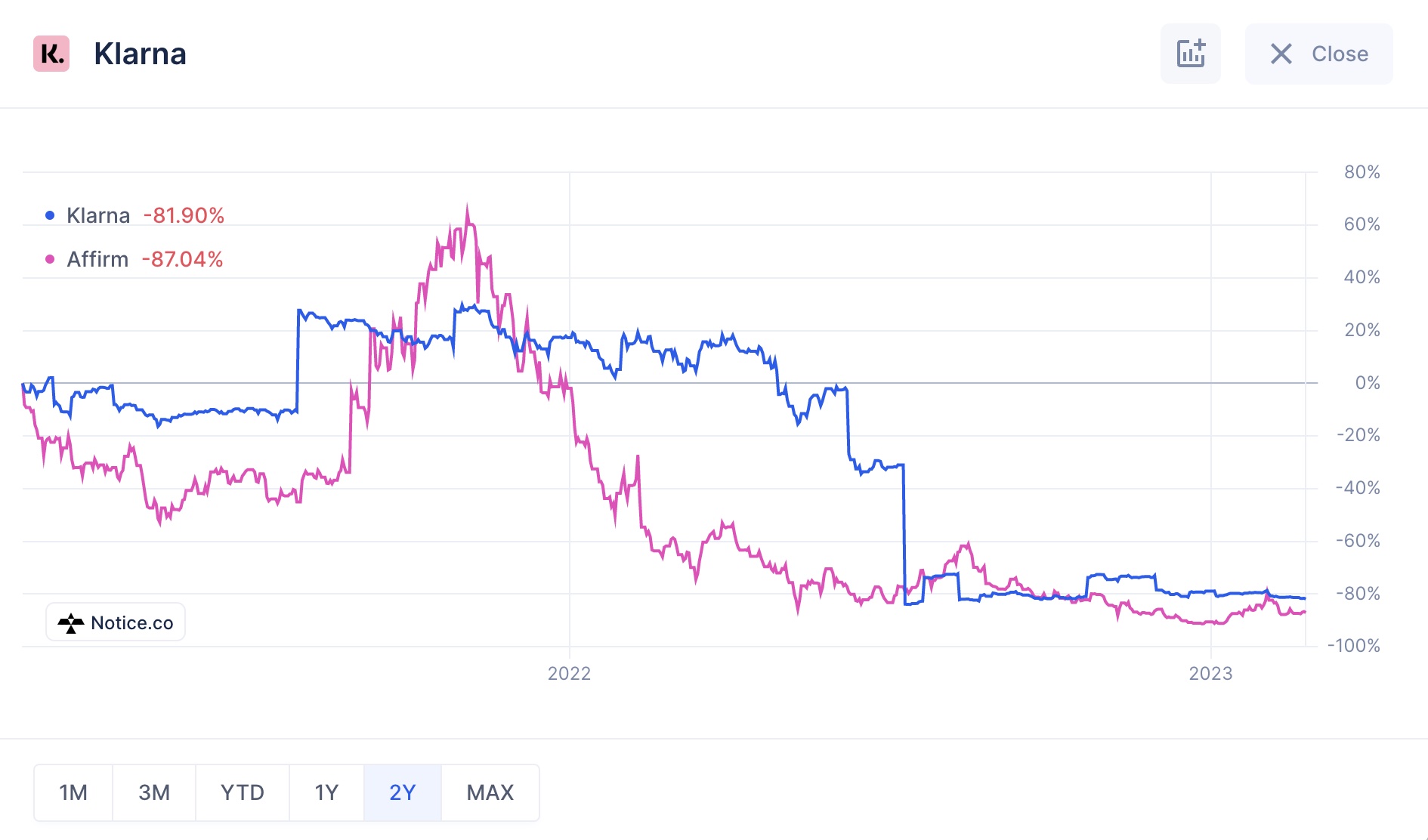
Image Credits: Notice

Reports Tage Kene-Okafor: “African cross-border payments platform Chipper Cash conducted a second round of layoffs…just 10 weeks after it cut approximately 12.5% of its workforce (affecting its engineering team the most). The company’s VP of revenue shared the news on LinkedIn, saying “all areas” across Chipper Cash’s markets were impacted this time. “Friday was a sad day for Chipper Cash, as many talented people were let go,” his post read. More here.

Reports Manish Singh: “India and Singapore have linked their digital payments systems, UPI and PayNow, to enable instant and low-cost fund transfers in a major push to disrupt the cross-border flow of money between the two nations that amounts to more than $1 billion each year.” More here.

Reports Ingrid Lunden: “Stripe, the payments and financial services upstart, made waves in the world of mobile commerce last year when it became Apple’s first payment partner for “Tap to Pay,” the iPhone giant’s move to turn any iOS device into a payment-making or payment-taking terminal. Now, Stripe is expanding that business by a factor of googol. From today, businesses that use Stripe Terminal to take in-person payments now will be able to carry out Tap to Pay transactions on NFC-equipped Android devices, too.” More on that here.

MagicCube co-founder Sam Shawki points out in an email interview with me that Stripe is actually not the only payments company providing Tap to Pay on Android currently. He says that his startup, MagicCube, was first to market with Tap to Pay on Android devices in 2021 in the U.K., which has been transacting for a while now. Adds Shawki: “Since then we have many deployments around the world and a few new deployments in the US coming up shortly with major processors in the US, Canada and EMEA that are using Apple on iOS and MagicCube on Android.…We welcome Stripe to the market as it confirms our vision and lights the fire under other processors, merchant acquirers, and financial institutions to more quickly move to adoption in order to maintain their market share. We believe that this year will be the year of massive shift to using our product on Android and on Apple’s iOS to capture the $140 billion a year opportunity of Tap to Phone.” I wrote about MagicCube in 2021 here.

Samantha “Sam” Eisler has joined Lightspeed Venture Partners’ NYC fintech team. Prior to Lightspeed, which she joined in late 2022, Eisler was an investor at Tusk Venture Partners, where she focused on investments in fintech and digital health. Prior to that, she spent five years at Google, working on go-to-market strategies for the company’s machine-learning-driven ad solutions, as well as helping to build an accelerator program for startups in emerging markets. More here.

Reports Bloomberg: “JPMorgan Chase & Co. has curbed its staff’s use of the ChatGPT chatbot, according to a person familiar with the matter. The artificial intelligence software is currently restricted, the person said, who asked not to be identified because the information is private. The move, which impacts employees across the firm, wasn’t triggered by any specific incident.”

Varo Bank announced the appointment of Wook Chung as chief product officer. A statement from a spokesperson said that Chung will lead Varo’s product vision and strategy initiatives and will play a key role in the expansion of Varo Tech, the innovation arm of the company, “which meets at the intersection of product, technology, data, and design.” According to Varo, Chung has an “extensive background” in product management through roles at Facebook, Twitter, Google, and most recently SoFi. More here.

Across the sea, as reported by Silicon Canals, “Amsterdam-based challenger bank Bunq announced on Tuesday, February 21, that it has reached a pre-tax profit of €2.3M in the last quarter of 2022. In Q4 2022, Bunq’s net fee income grew by 37 per cent compared to Q4 2021, and user deposits grew by 64 per cent compared to €1.8B at the end of 2022.” More on Bunq here.

Mastercard has tapped five startups to participate in its Start Path Emerging Fintech program. Here are the five startups, as described by the credit card giant: EMERGE Esports (Singapore) provides its network of gaming content creators and brands across Southeast Asia with commercialization options through its talent database. Mintoak (India) provides a software-as-a-service platform that enables banks to expand their value proposition for merchants through payment acceptance and commerce enablement solutions. Optty (Singapore) offers a single integration and orchestration solution that connects merchants directly to buy now, pay later solutions; wallets; and other alternative payment methods globally. PayCaddy (Panama) offers an all-in-one banking-as-a-service solution for digital banking and express card issuance. Finally, Prosperas (United States) enables lenders to deliver credit opportunities directly to a mobile phone using anonymized, nonbiased data to match and prequalify consumers.

Rob Galtman, senior director of Fitch Ratings, noted that Block (formerly known as Square) had a “solid” Q4 despite macro- and recession-related fears. Via email, he added that the company is among other large tech players that have focused more on profitability in light of tougher capital market conditions, with management revealing slower hiring trends in 2023. Galman added: “Market concerns around BNPL are not evident to date, with loan loss rates remaining low. However, BNPL remains an area to focus on, given low-income consumers are especially pressured with inflation pressures. If a recession or macro pullback arrives, Block is well positioned given exposure to secular growth areas including digital payments and omnichannel commerce, as well as a strong balance sheet.”

Opendoor Technologies continues to face challenges. As reported by Barron’s: The real estate tech company “reported a narrower fourth-quarter loss than expected after the market closed on Thursday, February 23. The earnings beat caps a year of change in both the housing market and the company, which buys and sells houses. Opendoor (ticker: OPEN) said it lost 63 cents per share on revenue of about $2.9 billion in the quarter, beating consensus estimates…In full-year 2022, Opendoor lost $2.16 per share on revenue of about $15.6 billion. Consensus had anticipated a loss of $2.33 on sales of roughly $15.2 billion. While the fourth-quarter results beat estimates, they were down significantly from year-ago levels. The company lost 31 cents per share on sales of about $3.8 billion in the final quarter of 2021.”

Fundings and M&A

Seen on TechCrunch

YC-backed HR-payroll provider Workpay raises $2.7M to scale in Africa

Nestment raises $3.5M to help friends and family buy homes together

Trust & Will secures $15M after doubling revenue: Amex Ventures, USAA are among the digital estate planning startup’s new backers

Telecom giant Airtel eyes a stake in Paytm

And elsewhere

Marijuana fintech firm Green Check Verified raises $6 million

Mexican startups Minu and Plerk merge to strengthen the benefits market. TechCrunch covered Minu’s recent raise here.

Goldman Sachs’ One Million Black Women and Now®️ launch $225M credit facility to accelerate growth of small and historically underserved businesses. TechCrunch covered Now’s 2021 raise here.

Nuvei finalizes $1.3B Paya purchase

Fintechs that are hiring

The good news is that I was inundated with DMs and emails from people letting me know that their fintech company is hiring. The bad news is that there is no way I can include all of them in this week’s newsletter. So if you reached out and don’t see your company here, check out upcoming editions of The Interchange. I’m making my way down the list!

  • Mesh Payments has about a dozen openings; the financial management startup announced a $60 million raise last September.
  • Highnote, an embedded finance and payments technology company that emerged from stealth with $54 million in funding in September of 2021, is hiring for a head of customer success, senior core infrastructure engineer, senior data platform engineer, senior software engineer, and a technical writer. More details here.
  • EarnIn is currently hiring across engineering, product, business development and finance among other departments in the U.S., LatAm, and Bangkok. It most recently raised a $125 million Series C.
  • Branch, a full-stack home and auto insurer that leverages data and technology, currently has more than 30 open roles throughout the company. The company raised $147 million at a $1.05 billion valuation last June.
  • Corporate spend management company Ramp, which was valued at $8.1 billion last year, is hiring for 30+ roles.
  • NorthOne, a small business-focused neobank, is currently hiring for nine roles in product, engineering, marketing, and compliance. The company raised $67 million in Series B funding last October.
  • Nova Credit, a consumer-permissioned credit bureau, has six open positions that are remote across engineering and marketing. In September, it received a $10 million investment from HSBC Ventures.
  • Silicon Valley–based neobank Upgrade is hiring for over two dozen roles. The company raised $280 million at a $6 billion valuation in 2021 and says it offers “affordable and responsible” credit, mobile banking, and payment products to consumers.
  • Prodigal, which has developed a cloud-based consumer finance intelligence solution that analyzes agent and customer conversations, is hiring for several roles across most of its departments, including for a VP of sales and chief of staff.
  • Stake, a digital real estate investment platform in MENA that raised $8 million last August, has 13 current positions to fill between Dubai and Cairo. More details can be found on its careers page.
  • Viva Wallet has a total of 188 openings across Europe. JPMorgan acquired a stake in the Athens-based SMB-focused fintech in early 2022.

It was a busy week in the world of fintech, so I’m looking forward to some downtime this weekend and hope you’re enjoying some, too! Let me end with a personal photo taken at the end of a walk the other day. Gotta admit that Austin sunsets are pretty breathtaking. Until next week, take good care. xoxoxo, Mary Ann

Image Credits: Mary Ann Azevedo / Austin sunset

Sequoia and Andreessen Horowitz invested more in fintech than any other sector in 2022 by Mary Ann Azevedo originally published on TechCrunch



Don’t leave developers behind in the Section 230 debate

Last week marked the first time the U.S. Supreme Court reviewed Section 230 of the Communications Decency Act of 1996. In oral arguments in the Gonzalez v. Google case, important questions were raised about platform responsibility and the risk of viral content.

As the court grapples with these questions, it is an opportunity to reflect on why 230 was created in the first place, how it fosters innovation and what we all stand to lose if the protections embedded within 230 are narrowed.

Nicknamed the “26 words that created the internet” by Jeff Kosseff, Section 230 established a liability shield for platforms that host third-party content. In the nascent days of the internet, 230 created favorable legal conditions for startups and entrepreneurs to flourish, cementing the United States as a world leader in software.

While today’s tech landscape is dramatically different from the fledgling internet of the ’90s, the reasoning behind Section 230 still holds true today. The architecture of law creates conditions for innovation and can also chill it.

Seemingly lost in arguments taking aim at the outsized influence of large social media platforms is an appreciation of how Section 230 supports the broader online ecosystem, especially software developers. Developers are at the heart of our online world and at the forefront of creating solutions for global challenges, working to make the software that underpins our digital infrastructure more secure, reliable and safe.

Policymakers should recognize the critical role of developers and work to support them, not stifle innovation.

Developers rely on 230 to collaborate on platforms like GitHub and to build and operate new platforms rethinking social media. Narrowing 230 protections could have far-reaching implications, introducing legal uncertainty into the important work of software developers, startups and platforms that provide them the tools to realize their vision. As policymakers consider how to address new frontiers of intermediary liability, it’s essential to center developers in decisions that will shape the future of the internet.

Software developers contribute significantly to the United States’ economic competitiveness and innovation and are important stakeholders in platform policy. GitHub counts 17 million American developers on our platform — more than any other country. Their open source activity alone contributes more than $100 billion to the U.S. economy annually.

These developers maintain the invisible but essential software infrastructure that powers our daily lives. Nearly all software — 97% — contains open source components, which are often developed and maintained on GitHub.

As the chief legal officer at GitHub, a global community of over 100 million software developers collaborating on code, I know firsthand the importance of keeping 230 intact. While GitHub is a far cry from a general-purpose social media platform, GitHub depends on 230 protections to both host third-party content and engage in good-faith content moderation.

That’s especially important when a platform has over 330 million software repositories. GitHub has been able to grow while maintaining platform health thanks to intermediary liability protections. GitHub has a robust, developer-first approach to content moderation to keep our platform safe, healthy and inclusive while tailoring our approach to the unique environment of code collaboration, where the takedown of a single project can have significant downstream effects for thousands or more software projects.

When it comes to the specifics of the Gonzalez v. Google case, which asks the court to consider whether Section 230’s liability protections ought to include third-party content recommended by algorithms, a ruling in favor of the petitioners could have unintended consequences for developers. Recommendation algorithms are used throughout software development in myriad ways that are distinct from general-purpose social media platforms.

GitHub’s contributions to Microsoft’s amicus brief in the case outline our concerns: Recommendations powered by algorithms on GitHub are used to connect users with similar interests, let them find relevant software projects and are even used to recommend ways to improve code and fix software vulnerabilities. One such example is GitHub’s CodeQL, a semantic code analysis engine that allows developers to discover vulnerabilities and errors in open source code.

Developers are using GitHub to maintain open source projects that employ algorithmic recommendations to block hate speech and remove malicious code. A decision by the court to narrow 230 to exclude protection for recommendation algorithms could quickly ensnare a variety of societally valuable services, including tools that maintain the quality and security of the software supply chain.

A ruling in Gonzalez v. Google that seeks to pull back protections benefiting social media platforms has the potential to impact a much broader community. In the lead-up to the court hearing the case, a host of amicus briefs emphasized its far-reaching implications: from nonprofits (Wikimedia Foundation) to community content moderation (Reddit and Reddit moderators) and small businesses and startups (Engine).

While calls to narrow 230 focus mainly on putting Big Tech in check, doing so would unintentionally curb competition and innovation while creating additional barriers to entry for the next generation of developers and emerging providers.

These concerns are not hyperbole: In “How Law Made Silicon Valley,” Anupam Chander examines how the U.S. legal system created favorable conditions for internet entrepreneurship in contrast to Europe, where “concerns about copyright violations and strict privacy protections hobbled internet startups,” and Asia, where “Asian web enterprises faced not only copyright and privacy constraints, but also strict intermediary liability rules.”

Narrowing 230 wouldn’t just harm the United States’ global competitiveness; it would impede tech progress within the U.S. While GitHub has gone a long way from our startup beginnings, we’re committed to leveling the playing field so anyone, anywhere, can be a developer.

As we await the court’s decision in Gonzalez v. Google, it’s important to note that whatever the result of the case, there will surely be more efforts to narrow 230, whether they are taking aim at algorithmic recommendations, AI or other innovations. While these new technologies raise important questions about the future of intermediary liability, policymakers must strive to chart a path forward that creates a legal environment that supports developers, startups, small businesses and nonprofits that power so many socially beneficial parts of the internet.

Policymakers concerned about reducing harmful content can look to how developers are leading the way in content moderation. Developers use GitHub to develop valuable software projects, including open source content moderation algorithms that reflect policymakers’ calls for algorithmic transparency on platforms, such as the Algorithmic Accountability Act of 2022 and the Algorithmic Justice and Online Platform Transparency Act.

Platforms including Twitter, Bumble and Wikimedia have used GitHub to share the source code for algorithms that flag misinformation, filter lewd imagery and block spam, respectively. Open source is spurring innovation in content moderation while offering new models for community participation, oversight and transparency.

As we encounter new frontiers in intermediary liability, policymakers should recognize the critical role of developers and work to support — not stifle — innovation.

Don’t leave developers behind in the Section 230 debate by Walter Thompson originally published on TechCrunch



Saturday, February 25, 2023

Magic Eraser comes to more devices, Spotify gains an AI DJ, and Netflix decreases prices

It’s Friday (or should I say, Fri-yay.) You’ve made it. Give yourself a pat on the back — and then go read the rest of this issue of Week in Review, TechCrunch’s newsletter summing up the past seven days in tech (sign up here to get it directly in your inbox every Saturday). I’ll continue to be your WiR emcee for the next few weeks until Greg returns from parental leave. Goodness knows I lack his wit, but I’ll try to make up for it in pith. Go easy on me, please.

First things first, I’m contractually obligated (not really… but maybe actually?) to highlight TechCrunch’s upcoming events this calendar year.

TechCrunch Live is making a special (virtual) trip to Boston on February 27 for City Spotlight: Boston, and it’ll be completely free. That’s right — free! No excuses for skipping out on this one. Beyond City Spotlight, TC will be back in Boston in April for Early Stage, which will feature expert-led sessions about growing an — you guessed it — early-stage company. Last but not least, mark your calendar for TechCrunch Disrupt 2023, which takes place in San Francisco from September 19–21. It’ll be one to remember.

With the PSAs out of the way, let’s get on with the roundup:

most read

Erase your mistakes: One of Google Pixel’s best photo-editing features, “Magic Eraser,” is now making its way to other Android and iOS devices. But it won’t be free. This week, Google announced that the popular tool, which uses AI to remove unwanted content from images, will become available to Google One subscribers and to existing Pixel owners. Google One subscribers will receive a small handful of other editing tools as well, like a new HDR video effect, exclusive collage Styles and more.

Facebook jail: Sarah reports that Meta will be reforming its penalty system based on the recommendations from the Oversight Board, the independent body of experts, academics, civic leaders and lawyers who now weigh in on appeals decisions made by Meta. The social network says it will reform its system to focus less on penalizing users by restricting their ability to post and more on explaining the reasoning behind its content removals, which it believes will be a fairer and more effective means of moderating content on its platform.

TikTok in cars: TikTok is making its way into vehicles, starting with the new Mercedes-Benz E-Class that’s coming to market in fall 2023. The car’s newly updated MBUX infotainment system, which will feature a “superscreen” that spans the entire dashboard, will allow drivers to click on the TikTok app and watch videos when the vehicle is parked. How’s that for TikTok overload?

AI in my Spotify: Spotify this week launched a new AI feature called “DJ” to better personalize the music-listening experience for its users. Similar to a radio DJ, Spotify’s DJ feature will deliver a curated selection of music alongside AI-powered spoken commentary about the tracks and artists you like, using what Spotify says is a “stunningly realistic voice.” Neat!

Price drop: Netflix decreased its subscription costs in more than 100 territories over the past week as customers continue to contemplate which streaming services to keep amid price hikes. The company has been under fire lately after rolling out password-sharing rules to Canada, New Zealand, Portugal and Spain, but another potential reason for the price decrease is to fare better against competition such as Paramount+Apple TV+Disney+ and Hulu.

Military secrets: On Monday, the U.S. Department of Defense secured an exposed server that had been spilling internal U.S. military emails to the open internet for the past two weeks. The server was hosted on Microsoft’s Azure government cloud for Department of Defense customers, which uses servers that are physically separated from other commercial customers and as such can be used to share sensitive but unclassified government data.

Compute by OpenAI: OpenAI is quietly launching a new developer platform that lets customers run the company’s newer machine learning models, like GPT-3.5, on dedicated capacity. In screenshots of documentation published to Twitter by users with early access, OpenAI describes the forthcoming offering, called Foundry, as “designed for cutting-edge customers running larger workloads.”

YouTube goes multilingual: YouTube announced this week that it’s rolling out support for multilanguage audio tracks, which will allow creators to add dubbing to their new and existing videos, helping them to reach an international audience. The company says the technology to support multilanguage audio tracks was built in-house at YouTube, but creators will need to partner directly with third-party dubbing providers to create their audio tracks.

audio

Here’s your weekly reminder that TechCrunch has a diverse array of podcasts for your listening pleasure. This week on The TechCrunch Podcast, Haje stepped in for Darrell to talk with Taylor about the Supreme Court cases that could change the internet as we know it. On Chain Reaction, Jacquelyn interviewed Alex Adelman, the co-founder and CEO of Lolli, a bitcoin rewards app that lets people earn bitcoin or cash back when they shop online or in person at over 10,000 stores. The Found crew spoke with Michael Chime, the co-founder and CEO of Prepared, which is leading the charge to modernize 911 calls by providing access to video and photos. And over at Equity, the gang covered trends such as the possible return of IPOs and accelerators that back the startups of laid-off tech workers.

TechCrunch+

TC+ subscribers get access to in-depth commentary, analysis and surveys — which you know if you’re already a subscriber. If you’re not, consider signing up. Here are a few highlights from this week:

Ocean conservation: Tim investigates whether ocean conservation startups are the next big thing in sustainability. The takeaway? Even some of the most intractable and high-profile problems facing the world’s oceans, like plastic pollution, are inspiring investors to dive in (pun intended).

Making layoffs suck less: Leslie Crowe of Bain Capital Ventures writes about how to announce job cuts and retain top performers. With some thought and planning, she argues, founders can manage the layoff process well and come out the other side stronger.

Say goodbye to $100 million venture rounds: Startups hoping to raise a nine-figure round in the future had best temper their ambition. Alex writes that venture funding events worth $100 million or more are going extinct — quickly.

Magic Eraser comes to more devices, Spotify gains an AI DJ, and Netflix decreases prices by Kyle Wiggers originally published on TechCrunch


AI’s hype isn’t going to be simply star-studded 

Welcome to Startups Weekly, a nuanced take on this week’s startup news and trends by Senior Reporter and Equity co-host Natasha Mascarenhas. To get this in your inbox, subscribe here.

First off, hello to all the new Startups Weekly subscribers who joined us after last week’s newsletter. I’m glad we all still resonate with a comeback story. Second, here are some basics on what to expect. 

I start off most of these newsletters with a mini-essay on what is top of mind to me, sometimes pointing toward one of my longer-form pieces from the week or just to share some extra thoughts at the end of the news cycle. Then I jump into three themes that stand out from the week, with extra reading for those that want to dig in more. I end with notes to know from around the tech blogosphere, TC events and, if you look closely enough, personal anecdotes that often have to do with coffee and food. Ok, now onto the aforementioned essay! 

It all started with a sound. More specifically, an SEC filing from Sound Ventures, actor and entrepreneur Ashton Kutcher’s venture firm, confirmed plans to raise an artificial intelligence-focused venture firm. Bloomberg estimates that the new investment vehicle could total around $200 million dollars upon close.

While Kutcher’s firm has been around for a long time and has lived through enough hype cycles to not be easily swayed one way or another, the filing made me curious. Are we going to see more celebrity-led venture firms jump onto the AI bandwagon? Especially since crypto, the hype train’s ol’ favorite sector, has sputtered and struggled in recent months?

If you ask me, I’d bet that we won’t see the same rush of celebrities looking to promote AI products on their Instagram stories the way they promoted [insert coin offering here]. It’s complicated, and I may be entirely wrong. Read my full take on TC+: “Will AI receive the same celebrity-fueled hype as crypto once did? It’s complicated.”

In the rest of this newsletter, we’ll talk about eggflation, thorny integration and breaking tradition. As always, you can follow me on Twitter or Instagram to continue the conversation. I’m also writing on my personal blog, if you’d like to follow along with the 1,835 other people who come to hang and be too wordy.

Eggflation

One of my favorite pastimes is going to the supermarket, so you can imagine that I am aggressively attuned to the changing prices of eggs these days. Luckily, there’s a startup angle to tell us more. TC’s Christine Hall wrote about how higher egg prices have burst open a bigger demand for alternatives. If you’re like me and just know about Just Egg, this story is illuminating for so many reasons.

Here’s why it’s important, Hall tells me: “There wasn’t a definitive yes or no about pushing the gas pedal on [alternative egg startups] getting more product out there. I was hoping someone would say, yes, startups should go for it, or no, this is just a passing thing and they should wait. So perhaps this kind of environment presents a very scrambled opportunity, pun intended.”

Image Credits: Paolo Farinella / Getty Images

Figma about it

The DOJ is getting ready to file suit to block the $20 billion Adobe-Figma deal announced last year on the grounds it is anti-competitive, early reports from Bloomberg say. If the DOJ succeeds, it may be shattering to both large and small tech companies that were taking notes on what a massive exit could look like.

Here’s why it’s important: It’s not a surprise, but more a confirmation of some early worries. At the time of announcement, the deal was largely seen as Adobe taking out one of its biggest rivals in the design world. Immediately, folks including TC’s Ingrid Lunden rang some alarm bells around Adobe’s future dominance, as both a platform and tooling leader in the space.

Also, Ehab Bandar, founder at design consultancy Bigtable.co, told TechCrunch back in September that “designers, and especially cross-functional teams, hate to switch software. Any new tool would need to excel at so many things that Figma is currently doing that it’s hard to imagine any new competitors coming out of the woodwork.” Others saw a potential liquidity event as an opportunity to usher in a new generation of creative, and perhaps entrepreneurial, designers.

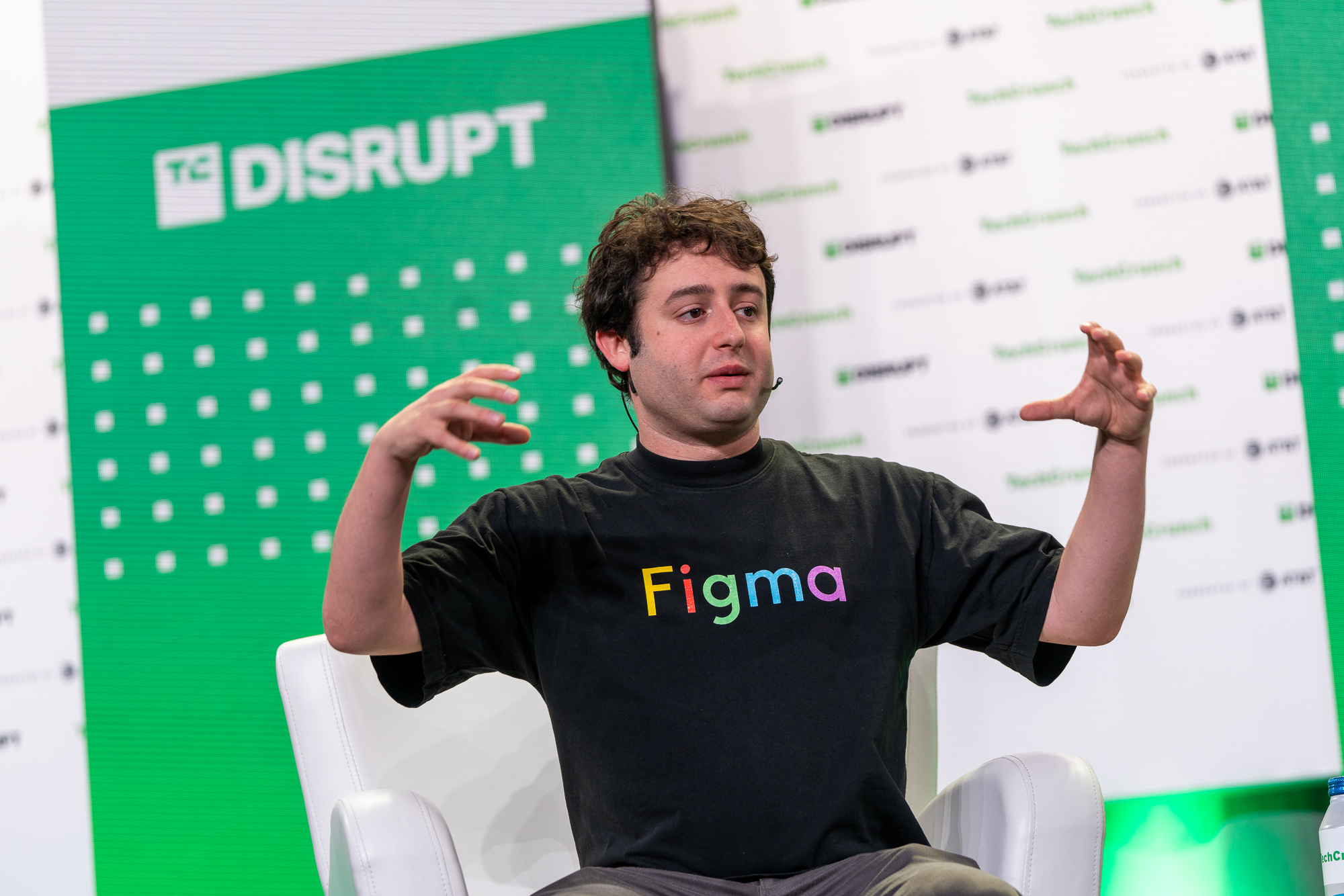
Dylan Field, CEO at Figma on the TechCrunch Disrupt stage in San Francisco on October 20, 2022. Image Credit: Haje Kamps / TechCrunch

Image Credits: Haje Kamps / TechCrunch

The follow-up

Remember when the IPO market was a bonanza meets party meets nerd stampede? We’re following up on past public market conversations with our latest episode of Equity, titled Scooters and social media companies are surprising IPO candidates. Come for our analysis, stay for our anger at the term “proficorn.”

Here’s why it’s important: Both Reddit and Lime are reportedly eyeing public market debuts this year, which completely took your dear hosts by surprise. We’ve been much more focused on Stripe, which is eyeing an exit over the next 12 months, and Instacart, which has delayed its IPO before. The growing list of potential candidates tells us that some companies believe they are doing well enough that the Nasdaq isn’t a scary acronym. Only FTX, now.

reddit app icon

Image Credits: TechCrunch

Etc., etc.

Seen on TechCrunch

Sensitive US military emails spill online

Modernizing 911 calls with Michael Chime from Found

SignalFire’s founder says his VC firm lost staffers who ‘thought we were too cheap’ in prior years

Elon Musk suggests Twitter could open source its algorithm ‘next week’

Seen on TechCrunch+

Pitch Deck Teardown: Uber’s $200K pre-seed deck from 2008

Is ocean conservation the next climate tech? 7 investors explain why they’re all in

The $100M venture round is going extinct

5 questions emerging managers should ask before selecting LPs

And with that, thank you for being here. If you’re reading this on a browser, get this in your inbox too! subscribe here and share it with your friends.

N

AI’s hype isn’t going to be simply star-studded  by Natasha Mascarenhas originally published on TechCrunch


Decentralized storage: Tailwinds and open questions

W

elcome to the TechCrunch Exchange, a weekly startups-and-markets newsletter. It’s inspired by the daily TechCrunch+ column where it gets its name. Want it in your inbox every Saturday? Sign up here.

Talking to Storj about its new version made me curious about decentralized storage. On the one hand, there are factors that could help boost its adoption. On the other, it also seems at odds with other trends, such as sovereign clouds. Here’s what I learned. — Anna

Slashing cloud bills

The volume of data generated by companies seems to be ever-increasing, but concerns about cloud costs are rising, too.

Earlier this month, we learned that AWS’ year-on-year revenue growth dropped into the mid-teens in January as customers sought to reduce their spending. “As we look ahead, we expect these optimization efforts will continue to be a headwind to AWS growth in at least the next couple of quarters,” Amazon CFO Brian Olsavsky said during the company’s earnings call.

While this preoccupation reignited the bare metal debate, it also creates tailwinds for another option: decentralized storage. Represented by players such as Arweave, Filecoin, Internxt, Sia and Storj, it offers a cheaper alternative to hyperscalers.

Decentralized storage: Tailwinds and open questions by Anna Heim originally published on TechCrunch


Biotech proved a surprisingly bright spot in 2022’s startup correction

No startup sector was entirely immune from the 2022’s market uncertainty — except maybe AI — but some proved more resilient than others. Biotech was one of the most fortunate.

The sector recorded 1,054 U.S.-based deals in 2022, worth a collective $30.7 billion, according to Pitchbook data. Those figures fell short of the 1,415 biotech deals struck in 2021 worth a total of $39 billion. But the declines were not the worst we found: Biotech showed a more modest year-over-year decline in investment volume (21%) than many other sectors including fintech (37.7%), consumer tech (53%) and enterprise tech (33%).

Comparing any sector’s results to 2021 is slightly specious, as that year was the peak of the last startup boom. Compared to 2020’s more conservative 1,143 biotech deals worth $29.6 billion, last year wrapped up on par.

U.S. biotech deals also set new records in 2022 for both median deal size, $33.5 million, and median valuation, $38 million.

Biotech investors told TechCrunch that while they definitely felt the squeeze of the overall economic conditions last year — and noticed tourist investors shying away from the category, similar to other sectors — many weren’t surprised that the category performed better than some of the other more buzzy industries for a few key reasons.

Biotech proved a surprisingly bright spot in 2022’s startup correction by Rebecca Szkutak originally published on TechCrunch


Friday, February 24, 2023

Daily Crunch: Falling short of analysts’ estimates, Warner Bros. Discovery posts $2.1B net loss for Q4 2022

To get a roundup of TechCrunch’s biggest and most important stories delivered to your inbox every day at 3 p.m. PST, subscribe here.

Folks, we’ve got some really sad news for you. The weekend is here, which means that you have to stop working for a couple days. We know, it’s a tragedy. But don’t worry, Monday is only two short weekend days away, and then you can get back to the grindstone.

Black History Month continues! Originally published in 1975, For Colored Girls Who Have Considered Suicide/When the Rainbow Is Enuf is a magnificent, passionate, and fearless story of what it meant to be a woman of color in the 20th century.  Well worth a read — or seek it out onstage!

Much love and hugs and such, Christine and Haje

​​The TechCrunch Top 3

  • Money, money, money…must be funny: Warner Bros. Discovery revealed that it lost another $2.1 billion in the fourth quarter. This is despite the success of shows like “The Last of Us” on HBO and games like “Hogwarts Legacy.” Lauren explains more.
  • Fashion layoffs: Secondhand apparel marketplace Poshmark is now laying off employees just two months after being acquired by Naver, Kate reports.
  • Another brick in the wall: Ron explains why a possible U.S. Department of Justice lawsuit over competition could derail the pending $20 billion Adobe-Figma deal.

Startups and VC

The truth of the matter is that Mobile World Congress (MWC) was never a consumer tech show, per se, but the participation of various smartphone makers transformed it into a handy launching pad. Brian explores in What we expect from MWC 2021.

In the face of conscripted co-founders and blacked-out bunkers, Ukraine’s tech industry marches on. Mike explores how, a year on from Russia’s invasion, Ukrainian startups show astounding resilience.

And we have five more for you:

5 questions emerging managers should ask before selecting LPs

Two Wooden People Figures Communicating

Image Credits: Constantin Johnny (opens in a new window) / Getty Images

Before an emerging manager can start backing startups, they’ll first need to earn the trust of limited partners who are willing to bet on their investment thesis.

“Each step up the decision-making ladder increases the risk of dismissal, lost information or miscommunication, which can be mitigated if you can get in front of the decision-makers early on,” says Linda Greub, co-founder and managing partner of Avestria Ventures.

Drawing from her own experience, Greub shares five questions emerging managers can use “to find the investors most likely to believe in you.”

Three more from the TC+ team:

TechCrunch+ is our membership program that helps founders and startup teams get ahead of the pack. You can sign up here. Use code “DC” for a 15% discount on an annual subscription!

Big Tech Inc.

A new hacker group going by the name CH01 defaced Russian websites to have them display a video of the Kremlin on fire. Lorenzo has more.

Google One subscribers can rejoice over this news that they now have access to Google Photos’ new AI-powered “Magic Eraser” that will remove unwanted content from images, Sarah reports.

We have a treat for you: six stories instead of five:

Daily Crunch: Falling short of analysts’ estimates, Warner Bros. Discovery posts $2.1B net loss for Q4 2022 by Christine Hall originally published on TechCrunch


Announcing the startups pitching at TechCrunch Live’s (virtual) Boston event!

I’m thrilled to announce the three startups pitch at TechCrunch Live’s special event in Boston. This virtual event start at 2:00pm EST/11:00am PST on Monday, February 27 and is free to attend. The event will features leaders in the Boston startup scene and concludes with a pitch-off. The following startups were picked by TechCrunch editorial staff to participate.

And you can watch live! Register here for the event.

The show kicks off with a conversation between .406 Venture’s Greg Dracon and Matt Caulfield, CEO of Oort, to talk through the Boston ecosystem, and why security startups should look at building their companies in Boston. This is followed by a conversation with the CEO of MassChallenge, Cait Brumme, on Boston’s deep community resources available for startup founders. Lastly, just before the pitch-off, legendary roboticist Marc Raibert, is speaking to TechCrunch’s Hardware Editor Brian Heater on why he built Boston Dynamics in Boston and explains his latest venture, leading the Hyundai AI Institute.

This is a free event, and I hope you can attend. Register here.

Startups

Penny Finance

Crissi Cole, Founder & CEO
Penny Finance is a tech-forward financial mentor for women. We are on a mission to close the wealth gap.

Piction Health

Susan Conover, Co-founder & CEO
Piction Health develops a healthcare technology intended to help patients and physicians address challenging skin diseases.

USEFULL

Alison Cove, Founder, & CEO
Usefull is a food and beverages company that provides delivery of coffee and food with reusable organic cups.

Announcing the startups pitching at TechCrunch Live’s (virtual) Boston event! by Matt Burns originally published on TechCrunch


5 questions emerging managers should ask before selecting LPs

When most people think of venture capitalists, they often think of investors, the people writing checks to fund startups. But that image is only one part of venture capital. In order to make those investments, venture firms must first have the money, which means they’re not only just the funders, they’re fundraisers, too.

But when you’re running a VC firm, especially as an emerging manager, how do you know which investors and limited partners (LPs) to target?

After more than 30 years of investing in both private and public companies, I’ve now started as a fund manager, and I recommend that emerging managers ask these five questions before seeking out and pitching to potential LPs.

Which LPs are you targeting?

To find the right investors, you first need to consider LPs’ investment criteria.

Institutional investors usually look for managers with a 10-year track record and at least three funds under their belt. These investors can also be hesitant to bet on emerging managers, whom they may perceive as higher risk than established investors, even though Cambridge Associates data shows emerging firms made up 72% of the top returning firms between 2004 and 2016.

Each step up the decision-making ladder increases the risk of dismissal, lost information or miscommunication, which can be mitigated if you can get in front of the decision-makers early on.

Managers who are stepping out on their own after working with an existing fund, meanwhile, can target fund of funds (FOF) since the FOF will use their track record as a prior employee as a proxy for standalone experience. Emerging managers can also target niche investors: for example, if you’re investing in education, a like-minded foundation might be a potential LP, or if you’re investing in medical technologies, you might try to connect with hospitals that could benefit from those innovations.

After launching Avestria in 2019, we found that family offices and high-net-worth individuals were the best targets for us. Their investment requirements aren’t as stringent as institutional investors or FOFs’, and they’re willing to accept the risk of investing in an emerging manager in exchange for potentially high financial returns.

How well do your target LPs understand your investment thesis?

Emerging managers should find out how well their potential investors already understand the unmet need your fund is addressing.

The venture capital community has significant influence on what potential LPs see as great investment opportunities. As a result, capital can be concentrated in certain areas. For example, Juul, a male-founded e-cigarette company, received $10 billion more in funding in 2018 than female-founded companies received collectively that year. In 2020, now-defunct video platform Quibi alone raised almost 8% of the total funding that female founders got that year.

Our fund focuses on female-led life sciences and women’s health startups, and it’s sometimes hard to rope in LPs who have the most exposure to headline-making investment sectors like consumer goods or media platforms. We often have to explain the white space: Women of child-bearing age weren’t allowed to participate in clinical trials, even for products meant for women, until 1993. Even 30 years later, only 4% of all healthcare research and development is meant to address women’s health issues.

5 questions emerging managers should ask before selecting LPs by Ram Iyer originally published on TechCrunch


A year on from Russia’s invasion, Ukrainian startups show astounding resilience

Today marks exactly one year since Russia’s illegal, unprovoked, and brutal of Ukraine. This week, a majority of the members of the United Nations reiterated its demand that Russia “immediately, completely and unconditionally withdraw all of its military forces from the territory of Ukraine and called for a cessation of hostilities”.

It would be fair to say that TechCrunch can only concur with this sentiment. So, in keeping with our mission, we present to you today a list of Ukrainian tech companies and initiatives you can support, the products you can use, and the startups which you – if you’re an investor – can look at funding.

Ukraine’s startup ecosystem was thriving before the war and making great progress, with Ukrainian startups raising $832 Million in VC funding in 2021. VC Funding was steadily growing before the war and there are more than 50 VC firms continuing to operating in the country.

According to research by the Ukrainian tech industry itself, there are about 228,000 members of the tech industry in Ukraine today, with the main tech hubs being located in Kyiv, Lviv, Kharkiv, Dnipro and Odesa. During the last year, as many as 57,000 were forced to relocate abroad, while around 7,000 joined the ranks of the Armed Forces or Territorial Defense, and today fight on the front lines against the aggressor.

As a mark of the Ukrainian’s astounding resilience both on and off the battlefield, in the first 10 months of 2022, Ukraine’s export of IT services grew by 9.9% from a year earlier, and brought in more than $6 billion in revenue, more than $542 million the revenue generated in 2021.

TechUkraine and Emerging Europe also published the results of a survey looking at the country’s start-up ecosystem. It found that despite the ongoing war, Ukrainian start-ups had demonstrated enormous fortitude. While some Ukrainian start-ups have relocated, the vast majority have kept at least a part of their operations or team in Ukraine. And more than half continue their operations exclusively from Ukraine.

But over 90% of Ukrainian startups say they need financial support to survive the war.

Thankfully, the wider tech industry has rallied around Ukraine in the last year.

Google presented 25 startups with a grant to help them continue operating and growing.

For the first time, as part of the Horizon Europe, the EU will include targeted support for Ukraine out of the €13.5 billion in research and innovation it has to spend this year.

Around 7,000 tech workers have joined the ranks of the Armed Forces or Territorial Defense

Only last month, OneUkraine sprang up from a host of major European tech founders and investors, who plan to provide sustainable humanitarian relief for the Ukrainian people.

The Ukrainian government also has a range of non-repayable grants and other support for its tech sector, despite also having to fund the war.

And two new unicorns with Ukrainian roots were born in the last year. Ukraine can now lay claim to at least 6 startups with more then $1 billion valuation: GitLab, Grammarly, Genesis, Bitfury, People.ai and Firefly Aerospace.

Below, we present a list of Ukrainian startups and tech companies (roughly in A-Z order) that you can check out. Obviously, this list is not exhaustive. But the list attempts to highly organizations which retain staff inside Ukraine or remain domiciled there, supporting the war effort. If you have a tech company or initiative you think we should include, you can apply to be listed on this post here. Any questions about this listing can be directed to mike@techcrunch.com

Slava Ukraini!
——————————————————————————-

3DLOOK
A retail tech start-up behind the virtual fitting room YourFit. As the war began, the company relocated the team of 70 to safer regions in western Ukraine and EU. It has now moved to Poland and set up the office there. Despite such conditions, they rolled out a new product in March. It has raised $14.7 million, with the latest Series A round closed in November 2021. Main investors include TMT Investments, TLF Ventures, Flyer One and others.

Ajax
Ajax Systems makes professional security systems in Europe. Employees: 877 new people (2,620 in total). Markets: 39 new countries (169 in total).

Ahrefs
“Ahrefs is an SEO software company that helps optimize websites of any scale — from giants like Netflix, Facebook, Uber, and Forbes to small businesses looking to build their presence on Google’s top page.” The company continued hiring developers and marketers and raised the team by around 10%. Ahrefs claims to have become a $100 million company in annual revenue without venture capital.

Adwisely
An online tool for digital advertising campaigns to help increase clients’ revenue

Aspichi

Aspichi is working on audio/visual teleportation platform allowing people to capture experiences and let others be immersed into it. After 2 months in an underground shelter they have also used their technology to register evidence of war crimes and provide the ability to immerse oneself into Ukraine to experience it, it’s now developing applications for psychological trauma treatment, VR medical trainin, combat surveillance systems and making the de-mining process safer. Incorporated in Delaware, USA. Secured seed finding from SMRK VC.

Blocksport
Blocksport builds Web3-ready platform solutions for the professional sports and entertainment industry to enable tokenization use cases for their fan community. Developed a SaaS-based white-label web3 platform that opens revenue streams and strengthens community engagement.

Birb
An apartment rental app to search for the best offers in a user’s favorite neighborhoods

Book Box
A library service for corporations to provide employees access to books and reading material

Corner
“The modern, frictionless way to set up a renovation with a pre-designed kitchen entirely online.”

Deus Robotics
Ukrainian Startup Deus Robotics secured a $1.5M seed round funding for its warehouse robotics solutions, led by SMRK VC, a Ukrainian venture fund. Deus Robotics specializes in full-cycle projects, including hardware engineering, software development, and integration, focusing on automating warehouse and logistics operations. Its robots are capable of sorting by direction and moving shelves, which are used in pre-sorting tasks, consolidation, and order picking. Deus Robots returned to Kyiv in May last year after the military defeated the Russians near the capital. Despite the ongoing war, increased the peak speed of parcel processing by 200%, compared to manual warehouse operations.

DjookyX A platform enabling musicians to sell songs’ royalty rights to generate funds for their career

Drug Cards
A cost-effective software for automated medical literature monitoring

ELEKS
Provides full-cycle software engineering outsourcing services, from ideation to finished products. Its 2,000 staff work on software and product design for corporate giants including BNY Mellon and Havas, and moved its offices in the Western part of Ukraine.

ELVTR
Is an online learning company offering professional courses in the US. As the war began, part of the team decided to relocate to the EU, while the rest kept hustling from bomb shelters. Despite not having electricity or internet access half of the time, the company keeps working and growing, saying it has sustainable 50% quarter-over-quarter growth.

Finmap
A cash flow management service for businesses. Recently closed a new funding round of €1M from SMOK Ventures, a US-Polish venture capital fund. In April 2022, Ivan Kaunov, the company’s co-founder and Head of Growth, was mobilized into the Armed Forces of Ukraine as a reserve officer.

Fuelfinance
Their pitch: “We do your spreadsheets, graphs, and automation. You get P&L, CF, Financial Projections, Plan/Actual , Unit Economics, and finally, peace of mind”. It raised $1M in Seed Funding and investors include Bolt’s Markus Villig, and SendBird’s John S. Kim, as well as San Francisco-based Stratmind and Eastern Europe-focused Bad Ideas funds. FuelFinance has created a “first aid” resource kit for Ukrainian entrepreneurs with information on how to reorganize and keep working during the war. The company has created a platform to aggregate donations for small businesses that are fighting back.

Gradual
An online platform for sales specialists to build their professional skills

Folderly
An AI-based platform to improve clients’ email performance

Esper Bionics
Listed as one of Time Magazine’s best inventions of 2022, this makes a prosthesis that “improves
and gains abilities over time.”

Еfarm.pro
“The IOT navigation field assistant for agricultural work that allows you to save resources and work more accurately.”

G-Mak
“The innovative security device equipped with a number of unique technological solutions that can physically stop or disorient an intruder.”

Happy Monday
Matches employees with purpose-driven organizations

Hacken
Hacken, the blockchain cybersecurity firm, has also been working on tools to help Ukraine cyber warfare efforts and combat Russian propaganda. The company says it donated around $350,000 in aid and Budorin, its CEO, said he gave his own Tesla to a local Territorial Defense unit.

Howly

“You choose a category where you need professional advice and type your question in the chat form. On Howly, you gain 24/7 access to thousands of experts in various areas – from finance to household appliances repair.”

Headway
Headway is a Ukrainian EdTech startup which claims 15+ mln users from 140+ countries and 170 employees.

i3 Engineering
“The complete solution for Smart Home projects and business’s automation, which consists of controllers mounted on a DIN-rail, software and mobile application.”

Jooble
Jooble is a job search site that operates in 69 countries and says it is one of the top 10 most popular employment resources in terms of traffic in the Jobs and Employment segment, according to SimilarWeb. Jooble Venture Lab has also invested in JayJay, a startup in the field of online education.

Knopka
“The advanced nurse call system for patient care automation on hospital beds.”

The company’s co-founder was mobilized into the Armed Forces of Ukraine as a reserve officer.

Jiffsy
A mobile commerce platform for “slow” fashion brands to help them boost sales

Kycaid
An online identity verification and compliance management system

MacPaw
MacPaw is a software company with headquarters in Kyiv, Ukraine, that develops and distributes software for macOS and iOS. MacPaw is the maker behind CleanMyMac X, Setapp, ClearVPN, and other products. In 2017, MacPaw acquired The Unarchiver. MacPaw claims its products have more than 30 million users worldwide.

Musemio
Musemio uses immersive technology and has partnerships with paid customers, such as the Crisis Charity and the Royal Museums of Greenwich. Educators (cultural institutions) and IP owners (publishers and broadcasters) can use it to create immersive games with a drag-and-drop interface that can be deployed in VR and on mobile.

Melt Water Club
“The technical solution for obtaining premium drinking water, thanks to the innovative Freezing Process technology.“

Mama Plant a Tree
A digital service that allows users to plant a tree in one click

Mate Academy
Tailor-made computer science courses for people who want to start a job in tech

Mathema
An online math school for students from kindergarten to high school

Nanit Robot
“The STEM Robotics education solution with a high engineering perspective and a creative learning process for kids and adults.”

Numo.so
Is an app for adults with ADHD that helps gamify daily tasks and get support. They launched in the midst of the war in Ukraine and claim to be growing 2-3x MoM in revenue and active users. Numo provides a social to-do list that people with ADHD use to complete daily tasks. Other ADHDers can endorse them for added or completed tasks.

NetHunt
A customer relations management system designed for sales teams and integrated with Gmail and LinkedIn

OptySun filters
“The technology of water purification and disinfection in any conditions.”

Orderry
Taking local businesses from offline to online to improve their competitiveness

PeopleForce
HR software for companies to manage employee performance

Pricer24
A platform providing brands, distributors and online stores with market analytics

RECEPTOR.AI
An AI platform enabling pharma and biotech companies to design new drugs more easily

ReLeaf Paper
Turns fallen tree leaves into paper and sustainable packaging. It claims it can reduce CO2 emissions of shipping bag oproduction by 78%, using 15 times less water and 3 times more energy efficient than wood papermaking. It raised €2.5 million from the European commission. They started during the COVID pandemic and made a move to export sustainable packaging in Europe during the war in Ukraine in 2022. Its main production site is located in Lutsk (Ukraine).

Reply.io
Reply.io is a B2B platform that automates cold messaging by creating sequences that are delivered directly to the recipient’s inbox.

Rekava
“The Ukrainian brand of biodegradable products made from reused coffee grounds. The startup’s products include rekava cups, rekava pots, and rekava candles.“

Respeecher
Respeecher, AI voice generation startup used to create the Darth Vader AI voice in the Star War’s TV series – Obi-Wan Kenobi – and during the war! This generative AI voice cloning startup claims to have grown 2.5 times and doubled projects from 65 in 2021 to 98 projects in 2022 despite the war.

Reface
Reface applies AI/ML technologies for personalized content creation. The Reface app hit #1 in the App Store soon after release and was listed among the best apps of 2020 by Google Play. Celebrities including Elon Musk, Justin Bieber, Snoop Dogg, and Miley Cyrus have shared refaced videos. Claims 250M downloads (+70M / 38% growth). TQ Ventures and Andreessen Horowitz are the most recent investors

Solar Plex
“The service for upgrading new and already installed conventional solar (PV) panels into hybrid (PVT) ones.”

Softjourn
A full-cycle consulting and software development company. 17+ years in Finance and Media & Entertainment, with a special emphasis on Ticketing.

Sorbsys
Sustainable, low-cost and environmentally friendly carbon battery producer

Stape
A tool helping website owners and marketers to track customer behavior

Signal My Oligarch
“Do you want to help in the war for Ukraine but are frustrated and don’t know how? SMO is a non-profit, community-driven mobile app to signal the assets of Oligarchs in the world. All you need to do is to snap a picture, geolocate the asset, and boom the asset will be sent anonymously to the local authority to be frozen!”

Sigma Software
Sigma Software Group includes a VC fund, business incubator, University, and R&D centers. It managed to relocate 2,800 employees to safer places and became fully operational in just 2 weeks, after the outbreak of war. In 2022 they say they opened 17 new offices in Europe and LATAM and 40+ new clients.

The Breakfast
The Breakfast is a social app for modern humans that introduces two people to meet and talk over breakfast. It has closed its first round of $300k from investors in the US and Ukraine to fully launch The Breakfast in New York and Los Angeles.

UnderDefense
A bootstrapped cybersecurity company from Ukraine recognized by Gartner, Clutch and Splunk. Before the war, UnderDefenese had a team of 60 in Ukraine, opened offices in Malta and Poland, and increased its presence in the USA to guarantee the continuity of its operations. Since the war began, UnderDefense team has grown x2 and donated $500k directly to artillery units of the Armed Forces of Ukraine.

UA Drone School
UA Drone School offers a 4-day training drone courses in Kyiv and the region. Free for the military. You can support the school by purchasing its course for civilians or by donating. It now plans to use Ukrainian military drone veterans on an EdTech platform and is fundraising from investors now to develop its own UAV systems, development of software and OSINT intelligence in connection with drone intelligence data.

Wantent
An AI-powered platform to measure audience engagement and test video content at all stages of production and distribution

Workee
A simple personal website builder designed for private tutors and freelancers

WEEDAR
WEEDAR created a loyalty and distribution platform for cannabis brands. They relocated the team to Europe as the war began, though some have chosen to come back to Ukraine already. Despite the war, WEEDAR recently closed its Seed Round of $1.5 mln, rolled out its new product, partnered with the leaders in the cannabis industry, including The Cure Company and Kushstock Festival, and says it shows sustainable month-over-month growth of 30%.

WheelKeep
“The invisible security system that helps cycling enthusiasts to protect their bikes from thefts and enjoy the freedom of everyday cycling. It includes a smart hardware device and a mobile application.”

YouControl
Online service for compliance, market analysis, business intelligence and investigation of legal entities

HARDWARE

WeDoSolar
WeDoSolar, launched in February 2022 (the month Russia invaded Ukraine) says it has so far received “thousand of orders” for its “vertical solar power” panels, which are specifically designed to be mounted, with weatherproof straps, onto to balconies by non-tech-savvy users.

Delfast
Delfast is an Electric Bikes manufacturing company with app integration and security.

nect WORLD Inc.
The ultimate 4g lte modem for fast internet anywhere in the world.

Caretech Human
Empowering people with an innovative, fully automated, painless, and affordable toilet-integrated solution for daily health checks and early disease detection

Meredot

A solution for wireless charging of EV and LEV electrical transport machines.

FeeLo

An easy way to tell someone about the feelings you are having about them.

Manna

Co-creating fantastic lifelike avatar media like games, quests, cinema, shows, webcasts, social and business events in a 3D/AR/VR ecosystem.

OTHER SUPPORT INITIATIVES:

Invest In Ukrainian Founders
Eamonn Carey, a partner at Tera Ventures is matching investors with Ukrainian founders.

Spend with Ukraine
The Spend with Ukraine campaign aims to support Ukrainian made products and services in the time of war. For instance, get pet cameras by Petcube, use Grammarly, increase work productivity with Readdle apps, protect your homes with the professional Ajax smart alarm, etc.

Ukrainian Tech Ventures
This is a nonprofit venture fund that will invest in tech startups founded by Ukrainian immigrants in Europe and the US. The fund is listed on AngelList:

Free Ukraine Foundation
This NGO was created by Ukrainian and Belgian tech founders

EASE Work
The European Association of Software Engineering has launched a service for helping Ukrainian tech people get jobs. It lists tech professional CVs.

1k Project
Send $1k to directly sponsor a family from ukraine

United Delivery Mission
United Delivery Mission is a non profit initiative that supports Ukrainian Military Forces with various supplies.

Vranishna Kava
“Order a UAV to deliver “morning coffee” to the enemy in the trench. Made according to a special recipe of the Ukraine Armed Forces, it will cheer up the occupiers and give them the strength to flee from Ukrainian land as soon as possible. $5.44 to send an “Espresso” (4 Drones).

MEDIA:

Kyiv Independent
This iconic Ukrainian online news outlet reporting from Kyiv. It has launched the Tech section where you can track Ukrainian tech industry news. You can support it on Patreon here.

‘Voices of Ukraine’
‘Voices of Ukraine’ presents multilingual readings of Ukrainian poetry and drama by artists and performers affected by the Russian invasion.

A year on from Russia’s invasion, Ukrainian startups show astounding resilience by Mike Butcher originally published on TechCrunch


5 investors discuss what’s in store for venture debt following SVB’s collapse

There are many questions around the implications of Silicon Valley Bank’s (SVB) collapse that won’t be answered for a long time. But there’s...