Thursday, July 28, 2022

South African startup Qwili gets $1.2M to scale its app and low-cost NFC-enabled smartphone

Qwili, a startup that provides a hybrid sales product to micro and small merchants in South Africa, has raised $1.2 million in seed funding a year after closing an undisclosed pre-seed round.

E4E Africa, a South African venture capital firm, led the round, which welcomed participation from other firms such as Strat-Tech, Next Chymia, Untapped Global and Codec Ventures and angels like Ashwin Ravichandran and Kanyi Maqubela.

In a statement shared with TechCrunch, Qwili said it would use the investment for app development, new hires (improvement in operations and development capabilities) and hardware production.

The company’s hardware is a low-cost NFC-enabled smartphone called Qwili Pula that allows merchants to send and receive payments. The platform’s software (which can be downloadable as an app on any smartphone or automatically installed on Qwili’s phones) turns these smartphones into point-of-sale devices permitting merchants to sell value-added services such as data and pay-TV subscriptions, groceries and clothing to their customers. CEO Luyolo Sijake told TechCrunch on a call that Qwili’s phones cost between $60 and $70.

Qwili says its target audience are digitally excluded and unbanked customers. Its mobile app serves as a “digital sales portal” through which micro and small merchants (agents) can facilitate the sale of goods and value-added services, the company said in a statement.

At first, Sijake and his co-founders Thandwefika Radebe and Tapfuma Masunzambwa launched Qwili as a different idea. They employed a business-to-customer model where Qwili sold these devices to individual users who used the platform’s digital wallet to buy value-added services. The plan was as users operated the phone and Qwili took a piece of every transaction, the phone would eventually commercialize itself, and users could buy them off Qwili. It turns out that didn’t work, hence the pivot to merchants.

“During those early stages, the phone wasn’t paying back quickly enough, and there wasn’t high enough adoption of the digital services. But what happened was that people started using the digital wallet to sell pay TV, electricity and other value-added services to people around them,” said the chief executive. “They started using the phone in a way we hadn’t intended, making more sense commercially. That’s how we ended up with this agent model: essentially people using the device and the software to sell to others instead of buying services for themselves.”
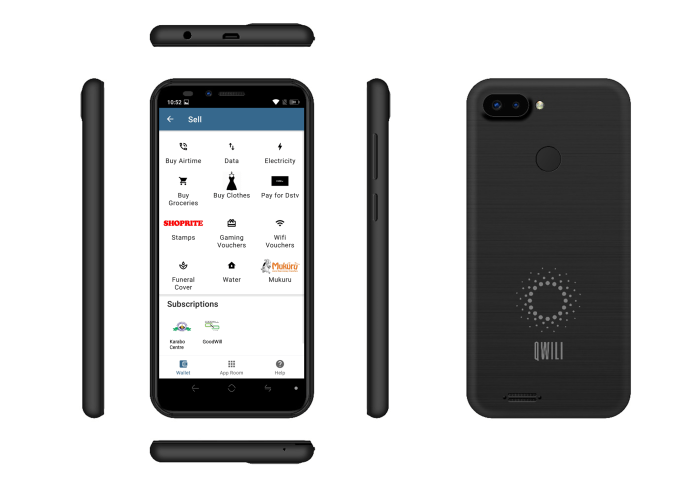
Image Credits: Qwili

Qwili sold over a thousand smartphones to end users before the pivot. Its business-to-business model has picked up steam, too, as 500 micro and small merchants use the hybrid platform (about half use Qwili’s NFC-enabled smartphones). Its typical business customer is a seller without a storefront that sells digital products to immediate communities and networks informally. Buying a point-of-sale device with limited functionality doesn’t make economic sense for this category; in contrast, a smartphone where they can collect payments and advertise products over WhatsApp suffices.

Sijake said Qwili doesn’t profit from selling smartphones, as it is just an enabler to the company to impact merchants that use the platform for commercial purposes. It takes a commission on every sale made on its application. “We’re all about enabling people who are currently digitally excluded, to participate in the various forms of value that being digitally included has to offer,” he said. “So the real barrier to that has been hardware: a reliable quality smartphone being too expensive, which means access to the mobile internet being too expensive. So we hope to continue making smartphones available at below cost.”

Qwili, in a statement, says its impact is felt in three areas: first, agents on the platform have access to an alternative, flexible source of income through the commission they earn on sales made through Qwili. Second, customers of these agents see time, efficiency and financial barriers between them and the services they need significantly minimized. And third, the providers of value-added services have facilitated access to a previously offline market. Qwili says the funding allows it to increase the pace at which it scales its operation toward seeing its effect in all three of these areas grow.

According to Sijake, Qwili currently processes $75,000 monthly GMV from its 500 merchants. However, the South African platform — which saw strong turnover growth of over 300% from Q1 to Q2 of 2022 — plans to get those numbers up to $1 million from 3,000 merchants by the end of the year after it expands into neighboring Botswana.

“We believe that Qwili is both highly scalable and high impact. Qwili agents love the entrepreneurial opportunity that Qwili provides them while giving their community access to e-commerce and to fairly priced goods and services,” says Bastiaan Hochstenbach, co-founder and managing partner at E4E Africa on the investment. “Qwili’s founding team is exceptional, and the business model is a strong fit with E4E Africa’s aspiration to support diverse founders in creating a thriving, innovative, and inclusive Africa.”




Wednesday, July 27, 2022

Pony.ai forms autonomous truck JV with Sany Heavy Truck in China

Autonomous vehicle company Pony.ai is forming a strategic joint venture with Sany Heavy Truck, a subsidiary of Chinese heavy equipment manufacturer Sany Heavy Industry, to create an autonomous truck brand.

The plan is to combine Pony.ai’s “virtual driver” with Sany’s technical prowess in building heavy-duty trucks to build automotive-grade self-driving trucks with Level 4 autonomy, which means the vehicles can drive themselves in certain conditions without needing a human to intervene. The JV’s autonomous truck product portfolio will include a mix of “new energy vehicles,” like electric trucks, and diesel-powered trucks, the company said.

“This partnership between SANY and Pony.ai is the ultimate collaboration between truck ‘body’ and truck ‘brain’ and thus makes it possible to mass produce high-level autonomous trucks,” said Liang Linhe, chairman of Sany Heavy Truck, in a statement.

The JV, which does not yet have a brand name, will begin small-scale deliveries of the robotrucks this year and next, with mass production commencing in 2024, according to Pony. The company expects to reach an annual production of around 10,000 trucks within a few years.

Sany and Pony have already begun road testing the JV’s first prototype, which was built on Sany’s new EV truck platform, according to Pony. Like all of the JV’s future autonomous trucks, the prototype was powered by Pony’s Autonomous Driving Controller, which is built on Nvidia’s Drive Orin self-driving toolkit.

The move signals that Pony.ai, which is technically headquartered in San Francisco, is investing more time and resources into its operations in China. The startup, which also builds and deploys robotaxis, recently lost its permit to deploy autonomous vehicles with a driver behind the wheel in California. In December 2021, Pony also had its license to test its driverless vehicles in California suspended. In China, however, Pony recently scored a taxi license to operate a commercial robotaxi service in Guangzhou and got a permit to provide driverless ride-hailing to the public in Beijing.

In November last year, Pony.ai had combined its self-driving truck and passenger car R&D teams, prompting at least two key executives from its trucking team to leave in a huff. Sources who spoke to TechCrunch at the time on the condition of anonymity said the startup’s U.S.-based trucking operations had been suspended, but that tests continued in China.

Earlier this year, Pony also announced that it had formed another JV with Sinotrans, one of China’s leading logistics and freight forwarding companies, to build a smart logistics network featuring autonomous driving trucking technologies. Cyantron, as the JV is called, began operations in April.

Pony said in a statement Thursday that its strategy to unlocking robotrucking is to create partnerships with top trucking and logistics companies to create a framework for future development, so we might expect to see more JVs in the future.


Daily Crunch: Google Maps unveils improved bike navigation, location sharing and aerial landmark views

To get a roundup of TechCrunch’s biggest and most important stories delivered to your inbox every day at 3 p.m. PDT, subscribe here.

Hello, Daily Crunchers!

Personal story time: I came to the U.S. on an IR1 visa — also known as a “green card” — after having been married to an American for more than two years. I then became a naturalized citizen a little while back. There’s a tremendous amount of luck and privilege with my path to U.S. citizenship, and many have a much harder time settling in this fair country.

I’m so grateful for the TechCrunch team and our great relationship with Sophie Alcorn, our friendly immigration lawyer. She runs a great column on TechCrunch with tons of immigration advice, and tomorrow Walter is doing a Twitter Spaces Q&A with her. Set yourself a reminder and tune in tomorrow at 12 p.m. PT/ 3 p.m. ET, on @TechCrunch.

With much multicultural and international love, Haje

The TechCrunch Top 3

  • Taking a look at India’s streets: Google Street View made its debut more than a decade ago. Six years ago, India banned the service over security concerns. Jagmeet and Manish report that the tech company today relaunched Street View in India. It expects to roll out the service to 50 Indian cities by the end of the year.
  • $52 billion for U.S. onshoring chip production: One surefire way to make something happen is financial incentives, and Brian reports how the U.S. Senate just threw $52 billion at the semiconductor industry for companies to manufacture computer chips on U.S. soil again, by way of the CHIPS Act.
  • The little three-wheeled prototype that could: I took the Nimbus three-wheeled urban transportation pod for a spin last week, and found myself getting excited and confused in equal measure. I want it to exist, but at the same time, I’m struggling to imagine the vehicle finding a market, when its $10,000 price tag buys a lot of other cool transportation options.

Startups and VC

As regulation, platform dynamics and consumer choice continue to eat into cookies, it’s leaving a gap in the market for advertising solutions that can work well without relying on cookie functionality. Today, Ingrid reports that Seedtag, an adtech startup based in Spain, is doing just that. It has raised a $250 million round of funding to double down on the opportunity.

Annie reports how internet use in most of Africa remains low despite the growing broadband internet coverage. A recent report surveyed most of the countries in the world, and shows half of the top 10 most expensive countries to buy mobile data in the world are in Sub-Saharan Africa, which may be hindering investor activity and startup opportunity in the region.

More startup magic:

8 fintech investors discuss the shifting investing landscape and how to pitch them in Q3 2022

Empty road winding across moorland.

Image Credits: James Osmond / Getty Images

What are fintech investors willing to bet on in this climate?

To get a sense of how their viewpoints and strategy have changed in recent months, Mary Ann Acevedo asked eight of them about the advice they’re offering portfolio companies, how they expect the next few quarters to unfold and their pitch preferences:

  • Paul Stamas, managing partner and co-head of financial services, General Atlantic
  • Alda Leu Dennis, general partner, Initialized Capital
  • Michael Gilroy, general partner and co-head of fintech, Coatue
  • Justin Overdorff, partner, Lightspeed Venture Partners
  • Addie Lerner, founder and managing partner, Avid Ventures
  • David Jegen, managing partner, F-Prime Capital
  • Nik Milanovic, general partner, the Fintech Fund
  • Jay Ganatra, co-founder and managing partner, Infinity Ventures

(TechCrunch+ is our membership program, which helps founders and startup teams get ahead. You can sign up here.)

Big Tech Inc.

Our top Big Tech story for the day — and the subject of our Daily Crunch newsletter today — is brought to us by Ivan. Google is increasing its bid for being the first place people go for discovery and planning pastimes. In aid of that, today the company announced three new features for its star navigation app, Google Maps: aerial and more immersive views of 100 landmarks, more detailed cycling routes, and improved location sharing with notifications for the arrival and departure of your friends.

Ax Sharma makes his TechCrunch debut as a contributor today, delving into how some open source projects effectively sabotage their own software, as a form of protest. “Did it make an impact? We’ll probably never know,” said one of the developers. “That being said, I think it was completely worth the chance to disseminate information and hopefully catch the eye of software folks in Russia that might not have seen what was happening otherwise.”

And a few more to keep your mind nimble:


Tuesday, July 26, 2022

TechCrunch+ roundup: Bridge round scarcity, resilient e-commerce, CVC negotiating tips

Inflation is up and consumer confidence is down, which is why e-commerce startups that hope to weather the ongoing downturn should expand their product offerings.

Does that sound counterintuitive?

“The more complementary and additive a product is to your catalog, the larger your cart size and the more likely a customer is to return,” says Bennett Carroccio. Prior to co-founding Canal, he worked with hundreds of companies as a consumer investment partner at Andreessen Horowitz.


Full TechCrunch+ articles are only available to members.
Use discount code TCPLUSROUNDUP to save 20% off a one- or two-year subscription.


In a post for TechCrunch+, he identifies two cost centers that are the easiest to control (user acquisition and product R&D) and shares three tactics for “staving off the brand-pocalypse.”

Dialing up your marketing budget during a downturn is the wrong call, since “margins are everything” and consumers are more skeptical than ever.

Instead, look for ways to increase LTV with a larger catalog and use third–party suppliers to reduce the cost of goods sold.

Landing a new customer is several times more expensive than retaining an existing one, “and that multiple is likely growing as acquisition costs rise,” Carroccio says.

Thanks for reading!

Walter Thompson
Editorial Manager, TechCrunch+
@yourprotagonist

3 views on Amazon’s $3.9B acquisition of One Medical

Amazon climate change fund invests in ev charging, renewable fuels

Image Credits: PATRICK T. FALLON/AFP / Getty Images

Last week, the world’s largest retailer announced its plans to wade deeper into the healthcare sector with its purchase of concierge provider One Medical.

Three members of the TC+ team shared their thoughts about the deal’s potential impacts on patients and Amazon’s operations:

  • Walter Thompson: Amazon is the black hole created by the death of Main Street retail
  • Miranda Halpern: Following a logical progression
  • Alex Wilhelm: What happened to the value of focus?

Every startup wants an extension round, but there aren’t enough to go around

Bridge financing

Image Credits: Getty Images

“Titanic” came out in 1997, but people still argue about whether there was enough room for Rose and Jack on the floating door she used to stay alive.

That makeshift raft had enough room for both lovers — the issue was buoyancy: With two people aboard, neither one would have been protected from the icy water.

Investors can afford to offer bridge rounds to founders who are struggling to keep their heads above water, but metaphorically, everyone would still get wet, reports Rebecca Szkutak.

“I think the roadblock with these bridge financing investors is you have to prove you are really building the bridge,” said one founder who closed a round recently.

Looking for an investment from a CVC? Take these 3 tips to the negotiation table

Big and small metal gear with copy space. negotiating with corporate venture capital startups

Image Credits: Ivan Bajic (opens in a new window) / Getty Images

Startups that hope to work with corporate venture capitalists need to be prepared for rigorous due diligence that examines everything from revenue to diversity.

In a TC+ guest post, Luisa Rubio Arribas, head of Telefónica’s digital innovation hub Wayra X, shares her advice for how founders should approach negotiating with CVCs and what they can expect.

“When an angel investor or traditional VC backs a company, their primary interest is to get a good monetary return,” she writes.

“CVCs, however, don’t want just financial outcomes, they want to tap into the innovation and disruption you bring.”

How to check for founder-investor alignment before you start fundraising

Thermal image of woman kicking automobile tire on roadside; founder investor alignment

Image Credits: Joseph Giacomin (opens in a new window) / Getty Images

Everyone wants to get their company off the ground, which is why it’s critical to find an investor who shares your values and perspective.

It’s particularly tempting to accept the first offer that comes, but “choosing the right partner for the right stage of your business can make the difference between building a billion-dollar company and losing control.”

Partners Evan Kipperman, Paul Hughes and Len Gray at law firm Wiggin and Dana shared a post with TC+ that explores the finer points of working with institutional investors, angels, friends and family, and capitalists of other stripes.

“As funding gets harder to come by, your risk tolerance may change, but your process for evaluating investors should not.”


US Southeast surges ahead as other regions see VC funding decline

It seems everything is doom and gloom in the U.S. venture market, between startup layoffs and declining venture deal counts to an essentially moribund exit environment. But there are bright spots, one of which being the Southeast region, which is on track for its best year yet.

The Southeast region had its best quarter for funding on record in Q2. More than $5.1 billion was invested across 289 deals during the period, according to PitchBook. The first half of this year collected $9.1 billion, which puts the region on track to surpass last year’s full-year record of $15 billion.

This compares to declines across many of the more active regions in the first half of 2022, including New England, down 28% from H1 2021; the West Coast, down 10%; and the Mid-Atlantic, down 7%.


Pogo lands millions to become the ‘Honey for the real world’

If Pogo had its way, you’d get paid every time you stroll down Market Street in San Francisco. Or check your e-mail. Or open its app. The only catch is that you give your personal data to the consumer-focused fintech in return.

“We can almost create Honey for the real world,” said Pogo co-founder and chief executive Dom Wong, who is building the company alongside founders Oskar Melking and Shikhar Mohan. The startup seeks to use a few tech trends to its advantage. First, as data privacy becomes more of a concern, users are able to choose whether to share their information with companies. Pogo’s argument is that if they do share — why not get a benefit out of it?

Second, Pogo is a play on the rise of e-commerce tools such as Rakuten and Honey, browser extensions that automatically find cash, coupons and deals in return for your shopping history. And third, it is using a slew of APIs to plug into everywhere consumers exist, from their inbox to their transaction history to, if they so choose, their location data.

To scale data in exchange for cash, the startup raised $14.8 million in venture capital in the form of a $12.3 million seed round led by Josh Buckley and a previously unannounced $2.5 million pre-seed round. Other investors in the startup include Slow Ventures, Village Global, Harry Stebbing’s 20VC, MrBeast’s Night Ventures, Hyper, Shrug and creators including The Chainsmokers, Sophia Amoruso, Ryan Tedder and Lenny Rachitsky. Additionally the startup has money from the founders of Front, Rent the Runway, and, quite fittingly, Honey.

Here’s how it works: When a user joins the app, they are invited to send their data to the company. Once Pogo is connected with different sources of information, it begins to show rewards for purchases or recommendations to “act on” to save money.

Part of the app is helping people, who opt in, get paid for their data: “Pogo makes it easy for you to aggregate your data in one place, giving you the controls to get paid for use cases that you’re comfortable with, whether that’s anonymous market research or personalized marketing from trusted brands.” The other part of the app is similar to Honey, in that it works as a type of financial agent that sees your spending and makes suggestions, both for better deals or promotions you may not know about.

This isn’t entirely unheard of. Dosh, for example, is a venture-backed startup that makes deals with retailers, brands and payment providers, and then offers cash back to users once they purchase a product associated with connected providers. The startup was valued at $400 million in 2019, per TechCrunch reporting. There’s also Nigeria’s ThankUCash, which landed $5.3 million to set up cash-back infrastructure and existing work from PayPal, which launched a new credit card that offers 3% cash back on all PayPal purchases.

Image Credits: Pogo

It makes sense that there is activity here. As advertising dollars flock away from Facebook and Google, retailers and brands want to find new ways to reach potential customers. I think of it like this: You can choose to sell your new workout gear while you’re browsing Twitter, or in the locker room at your local Crunch gym. The latter finds a consumer when they’re more attuned to fitness and style, while the former bets that someone may just happen to be in the mood for a new set while surfing tech news.

Pogo doesn’t have exclusive partnerships with local businesses to have certain cash-back feels in exchange for lead generation, a route that some neobanks have gone down. Instead, the startup just brings together all existing deals in one place — and it’s that interoperability between different data sources that Wong thinks is the biggest competitive advantage.

Pogo’s true differentiation is the invisible layer it provides for users just existing in the world that can turn notifications into money. A majority of Pogo’s users link location data because they get rewards while existing in the real world. “You’re walking by Wendy’s and a notification pops up for a free breakfast sandwich if you purchase it on the app. All you have to do is view it, and then you get paid and we get paid as well.”

Right now, the company gets largely paid through affiliate fees and exchange of data:

  • Opt ins for a suggested insurance plan.
  • Clicks into a location-based offer.
  • Answers market research or campaign measurement questions.
  • Scans Pogo card for a discount when buying a prescription.

In the next iteration, Wong says, Pogo will suggest users turn to fee-free banking alternatives, and then Pogo can make money through affiliate fees.

“We also think about how we can help you leverage offers that are at your fingertips today without formally brokering partnerships. This may mean surfacing publicly available content, or in the future, even personalized promotions in your inbox in a private, secure manner,” he wrote in an email. “For instance, imagine Pogo alerting you of the 40% off any item storewide coupon sitting unopened in your inbox next time you walk into a CVS.”

While Pogo certainly sees itself as an incentive aligned with customers, in order for it to make money, it needs to prove to other companies that personal data is a commodity. Pogo is going to have an intimate window into someone’s life, from where they live to their favorite coffee shop to just how many subscriptions they own. It’s similar to what a bank would see, but it’s a venture-backed startup that it wants you to trust.

The Electronic Frontier Foundation, a nonprofit that has defended civil liberties in the digital world since 1990, describes the idea of exchanging data for money as “data dividends.” In an essay, the organization urges consumers to rethink if getting money for their data really fixes the existent imbalance between users and corporations. The EFF asks a series of questions such as who will determine what the cost of certain data is and what makes your data valuable to companies? Plus, what does the average person gain from a data dividend and what do they lose in exchange for that extra cash?

“EFF strongly opposes data dividends and policies that lay the groundwork for people to think of the monetary value of their data rather than view it as a fundamental right,” the organization wrote in a post. “You wouldn’t place a price tag on your freedom to speak. We shouldn’t place one in our privacy, either.”

Over e-mail, Wong said that there are existing market rates for common data fees, but the startup is working on a pricing strategy based on “a lot of greenfield territory that simply isn’t possible today.”

“For instance, our ability to serve a location-based offer or ad that also takes into account your past purchases allows us to command rates that are many orders of magnitude higher than your typical ad placement,” he continued. “Another example would be the ability for brands to get real-time consumer feedback based on verified purchases. The ability to do so is incredibly slow and clunky today, and it’s not unusual for brands to pay hundreds of dollars per response based on rates set by existing behemoths that do billions of dollars a year in revenue.”

Wong isn’t too worried about losing user trust, just yet. So far, the app has been used by “hundreds of thousands of families” and the startup claims it has generated millions of dollars in savings and earnings.“We’re being very intentional about how we think about partnerships here” with a focus on giving users “fine grain controls over the use cases they’re comfortable with.”


Sono Motors reveals final design of its solar-charging Sion EV

Sono Motors unveiled this week the final production design of the Sion EV, a solar electric vehicle that’s been in the making since the Munich-based startup launched in 2016.

It’s been a long and bumpy road for Sono Motors, a journey that involved a couple of crowdfunding campaigns, a near insolvency and a debut on the Nasdaq exchange as a publicly traded company.

The solar-power fruits of those rather tumultuous labors were shown off at its bustling “Celebrate the Sun” Community event. The Sion solar-powered EV took center stage. However, another product called the Solar Bus Kit, a series of solar panels that are designed to be retrofitted onto 12-meter public buses, suggests the company has more ambitious plans beyond one passenger vehicle.

The question, of course, is can Sono Motors produce and sell the EV at volume? And how?

Sono aims to begin deliveries of the Sion in the second half of 2023 to customers in Germany, Austria and Switzerland. The company did not provide guidance on how many Sions would be delivered next year. The only metric it has shared is that it expects to make 43,000 Sions per year with a production capacity of 257,000 over seven years, according to a company spokesperson.

However, even the most well-funded EV startups have had trouble making it to production recently. Sono has had to combat a range of challenges since going public in November last year, from a plummeting stock price to switching manufacturing partners, and its path forward to production and delivery will likely continue to be bumpy given current market and supply chain uncertainty.

Let’s break down what this company is up to:

The Sion’s final production design

Rendering of Sono Motors Sion, a small black hatchback

The Sion will consist of 456 integrated solar half-cells that will collect power from the sun and enable self-sufficiency on shorter journeys. Image Credits: Sono Motors

The Sion is a compact, five-door, family-friendly hatchback that will sell for €25,126 (~$25,628 at today’s conversion). Its outer shell will consist of 456 integrated solar half-cells that will collect power from the sun and enable self-sufficiency on shorter journeys. Of course, the vehicle will still use a traditional charger to refuel, but the constant drip-feed of solar should be enough to take care of most urban commutes, the company says.

The car’s 54 kWh lithium iron phosphate battery has a range of about 190 miles. Sono expects the energy generated by the solar cells to extend that by an average of 70 miles, and up to 152 miles, each week. In addition, the Sion is built with bidirectional charging technology, which allows commuters to use energy stored in the battery (~11 kW) to power homes or other electronic devices.

[gallery ids="2360114,2360119,2360115"]

Other enhancements to the final design’s exterior and interior includes a sleeker, cleaner-looking vehicle, according to Sono.

The exterior has new headlights, including a new daylight strip, rear lights, a rear camera, a bottom sideline design and a revamped charging lid in front. There are also new door handles, which photos show have the words “made to be shared”  — a nod to Sono’s hope to get this car into fleets.

Sono says paid reservations have increased from 13,000 last November to more than 19,000. That could mean a net sales volume of €415 million if all reservations result in sales. With an average down payment of €2,225, Sono could have over €42 million in the bank to help it get to production.

(By the way, if those numbers — 19,000 x €25,126 — don’t quite add up, it’s because the price of the Sion has shifted over time and earlier backers are grandfathered into their original prices, says a company spokesperson.)

To bring costs down, Sono Motors has relied on outsourcing its vehicle’s manufacture and distribution. Previously, Sono planned to partner with NEVS, the Swedish EV manufacturer that acquired the assets of the bankrupt Saab Automobile in 2012. But NEVS’s parent firm, Evergrande, is deep in debt and is still trying to sell NEVS, which is still struggling to put its Saab 9-3 into production.

Sono switched gears in April and signed a contract with a new partner, Valmet Automotive, which manufactures in Finland.

The solar bus kit

bird's eye view of sono motors solar bus kit -- solar panels across the top of a green bus

Sono’s solar bus kit includes 8 square-meters of solar panels that provide around 1.4 kW at peak installation. Image Credits: Sono Motors

While Sono’s solar bus kit can’t turn a diesel-pumping bus into an eco-friendly hybrid, it can take some of the emissions out of the equation.

The kit, which has been standardized to work with “virtually all European bus fleets,” can save up to 1,500 liters of diesel and up to 4 tons of CO2 per bus per year, according to the company. Its total size of about 8 square-meters of solar panels provide around 1.4 kW at peak installation. That solar energy can be used to power a bus’ subsystems such as HVAC.

Sono said bus fleet operators stand to see a potential payback time of about three to four years, depending on the sunniness of days in operation and fuel prices.

At CES 2021, Sono said it would license its solar body panel technology to other companies as an additional source of revenue, and this new bus kit is a part of that move to diversify the business.

Since going public, Sono says it has ongoing letters of intent, pilots and prototypes for 19 companies that are implementing the company’s solar technology on a variety of vehicle architectures, like buses, trailers, trucks and electric transporters.  For example, Sono recently piloted a solar bus trailer in Munich to provide backup power for public transport. Sono has also partnered with the Reefer Group, a manufacturer of refrigerated semi-trailers, to build a solar trailer for testing.

The company said its B2B solar business is already generating revenue, more details on which will be shared during the company’s earnings call in September. Sono’s stock has plummeted since its debut, losing close to 93% of its value, so the company will definitely need to earn another source of revenue as it revs up for production next year.

Why Sono stock has taken a hit

When Sono Group, the parent company of Sono Motors, began trading, it opened at $20.06 after the IPO was initially priced at $15. Shares hit a high of $38.74 before the market closed on its first day. At the time of this writing, Sono Group is trading at $2.64, a slide that has continued even after the company revealed the production version of the Sion.

It seems the buzz around EV startups has started to fizzle.

In May, Sono closed its previously announced underwritten follow-on offering of 10 million ordinary shares, with an additional 1.5 million shares available for the underwriters — which include Cantor Fitzgerald and B. Riley Securities — at an even greater discount.

Sono said it gained $40 million in gross proceeds from this offering, which it used to help fund the start of production of its Sion, but investors are likely to see the offering as one that devalues shares to an even greater extent.


Latin America’s slowing VC market hides local strength

The Latin American startup market, once among the hottest in the world, is cooling. But its slowdown is far from uniform; some countries are surviving the downturn far better than others, data reveals.

A few weeks back, this column took an early look at venture capital data concerning LatAm startups and their financial backers, noting that the region was seeing successive quarterly declines that had become more than simply material. As the global pandemic turbocharged growth in the e-commerce market, so too did the COVID-19 period lead to huge venture gains in the region; and as the pandemic somewhat waned, so too has e-commerce growth, and, perhaps unsurprisingly, venture activity in Latin America as well.

But the picture isn’t singular. To really understand what’s going on, we have to go deeper than the regional perspective can afford us.


Monday, July 25, 2022

Private equity descends on Chartbeat

Chartbeat, a website that tells publishers about their readers, is getting the private equity treatment.

Launched out of Betaworks in 2009, the service offered real-time analytics back when Google Analytics made you wait 24 hours to see who was clicking around your site. Eons later, private equity firm Cuadrilla Capital has swooped in to buy it, Chartbeat chief executive John Saroff said on Twitter today. The CEO added that Chartbeat’s staff, including leadership, will stick around following the deal.

Axios, which broke the news, reports the deal will let Chartbeat “build a suite of products that help media companies grow their businesses, in addition to helping shape their editorial strategies.” Ah, yes, private equity—the institution known for helping media companies grow.

Betaworks is headquartered in New York, and known for its early investments in Twitter and Tumblr, and for incubating services like Giphy and Bit.ly.

Since launching last year, Santa Barbara-based Cuadrilla has snapped up two other data firms: Agilence and InfoDesk.


Crypto valuations may sink until September as VCs play a waiting game

Tons of capital has been raised across the crypto industry in recent months, but there has been a noticeable pause in deployment. That might change in the coming months.

As it’s taken longer to close crypto VC deals, valuations across the industry have dropped, according to David Nage, venture capital portfolio manager at Arca.

Some VCs are taking advantage of this time as the market remains investor-friendly, while others are waiting just a bit longer to push out capital.

“There’s been this kind of viral dialogue that sometime around September, valuations are gonna come down even more significantly and it’s just gonna be a frenzy,” Nage said.

Even though there might be a waiting game happening right now, the total amount of capital going into crypto is still up from the year-ago period. Capital raised in the digital asset sector rose nearly 35% from $6.08 billion during the second quarter of 2021 to $8.13 billion in the second quarter of 2022, according to data compiled on PitchBook.


Can a baby’s cry identify neurological disorders? Ubenwa says ‘yes’

When Charles Onu’ cousin was both born with birth asphyxia and later developed a hearing condition, the seed for Ubenwa, an audio biometric company geared at identifying neurological disorders in infants, was also planted. 

Onu, CEO and co-founder, said he hopes Ubenwa will change the way physicians provide care to infants. 

“We’re trying to bring the world to a point where infant cries are considered to be a vital sign just as much as we would consider their heart rate to be a vital sign,” he explained in an interview with TechCrunch.

After Onu graduated with his undergrad in engineering he volunteered with health-based NGO’s and saw more cases like his cousins — though some were far grimmer. 

The Montreal-based company uses an infant’s cry to determine if it falls within the range of having signs of a neurological condition. Crying audio is collected at partner hospitals, internationally, and then categorized into what is considered normal or abnormal . From there, the company can predict whether a child may be suffering from a potential disorder. 

For now, the AI-powered software only identifies early signs of birth asphyxia, and can potentially determine learning milestones based on cry triggers. According to Onu, the company is hoping to evolve the technology to identify congenital heart disease.  

It should be noted that a recent Stanford University study identified that some FDA approved AI medical devices are “not adequately” evaluated and there are no best practices set for the development of these technologies. 

But to Ubenwa’s credit, they are performing studies in pursuit of building out the case for the science behind their tech further still. 

For those actually using the application, they record the baby crying and then receive weekly summaries of patterns. If there is an abnormality detected, the application notifies the user and provides data to share with doctors. 

“Today, doctors use physical assessment to look at eyelids, look at the skin tone, and so on and so forth,” Onu said. “If [doctors] are really worried it could be with an MRI or a brain MRI machine because that’s the ultimate standard, but we don’t live in an MRI machine every day. That is costly. With simple cry analysis you can track neurological biomarkers on an ongoing basis, non invasively.”

Despite the company being based out of Canada, they have additional operations in Nigeria (where Onu is originally from) and Brazil. The company partners with hospitals in those regions in order to get larger sample sizes for their data. Despite the fact that users will be recording cries, Onu said, those cries will not be collected and store: analysis of the cries will be matched to their existing database. 

Although Ubenwa has a focus on an infant’s cry, other companies are using audio biometrics to help diagnose other conditions, but typically for an older age group. StethoMe says they use breath to identify air pathway disorders in children and share that data with physicians. Similarly, Ellipsis Health claims to use voice biomarkers to diagnose depression in patients.

To date, Ubenwa has raised $2.5 million USD ($3.2 million Canadian) in a pre-seed round led by Radical Ventures with participation from AIX Ventures, Yoshua Bengio, a fund co-founded by AI researchers and entrepreneurs Pieter Abbeel, Richard Socher, Google Brain’s Hugo Larochelle and Marc Bellemare. 

Up to now the company’s focus has been on developing the technology, but this round’s funds will allow the company to do a beta launch and begin trials. Additionally, it will allow the company to potentially begin integrating their technology into baby monitors, according to Ubenwa.

Once trials are complete, Onu hopes to apply for FDA and Health Canada approvals.

“There’s a lot of guesswork doctors have to do with babies,” Onu said. “But a lot of (infant care) is really making informed guesses as to when to make this action or where to make that action, and we’re hoping to close some of these gaps.”


An actionable framework for founders bridging into web3

What’s your web3 strategy?

I doubt it’s the first time you’ve been asked that question. It’s been on the lips of a growing number of investors on the hunt for disruptive opportunities blockchain-based technologies can offer.

But for founders looking to foray into the world of decentralization, it’s all too easy to become distracted from core business objectives by shiny new buzzwords emanating from the space.

FOMO is real. If everyone else is doing x, y or z, you wonder, then shouldn’t we?

I understand that pressure. As the founder of an infrastructure project that has been around since 2016, I want to remind you that web3 isn’t just a drop-down menu of features to be bolted on to your project. It’s a transformational ethos that should be the cornerstone of what you’re looking to build.

My message here is simple: Focus on the basics, and don’t allow yourself to get distracted by the hype.

If the people who form the backbone of your community do not feel good about your project or their participation, you’re in big trouble.

I’d like to offer some insights into how to build a strong project that can tap into the enormous power and potential of web3.

If you aren’t addressing a problem, you’ve got a problem

A successful web3 company, project or DAO starts with a clear-eyed view of the use case (or cases) blockchain equips them to serve in a way that was not possible before, and how they can change the game for a problem.

Until you’re satisfied you really have identified both a well-defined pain point and a compelling solution, you’re unlikely to convince users to beat a path to your door.

Once you’ve identified the problem or need you plan to address, drill a little deeper. What is the functionality that web3 can bring to the party? Blockchain is at its most powerfully disruptive when it supplies the missing link.

For instance:

  • Does a global, permissionless, digital money layer change the game?
  • Will access to a shared, open, data layer make your offering more attractive than if you hoard the data in a proprietary database?
  • Does the ability to make users collective owners in the platform’s success give you an advantage over web2 incumbents?
  • Can you bootstrap one side (or both sides) of a marketplace through in-protocol incentives?
  • Can web3 primitives such as NFTs, on-chain credentialing, crowdfunding, and wallet-based-identity enable an experimental experience for users?

If the problem you’re solving can benefit from one of these uniquely web3 value propositions, then you are probably on to something interesting!


Why you have to pay attention to the public markets this week

Hello and welcome back to Equity, a podcast about the business of startups, where we unpack the numbers and nuance behind the headlines.

Alex and Grace are back to cover the biggest and most interesting technology, startup and markets news. Sitting as we are on the precipice of a huge data dump, we had lots to chat through!

No live show this week, just three episodes! Hang in there we got you!

Equity drops every Monday at 7 a.m. PDT and Wednesday and Friday at 6 a.m. PDT, so subscribe to us on Apple Podcasts, Overcast, Spotify and all the casts.


Is the advertising market in trouble?

Snap, the parent company of the popular Snapchat social media service, reported earnings last week that investors rejected. In the wake of its second-quarter financial reporting, shares of Snap cratered from $16.81 Thursday afternoon, before its earnings report, to around $10 per share as of this morning.

Snap was not the only victim of its lackluster earnings digest — other companies that make money off of advertising incomes saw their share prices dip on concerns that the social network was not an outlier. Alphabet, Meta, and Pinterest also took blows, cutting their worth ahead of earnings disclosures as investors lowered their hopes for ad-based incomes.


The Exchange explores startups, markets and money.

Read it every morning on TechCrunch+ or get The Exchange newsletter every Saturday.


Given the sheer number of mega-tech companies that are betting on the advertising market, the news matters. Mix in the fact that startups are also pursuing ads as a monetization lever, and concerns about the health of advertising spending matter to tech companies big and small.


Allwhere launches out of stealth to help companies manage their remote workforces

Given the recent economic downturn, some companies are skeptical that the pandemic-led move to remote and hybrid work will have staying power. According to an April survey by Good Hire, 77% of managers said they’d considering firing employees or cutting their pay for refusing to return to the office. Most expressed concerns about remote employees’ perceived lack of focus, negative impact on company culture, and productivity issues.

Oscar Mattsson is of a different opinion. That’s not shocking — his startup, Allwhere, sells businesses tools for facilitating remote work. Emerging from stealth today with $9.5 million in seed funding from DESCOvery, Allwhere aims to work with companies to implement remote work setups, manage the lifecycle of equipment from procurement to disposal, and craft onboarding, engagement, retention, and wellness programs, Mattson said.

“While the current market is temporary, the new ethos that’s emerged regarding flexibility and employee wellness is permanent. Teams have realized that they can work just as efficiently using a distributed model, and a strict return-to-office plan often leads to losing top contributors even in a recession,” Mattson said. “[But] after two years of remote and hybrid work, nearly half of knowledge workers still do not have the tools they need to do their job. As a result, budgets are lost, and employees are stretched thin, which is why companies outsource these tasks in the first place.”

Mattsson began his career at WeWork, where he was a founding member of the company’s enterprise division before working with partners to expand WeWork into daycare, food and beverage, mobility, and other areas. While he saw WeWork through its low points, Mattsson says he ultimately saw the value in services that enable flexible work.

Mattsson founded Allwhere in 2021 within DESCOvery, D.E. Shaw’s venture studio, where he was joined by WeWork alumni Ben Kessler (Allwhere’s chief marketing officer) and Josh Rosenthal (head of customer experience).

“I saw a gap in the market for a solution that catered to the needs of businesses that were adapting to a newly remote, hybrid, and distributed world,” Mattsson said. “Allwhere is an Old English term meaning ‘everywhere,’ which aligns with our mission to support employees and employers in any type of workplace.”

Allwhere furnishes corporate customers with employee equipment, products, tools, and perks, even going so far as to find vendors and suppliers. In addition to installation and retrieval of office hardware, furniture, and accessories, Allwhere provides wellness programs, subscriptions, gifts, IT hardware repairs and upgrades, and more.

Allwhere

Image Credits: Allwhere

Using Allwhere, companies can build their own white-labeled “stores” with configurable kits and HR and IT process integrations. Dashboards allow management to oversee the doling out of equipment, wellness, and perks as well as budgets and status updates. Meanwhile, when provided a link to the aforementioned store, employees can select the equipment, benefits, and services they need and get tracking information as well as pick-up and delivery options for any applicable equipment.

Mattsson says Allwhere has worked with customers looking to onboard new hires with hundreds of laptops to companies purchasing merch — branded backpacks, T-shirts, and the like — for their first in-person events post-pandemic.

“Concretely, Allwhere provides white glove, personalized service at scale so internal teams can focus on other tasks,” Mattsson said. “Most companies are working with different vendors for all of these different things, so the HR, IT, and executive teams we speak with are often relieved to find a solution that does it all.”

Mattsson notes that, during the pandemic, companies attempted maximize the value of their IT assets in particular even at the expense of employee satisfaction. A 2020 survey by Nulab found that nearly a third of people working remotely due to the pandemic had to purchase equipment out of pocket for work.

The pressure to cut operations costs is increasing as a recession threatens to materialize.

“Many companies are scaling back budgets, reducing the sizes of their teams, and experiencing equipment supply chain issues for the new hires they are bringing on. We solve all of those pain points with competitive pricing and efficient retrievals, both of which optimize inventory and trim vendors,” Mattsson said. “These services sit at the core of our business and benefit our customers especially in the current market … While it’s in theory possible to have internal teams handle equipment management, employee wellness, and swag, among our other offerings, it’s not the most economically sound or effective solution.”

Mattsson claims Allwhere, which is New York-based, currently has customers ranging from startups to enterprises in North America, Latin America, and Europe — though he wouldn’t reveal names. The focus in the next year will be on hiring and scaling operations as well as expanding the capabilities of Allwhere’s platform, he said.

“In response to demand, Allwhere continues to grow rapidly. We’ve tripled in size in just a few short months, and plan to double again by the end of the year,” Mattson added.


Egyptian B2B e-commerce platform Cartona raises $12M to scale and explore new verticals

Startups that solve the supply-chain and operational challenges of players in the fast-moving consumer goods (FMCG) industry–by helping buyers access products from sellers on a single platform–keep attracting venture capital from investors.

Cartona, one of the major players digitizing the traditional trade market, including mom-and-pop stores, FMCG producers, wholesalers, and distributors in Egypt, has raised $12 million in Series A funding. Jordan and U.S.-based early-stage venture capital firm Silicon Badia led the round, which also welcomed participation from the SANAD Fund for MSME, an impact investment fund for the Middle East and North Africa, Arab Bank Accelerator and Sunny Side Ventures.

Investors such as Global Ventures and Kepple Ventures doubled down less than a year after participating in the company’s $4.5 million pre-Series A funding last September. At the time, Cartona was present in three Egyptian cities; it’s now in eleven. Per a statement, the investment will allow the startup, launched in 2020, to cover all of Egypt’s governorates, grow its product, technology, and services, and explore new verticals beyond FMCG.

“So we believe that with this money, we would reach profitability. We will use this money for sustainable growth and only sustainable growth. We won’t expand like crazy without having positive unit economics in every city,” CEO Mahmoud Talaat told TechCrunch in an interview. “We plan to cover all the cities in Egypt, focus a lot on technology and product.”

Cartona’s platform allows buyers to order inventory from a network of curated sellers via an app that provides a communication tool for promotions and a dashboard for market insights.

The company operates an asset-light marketplace where it does not own a single product or vehicle. This model has led to customer complaints on both sides of the platform. And as a result, Talaat said Cartona had to focus more on its technical integrations with big manufacturers and their warehouses, which has created more upside for the business. With these integrations, he said Cartona could simultaneously pursue capital efficiency and growth while scaling its embedded finance product.

Providing loans, working capital, or BNPL to micro and small businesses is the sweet spot of B2B e-commerce and retail marketplaces in Africa. But how they provide this service differs. CTO Mahmoud Abdel-Fattah claims that in Egypt, a market with other upstarts such as asset-heavy MaxAB or hybrid model Capiter, Cartona stands out by integrating BNPL services into its marketplace processes without the help of a third-party provider. So instead of getting small businesses to pay their loans each month with interest like other platforms, Cartona allows them to repay these loans every time there’s a product shipment.

“In a market like Egypt, retailers are not very okay with the concept of paying for BNPL with interest at the end of the month. You do not want to think you’re paying more interest with an external company giving you these working capital loans. They prefer it to be a part of the product prices and to feel it embedded through the order cycle, making us a bit different.” Talaat added.

Cartona lends out of its balance sheet for now. But the executives say the company expects to receive some credit lines and venture debt from local and international partners by January next year.

Cartona

Image Credits: Cartona

There are over 400,000 shops and thousands of international and local brands across Egypt, with the sector growing annually by 8%. Reports also say the overall retail market size is $120 billion, with the food & beverages market worth $70 billion. The massive opportunity this presents to platforms such as Cartona has attracted investors like Silicon Badia into the B2B retail sector. According to the firm’s founding managing partner, “the market is hungry for these type[s] of solutions, and we believe Cartona’s asset-light approach will allow them to serve as many marketplace participants as possible in a highly efficient manner.”

In our interview with Cartona’s executives last year, the company had 30,000+ merchants and processed over 400,000 orders with an annualized gross merchandise value of EGP 1 billion (~$64 million). It has doubled some of its numbers since then. Talaat said the company now serves 60,000+ merchants and processed over 1 million transactions with an annualized gross merchandise value of EGP 2.3 billion (~$120 million). Cartona has more than 1,500 distributors and wholesalers on its platform and 200 FMCG companies, including big names like Unilever and Henkel. These numbers are up from last September’s numbers of 1,000 distributors, wholesalers, and 100 FMCG companies.

The founders say they want to build Cartona to become a better technology partner for these FMCG brands. Abdel-Fattah, the executive in charge of handling these technical integrations, said, “We started with very big FMCGs, but everyone, including multinationals, is interested because now they see our value. We are not competing with them or bringing down their prices. We’re not subsidizing their products as competition sometimes does. We’re just connecting them with the retailer, so it’s about making the process seamless.”


Sunday, July 24, 2022

Seedstars launches second fund to invest in 100 startups in emerging markets

Seedstars' portfolio founders

Seedstars’ portfolio founders

Since its launch nine years ago, Seedstars has invested in 81 companies in over 30 emerging countries. Now it’s set a goal of investing in 100 more startups with the launch of its second emerging market seed-stage fund, called Seedstars International Ventures II (SIV), with a first close of $20 million. The fund is expected to total $30 million and its limited partners include the International Finance Corporation (IFC), Visa Foundation, The Rockefeller Foundation and Symbiotics. The firm’s is to invest in pre-seed and seed-stage startups in Asia, Africa, the Middle East and Latin American over the next three years, with follow-on investments up to Series A.

Some examples of Seedstars’ portfolio companies include Pakistan e-commerce startup Dastgyr; Saudi Arabian cloud-based point-of-sale and restaurant management system Foodics; Indonesian workforce marketplace MyRobin; Latin American restaurant CRM OlaClick; and Nigerian B2B marketplace Omnibiz.

Patricia Sosrodjojo, partner at Seedstars, told TechCrunch that the second fund’s investment thesis is similar to its predecessor: to come in at very early stages, in tech ecosystems in emerging markets, and look for startups that have the potential to make a wide impact.

“I think of it as three different levels,” she said. “The first one is the fact that we’re coming in very early, we’re usually one of the first institutional checks after the angels so we can help catalyze capital. The second is the countries we cover, where the ecosystems is still not that developed yet. And the third one is that we look for business models that can scale up quickly, similar to the normal VC model, but that they would be able to affect a lot of people. We align ourselves with a lot of the ESGs.”

One difference between SIV II and the first fund is that it can writer bigger checks. Initial checks will be between $150,000 to $250,000, with potential follow-on investments of $500,000. It will also have a tighter geographical focus. The first fund invested in 30 countries, and the second fund will also have a global outlook, but it will focus on one to three countries in each region.

Specifically, these are Indonesia, Vietnam and the Philippines in Southeast Asia (though Sosrodjojo said SIV II will also look at other countries); Pakistan and Bangladesh in South Asia; Egypt in MENA; and Mexico in Latin America. Its view on Africa will be more distributed; it has already done investments in Kenya, Tanzania and Nigeria.

SIV II plans to follow on 25% of its portfolio.

“We’re really looking to diversify holdings, leveraging learnings from one market to another,” said Sosrodjojo. “For example, if we’ve invested in a B2B supply chain play in one country, we can take the learnings from that and apply it to another geography. We see that different trends can come in at different times in different markets, so it helps us to see the typical trajectory of a certain industry.”

The fund will focus on verticals including finance, commerce, health, work and education. In particular, “financial inclusion is challenging in many of these markets. It’s something we’ll continue focusing on,” said Sosrodjojo.

One of the things that makes SIV II unique is that it has a blended finance structure with facility provided by IFC, one its LPs. As part of the fund’s mandate, it will invest up to 25% of the fund in IDA countries, or low-income countries as defined by the World Bank. This mitigate the risk of these investments, because there is a first loss guarantee. That means if SIV II makes an investment in an IDA country like Senegal and the company doesn’t do well, a portion of the investment will be covered through the structure.

To help them scale up, Seedstar portfolio companies take part in a program called the Value Creation Platform, which has a network of 1,300 mentors and includes a three-month “mentor-led sprint” called the Growth Track. Supported by Seedstars’ entrepreneur-in-residence Jon Attwell, formerly of Naspers and Prosus, with operators who have experience working at high-growth firms like Careem and SkyScanner. During their time in the Value Creation Platform, companies can perform experiments to see what growth strategies are best for them.

“Startups can cover different modules, like if their key is acquisition,” said Sosrodjojo. “They can really look at their acquisition strategy and if it’s not working well. They will work together with their mentor and our entrepreneur-in-residence John, create a strategy, run with that, monitor it and see if it works. Each startup will decide on what experiment they want to do and decide if they want to translate it into their operation or not.”

Gender equality is also important for Seedstars, which points to data that shows just 11% of enterprises that obtain seed funding in emerging markets are led by women. Seedstars’ team has already achieved a 50:50 gender split, and its first fund had 26% female co-founded businesses. Seedstars has set a challenge for it second fund of at least 30% of its portfolio companies having female founders or leadership. Another criteria is to back local founders.

“There are cases where there are expert founders with really good startups, but we do try to cultivate local talent,” Sosrodjojo said.


5 investors discuss what’s in store for venture debt following SVB’s collapse

There are many questions around the implications of Silicon Valley Bank’s (SVB) collapse that won’t be answered for a long time. But there’s...