Wednesday, April 27, 2022

ChowNow founder on rethinking food delivery to serve local restaurants first

Welcome back to Found, the TechCrunch podcasts that get the stories behind the startups. This week we’re joined by Chris Webb from Chow Now.

ChowNow started as a way for founder and CEO, Chris Webb and his friends to easily order from smaller local restaurants but eight years later when COVID hit ChowNow became known as a restaurant-friendly alternative to some of the larger players in the space. They began ranking in the app store organically and getting a boost in users and customers. Chris talks with Darrell and Jordan about the ”fast and steady” approach to building a lasting company and how to seize a moment when growth occurs. They also get into:

  • Balancing having an app or product that puts promotion of their customers (in this case, the restaurants) rather than the app itself.
  • Learning from working at Leeman during their infamous bankruptcy and never wanting to get too far over his skis as a founder so that they will fail too quickly aka being “fast and steady.”
  • The difference Chris has found between Silicon Valley investors and those in New York and LA and why he prefers to get money outside of the Valley.
  • The beauty of companies that have to change to last and the feeling of starting a new company every day.

Take our listener survey and let us know a bit about yourself and what you think of FOUND.

Connect with us:


The corporate venture comeback: What startups considering CVC need to know

Corporate venture capital investments (CVCs) now represent more than a fifth of global venture. The bigger slice of the funding pie comes as founders have to navigate a more uncertain capital landscape. Amid the Ukrainian conflict and rising inflation — with many investors being more cautious with their dollars — startups are welcoming the longer-term stability that corporates can offer.

Corporate knowledge, R&D resources, M&A opportunities and networks are invaluable for early-stage companies. But many traditional investors have strong opinions about corporate venture capital projects, claiming that corporates’ role is to buy, not back, other companies. This approach, however, overlooks the benefits of corporate investment, especially in times of dwindling capital flows and more cautious investors.

I’ve worked in corporate venture capital for seven years and teach a master’s class about CVC at the Madrid Bar Association. This is why corporate investment is making a comeback — and what startups should look for in the return.

Corporate investment arms have gotten stronger

While few corporates used to offer startup investment (and the ones that did were primarily concerned with software, practically every corporate is involved in VC today and covers a range of niche sectors. That means there’s more corporate money and players for startups to explore.

Corporations have also come to realize the potential of a more open innovation strategy, where they invest in external startup ideas rather than only experimenting internally. This shift is why many corporates have investment funds specifically dedicated to startups — just look at Mondelez International (formerly Kraft), Nike, Microsoft, American Express and PepsiCo.

With the combination of capital and expertise, corporates can execute strong startup deals and deliver value to them faster.

These branches not only assign funds and tools to startups’ growth — they supply startups with decades of investment experience. With the combination of capital and expertise, corporates can execute strong startup deals and deliver value to them faster.

And, despite their size, corporations can be surprisingly agile. In the past decade, the majority have reacted to and mirrored changes in the startup space, helping to raise the bar for CVC investments. At Wayra, we’ve adapted our strategy a number of times to ensure that we evolve as the startup ecosystem does. In 2018, we moved away from being an accelerator to a CVC to better help more mature startups with joint-venture opportunities and scaling. Later, we also launched a fund aimed at supporting startups’ transformation in Southern Europe and Latin America.


CVCs should have a foot in your startup field


How PillSorted plans to use personalisation to compete with main-street pharmacies

Since the (relatively speaking) easing of the pandemic, pharmacies have come under increasing strain as people clamor for their drugs. This is particularly an issue in the U.K. where traditional mom-and-pop pharmacies have started to close and larger chains haven’t kept pace with demand. The problems are even leading to incidences of abuse by customers.

A new U.K. startup, PillSorted, thinks it has the answer by hooking directly into the U.K.’s NHS healthcare system to offer itself as a personalised pharamacy option, listed alongside local stores on GPs’ computers. It’s now raised $6 million in seed funding from Pear VC and Hoxton Ventures.

Founded in 2019 by former pharmacist Zeinab Ardeshir, PillSorted says it combines automation with a personalised service that arrives either via post or is delivered by its own delivery service.

Ardeshir, CEO and co-founder, said in a statement: “The typical pharmacy experience has long been in need of an upgrade, and most pharmacists are bogged down by manual, repetitive tasks… Our service makes medication deliveries easier and our pharmacists are also able to review medication regularly.”

Pepe Agell, partner at Pear VC, said; “PillSorted leverages technology to fulfil and deliver pharmacy products while creating personalised and human-focused experiences.”

PillSorted will use the new funding to develop its product and expand its services within London and the U.K. It has also begun trialling the service to support care workers as part of an ongoing integration with social care.


Reveal raises $50M to espouse the benefits of partner ecosystems

Business-to-business (B2B) companies are generating an increasing percentage of their revenue through partner ecosystems. In a 2018 Accenture survey, 76% of business leaders said that current business models will be unrecognizable in the next five years, with ecosystems being the main change agent. But despite their growing importance, businesses haven’t necessarily adopted technology to foster partnerships, instead relying on spreadsheets and lengthy virtual or in-person meetings.

Perhaps as a result, business ecosystems — while profitable — have a high failure rate. Research by BCG found that fewer than 15% were sustainable in the long run. But it doesn’t have to be this way. That’s according to Reveal CEO Simon Bouchez, who alongside Gautier Machelon, Perrine El Khoury, and Alex Sadones aims to build a platform that allows B2B companies to more easily identify sales opportunities with their partners.

With customers including Qualtrics, Tealium, Contentsquare, and Vonage. Reveal today announced that it raised $50 million in a Series A round led by Insight Partners with participation from Eight Roads, Chalfen Ventures, and Dig Ventures. The capital brings the startup’s total raised to about $54 million.

“Organizations create 2x more value when selling to a partner customer,” Bouchez told TechCrunch via email. “But most of the time, companies don’t know how to capture this value and don’t invest in partnerships. Partnership leaders still don’t have a clear seat at the revenue table.”

Before launching Reveal in 2020, Bouchez was the CEO of Multiposting, an HR tech startup, until 2018, when it was acquired by SAP. Sadones was the CTO at Multiposting, while Gautier cofounded employee sourcing and hiring platform Work4. Khoury was the director of business development at Work4.

Initially, Reveal, which was founded as Sharework, was focused on automated sales account mapping — i.e., the process of cataloging the people that work at a particular target account. But in 2020, the startup began to broaden its product strategy, targeting marketers seeking to create and convert sales leads.

Some might argue that Reveal’s product falls into the category of ecosystem management, or tools to navigate and manage B2B partner ecosystems. But Bouchez argues that Reveal goes a step further by involving sales and marketing teams in the process for lead generation, sales enablement, and ecosystem expansion.

“We believe we have created a new category: a collaborative growth platform enabling companies to leverage their ecosystem to accelerate growth,” Bouchez said. “Our closest competitor would be an Excel spreadsheet or companies not yet tapping into this growth potential. Of course, we are expecting competitors as our space grows and attracts investment from top investors, and many companies — like Partnerstack, Crossbeam, and Workspan — are growing fast.”

Reveal ingests data from existing customer relationship management systems to identify common sales accounts as well as potential new leads. Algorithms attempt to identify the top partners to add to a company’s ecosystem, even if the company isn’t directly connected to them.

Reveal

Image Credits: Reveal

Within the platform, ecosystems are composed of partners in the same industry, targeting the same customer segment, or selling a complementary product. The idea is that companies can connect with a partner’s account owners through Reveal to get introductions to key decision makers.

Throughout the process, using proprietary methods (Bouchez declined to go into detail), Reveal attempts to quantify the ecosystem influence on a company’s overall sales pipeline and revenue.

“Reveal … allows partnership professionals to quickly identify common customers and prospects with partners to generate more business opportunities,” Bouchez said. “Users [can] discover new relevant partners across the Reveal network.”

Reveal claims that its algorithms — which process more than 200 million customer relationship management records from the company’s over 4,500 customers — are accurate, but it hasn’t conducted outside testing to verify this. Reveal is more transparent about its data collection and retention policies, claiming to not store personally identifiable information and delete customer relationship management data “as soon as the user requests it.”

“Security and compliance has been a top priority from day one to allow our users to trust us with sensitive and important data in full confidence,” Bouchez said.

Reveal’s future plans include tripling its 40-employee headcount (within the next 18 months), investing in product development, and expanding its online learning hub for partnership professionals. Over the long term, Bouchez hopes to build the largest network of “connected companies,” with the tentative goal of eclipsing 20,000 companies by the end of 2023.

“Reveal is quickly becoming a leader in collaborative growth, an emerging category that integrates into a company’s customer relationship management system and serves as a bridge to partner customer relationship management systems,” Insight Partners’ Brad Fielder, who plans to join Reveal’s board, told TechCrunch in a statement. “Reveal allows sales teams to identify new opportunities and utilize partner connections to close deals like never before.”


Eden AI unifies ML APIs from several cloud vendors

French startup Eden AI has raised a $1.6 million pre-seed round (€1.5 million) to build a programming interface that lets you access AI engines from multiple vendors. The company unifies those APIs and offers a simple way to try them out, and mix and match.

Over the past few years, small and large cloud vendors have been building APIs that magically process data in their cloud infrastructure using machine learning models. For instance, you can use these APIs to detect and extract text from images, recognize objects, extract keywords from a block of text, turn speech into text, translate text and more.

And yet, all those APIs aren’t perfectly equivalent. Some APIs are better than others. Some APIs work well in one language but not so well in another language. Some APIs are easier to use and implement as well.

Eden AI is building the API to rule them all. “We started as a consulting firm specialized in data science and AI,” co-founder and CEO Taha Zemmouri told me. “As consultants, we couldn’t directly recommend the best model as we had to test them first,” he added later.

The startup has established 20 partnerships with AI engine providers, such as Mindee, Dataleon, Deepgram, AssemblyAI, Rev.AI, Speechmatics and Lettria. It is also compatible with big cloud providers, such as Amazon Web Services, Microsoft Azure and Google Cloud.

“We have created an overlay that acts as a single entry point. Switching to another provider is as easy as changing a parameter in the API,” Zemmouri said.

As pricing evolves, Eden AI also offers some flexibility as you’re no longer locked in with a single cloud vendor. On the billing side, you don’t have to open a user account with each provider. Instead, your Eden AI account lets you access all those APIs.

If you already have an account on a specific cloud, you can also add your own key to use your own account. Eden AI doesn’t charge more than what you’d get from cloud vendors. The startup takes a cut on the provider side.

Up next, the company wants to automatically select the right API for your needs. Currently, clients have to define the provider in their API calls. But you could imagine a feature that lets Eden AI pick the best route for you.

Supported by Paris-based accelerator 50 Partners, the company has raised its pre-seed round from several business angels, such as Olivier Pomel (Datadog), Nicolas Dessaigne (Algolia), Sébastien Pahl (Docker), Julien Lemoine (Algolia), Benjamin Fabre (DataDome), Laurent Letourmy (Ysance), Jean-Baptiste Aviat (Sqreen), Georges Gomes (Div Riots) and Thomas Grange (Botify).


Tuesday, April 26, 2022

Voi taps Drover to prevent sidewalk scooter riding in Oslo

Shared micromobility company Voi is deploying e-scooters in Oslo, Norway with Drover AI’s computer vision tech that can identify whether a scooter is on the pavement, road or cycle lane in order to help prevent sidewalk riding.

As the micromobility industry consolidates around a few key players and cities become more discerning about which operators they allow on their streets, operators are looking for ways to appear more attractive to cities. If there’s one thing cities seem to hate more than scooters riding on sidewalks, it’s taking ownership for why scooter riders are on sidewalks in the first place and responding with dedicated bike lanes. As a result, it operators like Voi have turned to advanced rider assistance systems to give them a good reputation.

And it appears to be working.

Voi, which has been operating in Oslo for over two years, recently had its tender extended another year, alongside Tier and Bolt (Bolt is another one of Drover’s customers, as well as Spin, Beam, Helbiz and Fenix). The inclusion of Drover’s tech was one of the reasons Voi’s Safety & Parking score on its application ranked the highest out of the 12 companies that also participated, according to someone familiar with the matter.

Out of the 2,000 scooters the Swedish startup is deploying in Oslo, hundreds with be equipped with Drover’s PathPilot AI technology over the next few months. Drover’s tech is capable not only of detecting when a rider is on the sidewalk or parking a scooter inappropriately, but it can also alert the rider of their transgressions and even slow them to a stop. These more involved capabilities are at the discretion of the operator and the city, and Voi has not yet clarified how or if it will step in should a rider be misbehaving.

This isn’t Voi’s first time deploying camera-based technology to prevent scooters riding or parking on sidewalks. Last summer, Voi launched a pilot in the U.K. with Dublin-based Luna that investigates how smart AI cameras could help better enable scooter parking, prevent sidewalk riding and avoid potential hazards. The Drover partnership is similar, although it will also help improve geofencing to govern how and where scooters are ridden and parked, and it will be done at scale, a Voi spokesperson told TechCrunch.

Voi also intends to use its collaboration with Drover to build a record of where and how scooters are being ridden in Oslo. PathPilot will automatically deliver insights on fleet use or rider behavior which Voi says it can share with Oslo City Council to help improve the service by optimizing locations of e-scooters or recognizing fallen scooters to be picked up by Voi workers, said the company.


Daily Crunch: Experts say Musk’s open-source vision could make Twitter vulnerable to attack

To get a roundup of TechCrunch’s biggest and most important stories delivered to your inbox every day at 3 p.m. PT, subscribe here.

It’s April 26, 2022, and today, all we’ve been heron about is news that has made our stomach churn – a case of irritable owl syndrome, if you will. No fowl play is suspected, although we did get an impression that Musk is just winging it here.

We know, we know — all of these puns are clucking terrible, but what is a poor pair of newsletter writers to do when they pull our favorite social media site from the stork exchange? – Christine and Haje

The TechCrunch Top 3

  • Same Twitter time, same Twitter channel: Today, we took a look at the aftermath of Elon Musk’s deal to buy Twitter, this time on the privacy front. Cybersecurity experts say that Musk’s idea to make Twitter’s tech open-source could make it more susceptible to attacks, though his ideas for going after spam bots may lead to better detection — and perhaps a reduction of followers for many people wondering about that blank egghead following them.
  • Left Lane making a right turn when it comes to investments: It was the gift that keeps on giving for Left Lane CEO and managing partner Harley Miller, who closed the venture capital firm’s $1.4 billion fund on his birthday. The firm is targeting “internet-enabled consumer tech with recurring business models,” which Miller felt was a white space among all the other enterprise and SaaS investors. We wonder what his birthday gift will be next year.
  • Teach a teen about money and you’ll raise a more financially conscious adult: At least that’s the goal most parents have. Being a good steward of your money is something even adults can have trouble with, which is why we’ve seen so many child- and teen-focused financial apps attract funding. The latest is Copper, which raised a $29 million Series A, offering debit cards, ATM access and digital wallet support. Parents can participate alongside their child, adding funds and monitoring their spending. Copper even helps with the financial basics, like what compound interest is.

Po-tee-weet?

If you don’t give two craps about Twitter or Elon Musk … we’re really sorry, it’s got to suck being you on the internet right now. Take a breath and go look at some actual birds. You know, the ones that live outdoors.

Break out the binoculars; we’re doing a lot of bird-watching today, just so you have it all in one handy place. In case you’ve been offline for the past month, we put together a handy timeline, which will give you some of the context.

We reported yesterday that Twitter accepted Elon Musk’s offer to buy Twitter, and then all hell broke loose. Twitter founder Jack Dorsey said Musk is the only solution he trusts, but as you read above, Carly isn’t so sure, saying that this is going to be a privacy nightmare. We discussed both how Trump wouldn’t be coming back to Twitter and how that is hogwash; he’ll be back.

Alex took a punt at what is next for Twitter with Elon taking over the penthouse suite of the birdhouse and encouraged Musk to please not mess it up. Natasha wondered what the Twitter diaspora will get up to. Sarah was curious whether all the advertisers are going to make nests on other platforms, and Amanda reported that Twitter is locking away the source code for the platform.

Startups and VC

The hardware dweebs among us were having a great day today. The detail of the EV Corvette using excess battery heat to heat the cabin — much like ICE cars using excess engine heat to make you nice and toasty as you cruise around – is such a cool (ha!) detail. The obvious benefit of reusing waste heat instead of spending electric power to run heaters is extended range – very clever indeed. Also in the world of hardware, Launcher demoed a 3D-printed rocket doing a full-scale burn, and the space-obsessed 15-year-old that lives within us is very very excited.

Non-Twitter news:

Klaviyo co-founder Ed Hallen’s 3 top pieces of advice for launching a startup

Image of two silhouetted heads, one orange and one yellow, with arrows running from one to the other to represent knowledge transfer.

Image Credits: jayk7 (opens in a new window) / Getty Images

Most founders are not experienced entrepreneurs, which means they tend to make the same mistakes as they try to overcome universal challenges like fundraising and hiring.

According to Klaviyo co-founder and chief product Ed Hallen, luck was a contributing factor to his marketing automation company’s success.

“But it’s also clear that if we had known more upfront, we wouldn’t have had to luck into those choices in the first place,” he says. “And for a founder, less luck means you’ll encounter less risk.”

In a TechCrunch+ guest post, he shared three fundamental pieces of advice for new founders. Lesson one: Don’t attempt to change user behavior — instead, look for a problem to solve.

“Rather than focus on telling a story, we found a problem and came at it hard because we knew if we found enough people with the same problem, we could build a company.”

(TechCrunch+ is our membership program, which helps founders and startup teams get ahead. You can sign up here.)

Big Tech Inc.


Robotaxi rivals Pony and WeRide join Chinese ride-hailing service OnTime’s $153M round

This is an interesting day when we see two of China’s major robotaxi foes come together, offering a clue to how the industry is evolving in the country.

WeRide.ai and Pony.ai, which both operate out of China’s southern metropolis Guangzhou and California, have participated in OnTime’s one billion yuan ($153 million) Series A funding round, according to an announcement from ride-hailing company OnTime on Tuesday.

As autonomous driving technology and regulations advance rapidly in China, ride-hailing platforms start looking for solutions to cut labor costs. On the other hand, robotaxi startups also want help from car-hailing services to reach the masses.

Financing from the round came from a mix of private and public funds in China and overseas. State-backed Guangzhou Automobile Group (GAC), the parent company of OnTime and one of the largest automakers in China, led the round. Investors other than WeRide and Pony include Japan’s SPARX, Singapore’s Pilgrim Partners Asia, as well as government-affiliated funds Guangzhou Industrial Investment and Capital Operation, Lingnan Commerce and Trade Tourism, and Guangzhou Industrial Control.

OnTime is the ride-hailing service introduced by GAC in 2019 as one of the newcomers competing with incumbent Didi, many of which are either operated by auto OEMs or are close to one.

WeRide has been known to be an ally of GAC, which infused it with an undisclosed amount of strategic investment last December. The duo has been working to build a fleet of tens of thousands of robotaxis, with GAC supplying vehicles compatible with WeRide’s driving solutions. WeRide and OnTime have already integrated their systems and together offered a trial ride to the public at Guangzhou Auto Show last year.

The seemingly close ties between WeRide and GAC make Pony’s involvement in OnTime’s new funding round all the more intriguing. For GAC, it’s probably a good idea to have more than one autonomous solution provider to encourage competition. Indeed, GAC has other major corporate allies, including Tencent, which helped kick off OnTime, as well as Huawei and Didi, which said last year would be helping GAC develop autonomous driving tech among other smart auto capabilities.

For Pony, piggy-backing off a major carmaker can potentially bring a steady stream of business and push for the adoption of its tech. Toyota, an investor in Pony, is considered Pony’s close partner, but the Japanese auto giant probably doesn’t enjoy the same breadth of resources as GAC in China, where public transportation is largely owned by the government.

Jiang Hua, CEO of OnTime, has this to say about China’s robotaxi space in a statement: “In the last stage, the industry was focused on improving computing algorithms and hardware capabilities. As technology develops, the focus has turned to the operation of autonomous driving. Robotaxis have to operate through ride-hailing platforms if they want to become a real service, which is why two of the world’s leading autonomous driving companies chose to back OnTime.”

With the proceeds, OnTime says it will be monetizing robotaxis at a faster pace and creating a vehicle-as-a-service platform for the industry in a bid to become a “global leader in autonomous driving operations.”


Umaro is turning ocean-farmed seaweed into imitation bacon

Don’t call it a pivot, exactly — but it’s a fascinating journey, nonetheless. Umaro Foods, which is set to release a seaweed-based bacon replacement, entered the world as Trophic. The firm, which is now technically a subsidiary of the former, was formed to compete for the $100 million Carbon Removal XPrize.

The organization managed to land a $5 million prize, due in part to research Beth Zotter had begun in 2010. This part of the story is familiar at least: With no clear commercial path forward, the firm had to rethink things. Given the the generally horrifying trajectory the planet has been on for the last several decades, most VC firms are looking for some positive climate investments. But the tricky bit is always the “C” in “VC.”

Image Credits: Umaro

“I knew biofuel was not commercially viable near term so focused my efforts identifying a new commercial opportunity in seaweed,” Zotter tells TechCrunch. “This was the same time alt protein was taking off as a new market segment and I identified protein from seaweed as an opportunity that had been completely overlooked in the emerging food tech space despite its massive potential scale and economics.”

Biofuel is undoubtedly compelling, but these are long runway ideas — the sorts of things most investors balk out. Turns out, however, that, in addition to offering a lot of potential for carbon sequestration, seaweed is also an excellent source of protein. Seems like a fairly straightforward win-win. The seaweed farming wing continues to work on those sorts of longer term breakthroughs, while the newly-formed Umaro Foods explores meat alternatives — targeting factory farming that has had its own destructive impact on climate.

But such a profoundly different path to revenue is never that straightforward. For starters, you need to recruit folks who know something about food. Zotter scored a $250,000 grant from the Good Food Institute for her plans to extract protein from red seaweeds. That, in turn, allowed her to bring on co-founder and CTO, Amanda Stiles, who brings a food tech background with four years at pea-protein dairy alternative company, Ripple.

Image Credits: Umaro

“Seaweeds can produce more protein per unit area versus conventional crops, with no freshwater and no synthetic fertilizer,” says Zotter. “This is due to a few factors, including higher photosynthetic efficiency, and the storage of protein throughout all harvestable tissue (versus in seeds). Like soy, seaweeds are a complete protein, and contain all the essential amino acids. Our goal is to produce a protein that can outcompete soy on price and volume, and match or exceed its quality, including taste and functionality.”

In addition to their XPrize winnings, Umaro recently raised a $3 million seed round led by AgFunder. The funding is being used to accelerate the company’s go-to-market strategy, with plans to begin piloting their seaweed-based bacon at select restaurants in Q2. As for Trophic, Zotter believes the seaweed farming subsidiary could have its own future as a spinout.

I’ve not tasted Umaro’s bacon. When we met with Zotter the other week, she told me that — at most — the seaweed taste is subtle. It’s the kind of thing refined palettes might be able to pick out. But hey, as someone who’s not eating any pork products in multiple decades who’s forever working to limit his meat intake, I’m certainly willing to give it a shot. As evidenced by the above photo, it certainly looks the part.


TechCrunch+ roundup: Immigration law Q&A, finding your problem, why a16z pitched Deel

Most founders are not experienced entrepreneurs, which means they tend to repeat the same mistakes as they try to overcome universal challenges.

According to Klaviyo co-founder and chief product Ed Hallen, luck was a contributing factor to his marketing automation company’s success.

“But it’s also clear that if we had known more upfront, we wouldn’t have had to luck into those choices in the first place,” he says.


Full TechCrunch+ articles are only available to members
Use discount code TCPLUSROUNDUP to save 20% off a one- or two-year subscription


In a TechCrunch+ guest post, he shared three fundamental pieces of advice for new founders. Lesson one: don’t attempt to change user behavior — instead, look for a problem that you can solve.

“Rather than focus on telling a story, we found a problem and came at it hard because we knew if we found enough people with the same problem, we could build a company.”

This week, we’re running several articles on entrepreneurship as TechCrunch staffers recap their conversations and panel discussions from our Early Stage event earlier this month. Stay tuned!

Thanks very much for reading,

Walter Thompson
Senior Editor, TechCrunch+
@yourprotagonist

Submit questions for today’s TechCrunch+ Twitter Space with immigration law attorney Sophie Alcorn

A composite image of immigration law attorney Sophie Alcorn in front of a background with a TechCrunch logo.

Image Credits: Joanna Buniak / Sophie Alcorn (opens in a new window)

Today at 2:30 p.m. PT/5:30 p.m. ET, I’m hosting a Twitter Space with Sophie Alcorn, an immigration law attorney based in Silicon Valley and author of Dear Sophie, a column that appears on TechCrunch+ each Wednesday.

We’ll discuss relevant issues for technology workers and founders who are considering setting up shop in the U.S., including H-1B visas, pathways for international student founders, what to do if you weren’t selected in the green card lottery, and information for members of the Ukrainian IT community who’ve been impacted by the ongoing Russian invasion.

This Space is open to everyone, so please click through to set a reminder for the chat and submit your immigration-related questions so we can raise them during the Q&A.

Why a16z pitched Deel to lead its Series A

Image Credits: Andreessen Horowitz / Deel

For any venture capitalist, overlooking a potential unicorn isn’t just potentially embarrassing — it’s the sort of mistake that can haunt them for a lifetime.

To learn more about how large a role FOMO plays in VC, Managing Editor Matt Burns spoke to a16z Partner Anish Acharya and Alex Bouaziz, CEO of payroll and compliance platform Deel on a recent episode of TechCrunch Live.

In the chat, Acharya explained why he approached Deel and asked to lead its Series A, and Boaziz shared his blueprint for fundraising without a pitch deck:

“If you have good momentum, you have a lot of money in the bank, and then people want to invest,” he said.

How to know when it’s time for your startup to stop DIY-ing legal work

Recruiting and fundraising are chief concerns for many early-stage founders. On a day-to-day basis, there’s little need for legal services, and because many firms charge hundreds of dollars per hour, it’s often considered a resource of last resort.

But just as startups can accumulate technical debt, putting off the decision to bring in a full-time lawyer for too long can create bottlenecks and liabilities, said San Francisco-based attorney Lindsey Mignano at TechCrunch Early Stage.

“For every founder who did a great job, there’s one that we have to do a lot of cleanup for,” she said.

Sapphire Ventures’ Cathy Gao on how VCs can help early-stage startups weather volatility

Illustration of a person trying to paint blue line on falling ladder.

Image Credits: Malte Mueller (opens in a new window) / Getty Images

At TechCrunch Early Stage, Sapphire Ventures Partner Cathy Gao spoke about how important it is for founders to find an investor who has the bandwidth and commitment to stay in touch when the world starts to tilt on its axis.

“In the past two years, I’ve seen situations of companies getting a term sheet from someone they’ve just met and making a decision to go with that person and firm in a matter of a week, which is mind-blowing.

How well do you really know that partner and that firm when you make that decision?”

Raising a Series A in a market of mixed messages

Image Credits: Artur Debat / Getty Images

Doom-and-gloom headlines abound, but for founders looking to raise a Series A, things are far from dire, Stellation Capital founder Peter Boyce II said during TechCrunch Early Stage.

He said it’s still a founder-friendly market, and startups should act like it, by being selective about the investors they work with and in particular, performing reverse due diligence on anyone who might sit on their board.

“I’m actually really quite surprised that this isn’t a kind of more common practice,” Boyce said.

“The reason I love it for founders is that it totally changes the power dynamic once you’ve started doing your own homework on the investor … like all of a sudden you put them in a totally different interface and relationship with you.”


Monday, April 25, 2022

How to know when it’s time for your startup to stop DIY-ing legal work

From the outside looking in, the world of startups can feel informal: You meet your co-founder at a happy hour, your lead investor over Twitter DMs and focus more on launching a minimum viable product than buttoning up onboarding processes.

But that’s not where the story stops. When founders take the formal leap into entrepreneurship, there’s a whole host of (sometimes tedious) work that needs to be done — legally and professionally. And startup lawyers, specializing in the niche documents and processes behind startup-building, can be useful resources.

At TechCrunch Early Stage earlier this month, attorney Lindsey Mignano spoke about the specific work she does as a co-owner of a San Francisco-based women- and minority-owned corporate law firm for startups. The firm, Smith Shapourian Mignano PC, largely represents early-stage startups and microfunds, which means she can detail the timeline for when founders should think about startup law — and their costliest mistakes.

Legal fees are expensive, and no good lawyer will tell you otherwise. For startups, this creates tension: A founder can either hire a professional or turn to online websites or legal tech companies for a more affordable option. The latter may be more realistic for founders, especially in the early days, when every dollar matters.


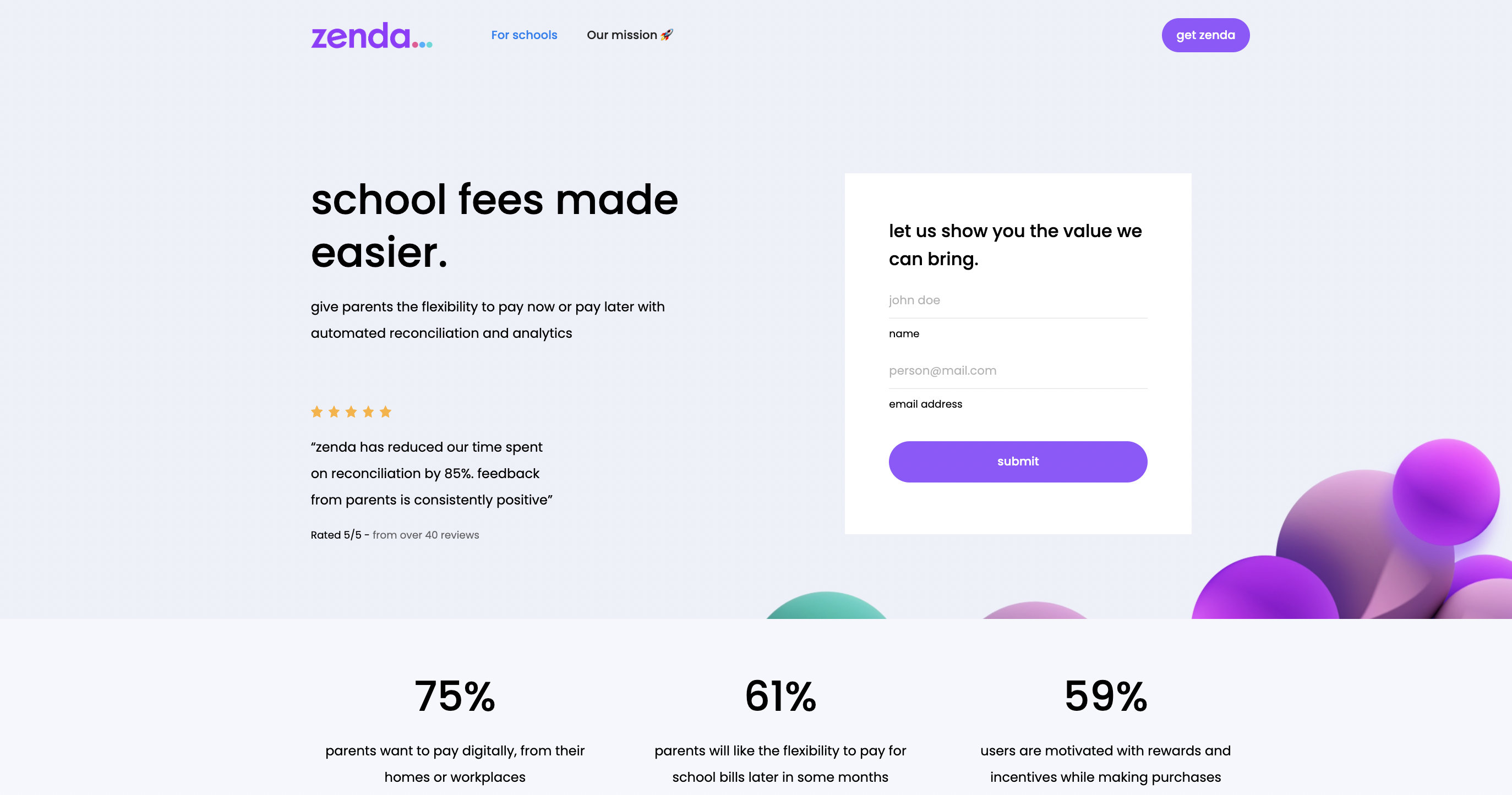
Zenda gets $9.4M to streamline school fee payment and management

Zenda, a UAE-based startup looking to change how parents pay school bills, and the way educational institutions manage fee collection, is eyeing Africa as its next frontier for growth.

Zenda (formerly nexopay) told TechCrunch it plans to enter the continent through Egypt — its third market after India — in the coming months, as it embarks on a growth drive accelerated by a $9.4 million seed funding it has raised.

Through its app, Zenda allows parents to pay fees directly to schools, all while streamlining collections by enabling schools to accept and manage payments online. This means that parents no longer need to provide bank deposit slips as proof of payment because all transactions on Zenda happen in real time. The startup also has an embedded financing option that extends tuition fee credit to parents on a flexible repayment structure.

The startup, founded in June last year by Raman Thiagarajan and Haseeb Ahmed, both ex-McKinsey & Company staff, is the duo’s second venture.

Thiagarajan said that Zenda borrows from their first social edtech startup, dubbed nexquare — a management and data analytics system for schools, educators and regulators. Thiagarajan, who previously led McKinsey’s financial services practice in the Middle East and North Africa (MENA) region, told TechCrunch that their first startup helped them understand the education market at a granular level, enabling them to build a fintech solution that solves the challenges encountered by parents and the schools around fee payment and management.

“Fee payments in schools are mostly manual, and where it is digital, it is cumbersome, expensive and has a manual aspect to it,” said Thiagarajan.

“With all the knowledge we have from our previous venture, we understand the education sector. And so, we have a parent-facing app… we also deeply integrate into educational institutions to remove the friction for both the parents and the schools,” he said.

Zenda plans to go beyond school fee payment by encompassing other personal financial management aspects. Image Credits: Zenda

Among the investors that took part in the seed round were STV, COTU Ventures, Global Founders Capital and VentureSouq.

The STV general partner Ihsan Jawad said, “Raman, Haseeb and the team have identified a compelling gap in the market and in supporting families on a topic that is very important to them. Seeing their strong traction over the past several months, we couldn’t be more excited about Zenda. The UAE itself is a $8+ billion market for private education fees and they are already well poised to capture leadership.”

Since launch, Thiagarajan says, Zenda’s users have increased 20 times, with the app reaching over $100 million in annual contracted payment volumes by the close of last year. And the startup is eyeing greater growth this year as it accelerates its expansion beyond the UAE using the new funding, which will also support the refinement of its product.

“Most of the funding is going to be used in the area of market development and customer experience,” Thiagarajan said.

In the long term, Zenda is envisioned to go beyond school fee payment by encompassing other personal financial management aspects.

“Our mission is to help families thrive. We aim to make it easier for families to manage their money, and to enable their financial wellness … We see a need for family-centric products that are simple and collaborative.”


Investors flock to fund an AI cornerstone: Feature stores

“Feature stores,” with their dreary and opaque moniker, might not sound like the sexiest subject.

But they’re an essential part of the AI systems that enterprises — and consumers, for that matter — use every day. That’s why they’re attracting an increasing amount of attention and investment from venture firms, which see the market opportunity growing into the distant future.

AI systems are made up of many components, one of which is features. Features are the individual variables that act like inputs in the system. In thinking about features, it can be helpful to visualize a table, where the data used by AI systems is organized into rows of examples (data from which the system learns to make predictions) and columns of attributes (data describing those examples). Features are attributes used to describe each example — an AI spam detector tool might use features like words in the email body, for example, or a sender’s contact information.

Working with features tends to be an ad hoc process within a single AI system. But at the enterprise scale, where data science teams are responsible for maintaining dozens to thousands of systems, a place to manage and track features becomes a necessity.

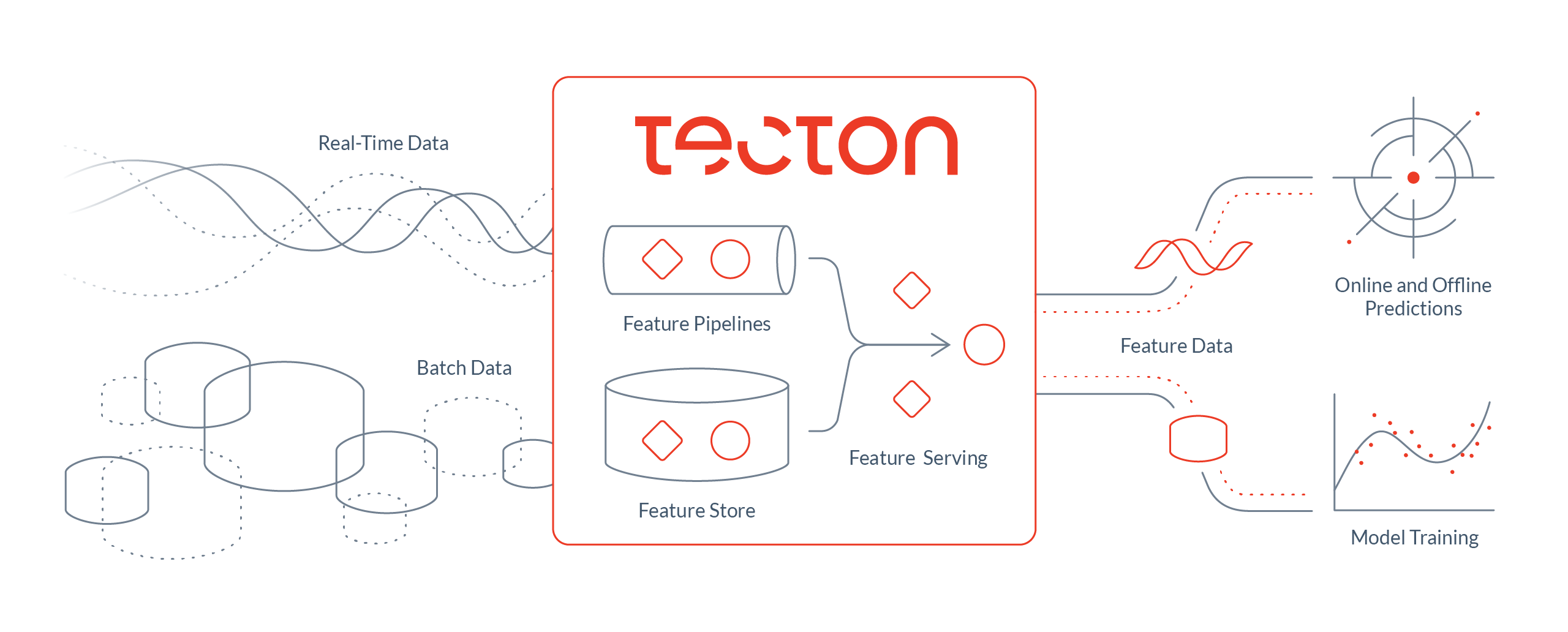
Enter the feature store, a centralized repository for organizing, storing, and serving the features that AI systems rely on. Introduced as a concept by Uber in 2017, feature stores provide a unified place to build and share features across different teams in an organization.

“Feature stores sit at the intersection of data and machine learning,” Michael Del Balso, the CEO of Tecton.ai, a startup developing feature store software for businesses, told TechCrunch in an email. “[Feature stores are] an essential part of the ‘MLOps’ stack because they enable data teams to quickly, reliably build high-quality features using real-time data and serve those features in production for real-time inference. They serve as the interface between data and [AI] models.”

Going beyond simply a database, feature stores allow data engineers to see statistics on features, including which features have been used, where they’ve been used, and the impact they’ve had on models. Feature stores also transform data, allowing users to aggregate, filter, and join features without necessarily needing to code. (Think aggregating orders at a restaurant to get the feature value “number of orders over the past 30 minutes.”)

Del Balso explained: “Advanced feature stores … automate production pipelines to collect data from batch data sources and real-time sources, transform the data in real time, and store the data in the offline and online store. [They often also] include built-in monitoring capabilities to monitor pipeline health, data drift, service levels and more.”

Image Credits: Tecton.ai

Feature stores promise to enhance collaboration between teams while streamlining the development of AI systems. As the demand for them grows, tech giants and startups like Tecton are developing products to meet the need — and investors are backing them enthusiastically.


Pandemic-fueled companies are finding the new reality hard to swallow

Companies that rode COVID-driven demand for their products during the first years of the pandemic are seeing their fortunes come back to Earth. Whether some of the biggest names in the cohort have a next act is becoming an open question.

Even more, could it be that companies that fell out of favor due to COVID-induced shifts in the economy are best prepared to excel this year?


The Exchange explores startups, markets and money.

Read it every morning on TechCrunch+ or get The Exchange newsletter every Saturday.


It’s never fun to sit around and list bad news. But the tally is starting to pile up: Today’s value of Robinhood, the consumer equities and crypto trading service boosted by the pandemic’s savings and investing boom, is worth just over $10 per share, far from its 52-week high of $85 per share. Coinbase, another company that saw demand for its fintech trading services soar during COVID, is worth just over $130 per share today, sharply lower than its $368.90 per-share 52-week high.

The list goes on: Instacart’s growth is slowing after a torrid period of expansion, leading to a valuation reset at the company. And recently, the Financial Times reported that the value of Hopin’s stock is off sharply on secondary exchanges, and some externally visible data could hint at a demand decline. The company executed layoffs earlier this year.

Seeing a rush of growth is never unwelcome at companies. And such a boom is especially coveted by companies usually valued more on growth than profitability. (Startups, in other words.)

That which has gone up is, it seems, coming down. Let’s talk about it.

Risk tolerance

The global economy is taking hits from many sides at once. Inflation concerns in some markets are stacked against growth woes in others. Geopolitical tensions are running high as the United States and China spar over trade and hot-button issues like the right of Taiwan to self-govern. Russia is busy digging into a quagmire in Ukraine, disrupting the energy market while supply chains creak and jam — not to mention the catastrophic loss of life. COVID lockdowns in China are also causing fears of more supply snarls, or worse.

The ebullient mood of late 2020 and most of 2021 this is not. And startups seeing their growth rates decelerate as their pandemic-led boom in demand fades, therefore taking stick twice at once.


Building a better mobility fintech startup on TechCrunch Live

Kevin Bennett started his auto financing company in 2016. It started as MotoRefi, and rebranded in early 2022 to Caribou. But the mission remains: Transforming consumers’ financial relationship with their cars. Since the founding, Bennett has raised $74 million for the company, including early angel funding from Rachel Holt. At the time, she was a rising executive in Uber — a post she left in 2020 when she co-founded Construct Capital. Hear how Bennett pitched early investors, and what investors like Holt can provide to mobility companies.

This event opens on May 4 at 11:30 am PT / 2:30 pm ET with networking and pitch practice submissions. The interview begins at 12 pm PT followed by the TCL Pitch Practice at 12:30 pm PT. Register here for free.

TechCrunch Live records weekly on Wednesday at 11:30 am PT/2:30 pm ET. Join us! Click here to register for free and gain access to Caribou’s pitch deck, enter the pitch practice session and access the livestream where you can ask the speakers questions.


What will Elon actually do if he buys Twitter?

Hello and welcome back to Equity, a podcast about the business of startups, where we unpack the numbers and nuance behind the headlines. Every Monday, Grace and Alex scour the news and record notes on what’s going on to kick off the week.

  • Stocks are down, and cryptos not looking too impressive as the world gears up for a packed week of mega-tech earnings.
  • The Twitter-Elon Musk deal could happen soon? As soon as today? It appears that after Musk dropped a filing indicating that he actually had the funds to buy the deal, talks shook loose. What’s ahead? I have precisely and exactly no idea.
  • Hopin is perhaps enduring some turbulence, per the FT. The company, once riding a torrid wave of market demand, is seeing its business molt into a more steady form. That meant layoffs earlier in the year, and a decline in its share price on secondary exchanges.
  • Startups! From the startup-realm this morning, new rounds for Zenda and Rooser. Not Rooster, mind, just Rooser.
  • And there’s a general climate of fear out there, which won’t do much for market sentiment. Alas, 2022 is not 2021 when it comes to investor excitement.

And we have a live show coming this week! Get stoked, details to follow.

Equity drops every Monday at 7 a.m. PDT and Wednesday and Friday at 6 a.m. PDT, so subscribe to us on Apple Podcasts, Overcast, Spotify and all the casts.


Circa wants to make first-of-the-month rent payments obsolete

Paying rent on time can mean the difference between having a place to live, and well, not. Circa believes there is a simpler way to help renters keep a roof over their heads.

The Maine-based payment technology company has created a mobile-first platform to enable renters to pay on time, in full, each month. And, if you run into problems and can’t pay the entire rent, Circa provides the option to break up the payments.

Co-founder and CEO Leslie Hyman told TechCrunch that over $15 billion in rent is paid late every month in the United States. Not only does that hurt their credit and their housing situation, but it also challenges the relationship between the renter and the property owner.

She shared some interesting stats, including that about 30% of rent payments come in later that the fifth of the month, and that 5.9 million renters, or 15%, were behind in payments, accounting for something like $41 billion in arrears monthly in the U.S. On the property owner side, evictions can cost them between $3,500 and $10,000, and they often have only an average success rate of 17% on debt collection.

Hyman’s background is in life insurance, and she had previously worked for large entities like AIG and MelLife, helping them build new businesses based on payments. She explained that when insurance premiums would bill at the beginning of the month, some 20% of them would not go through and need to be rebilled. When they started listening to the customer support calls that came through, many customers would be asking for a different date, when funds would be available.

That’s when she and her co-founder, Heman Duraiswamy, who has a background in residential real estate ownership, took a look at the pain of paying bills and started Circa in 2019. Circa completed the Techstars accelerator program at the Roux Institute in Portland, Maine in 2021.

“We started to understand what’s happening in America where if you look at the critical bills of housing, transportation and health, those all have the beginning of the month, and they add up to on average over $2,600,” Hyman said. “With income volatility increasing 40% in the past 50 years, you begin to question why we bill on the first of the month.”

Circa, Leslie Hyman

Circa CEO Leslie Hyman. Image Credits: Circa

Circa’s aim is to get out ahead of late rent, and in turn, foster a better relationship between property owner and renter. It is working with 1,000 units under management in the Northeast, Pennsylvania and in Sun Valley.

It raised $2 million — with another bit of money coming in soon — to expand the kinds of properties it can work with. Investors in the round include Maine Venture Fund, Techstars and Hub Investment Group.

Its sweet spot is properties with between 1,000 and 10,000 units. The app and web platform integrate with the property owner’s current property management software. Circa will promote to residents that it is there.

Renters set up an account in minutes and can choose their payment method and schedule the payment — a feature that can be changed anytime if money is tight. There is an option to pay in full or split up the payments and have money pulled on different weeks. Circa sends notifications letting the renter know the payment is coming out of their account, and there is the ability to make a last-minute change.

Circa makes money in a few ways: The company charges the property owner $1 per unit per month in a SaaS fee. Hyman explained that the owner actually recoups some of that cost because Circa charges the resident only when they do a flexible payment schedule. The company will then do a 50-50 revenue share with the property owner. For example, with a $1,000 rent the resident would pay $15 that month to do the flexible payment schedule. Of that $15, half goes back to the property.

In addition, the company offers credit reporting and takes over a property’s arrears management in a way not done by others, Hyman said.

“We have a transition in that same app that the residents are already comfortable with that is smooth and natural and goes straight from not making it at the end of the month into ‘would you pay a portion of that missed rent for the upcoming months,’” she added. “Others have people who go out and have a conversation with a resident. It is enormously labor intensive, and at a time when property managers have the highest turnover ever recorded. We take that heavy lift off their shoulders.”


Sunday, April 24, 2022

Arrow saves online shopping carts in Southeast Asia

Even in markets where credit card penetration is high, shopping cart abandonment is still a major source of concern for online vendors. Now imagine the situation in Southeast Asia, where many countries have scores of e-wallets, buy now pay later services and other forms of payment. Bank transfers are also popular option for online purchases, but involve several steps, which increases the risk of cart abandonment.

Arrow wants to make the checkout process easier by acting as a layer on top of payment gateways. It supports more than 50 different payment methods, including all the major ones in Singapore, Malaysia and Indonesia (including Atome, GrabPay, Boost and GoPay).

The company announced today that it has raised $4.8 million led by Sequoia Capital India, with participation from Alpha JWC and Zinal Growth. Angel investors including AIG and Maxis board member Ooi Huey Tyng, Paysend chief operating officer Steve Vickers and Coinbase head of Southeast Asia Hassan Ahmed also participated in the round.

Launched 15 months ago, Arrow was founded by Liat Beng Neo and Sebastian Roervig and is now used by 100 merchants. Liat Beng Neo told TechCrunch that a major reason for cart abandonment is that “the current checkout processes in the region do not account for its incredible diversity. Southeast Asia is made up of eleven different countries, each with their own unique e-commerce habits and nuances.”

For example, he added that some regions have poor internet connectivity, so customers may drop out of the checkout process if it involves clicking multiple webpages. Even popular payments, like bank transfers, involve several steps, and each one means the risk of a customer changing their mind about a purchase.

In addition to payment methods, Arrow also integrates shipping information and affiliated loyalty programs, so customers see everything on a single checkout page. Arrow can be integrated into shopping platforms like WooCommerce or Magneto or through APIs that let merchants replace their existing storefronts with Arrow. For social commerce, retailers get a checkout link they can message to their customers.

Arrow can be used by all kinds of merchants, but is focused on FMCG and other discretionary goods and services, Liat Beng said, because those tend to have high cart abandonment rates. It also caters in particular to merchants who deal in high order volumes, since they would benefit the most from improvements to cart abandonment rates, he added.

Arrow is currently active in Singapore, Malaysia and Indonesia, and plans to focus on those three markets for now, while planning for expansion into the Philippines, Thailand and Vietnam.


Fishy business: Rooser raises $23M for its seafood trading platform

The fishing market globally was worth $253 billion in 2021, and despite the controversy that swirls around the industry, that figure continues to grow. Today a startup that has built a platform to make the business of fishing more efficient — and thus the process overall more traceable and less prone to waste — is announcing a round of funding to ride on that wave. Rooser, which provides a marketplace for sourcing fish aimed both at those fishing and those buying for wholesale, trade or retail, has raised $23 million — funding that it will be using both to expand into more markets, and to continue building more functionality into its platform.

Today the company’s focus is on stock management, providing tools to help suppliers manage this, as well as to handle and track sales and assess the wider marketplace for their products. Soon, the plan will be to incorporate more quality control tools, supply chain finance, personalization for buyers and sellers to connect more likely trades; and further down the line, the startup will also bring more business intelligence and analytics into the mix for its customers.

Index Ventures is leading this round, with participation also from GV (formerly Google Ventures) and Point Nine Capital, as well as Figma CEO and co-founder Dylan Field, and David Nothacker, co-founder and CEO of freight and cargo startup Sennder,

The crux of the problem that Rooser is aiming to fix is that fishing is a huge and growing industry, but it’s been built on the back of major inefficiencies — inefficiencies that have time and again proven to be disastrous for more than just businesses, but for wider economic and ecological ecosystems.

Joel Watt — the CEO who co-founded the company with chief commercial officer Nicolas Desormeaux, COO Erez Mathan, and CTO Thomas Quiroga — saw this situation firsthand when he was running his own fishing business.

Originally an accountant by training, Watt hails from the north of Scotland (with an accent my American ear sometimes found hard to penetrate to match), and after years working for a big firm, he returned to his roots and hometown to start a fishing business — not a tech-based marketplace and budding big-data analytics play, but an actual, wet-floors, cold-rooms, and yellow boots fishing operation following in his family’s footsteps, with both his father and grandfather having also worked in fishing.

In nearly 10 years of operations, he scaled that business to 50 people and £10 million in turnover, “and it was then that we started to see just how inefficient it was,” he said. Fishing business’s greatest problem, he said, is uncertainty.

“You have the boats and fisheries, those turning the products into things you can eat, wholesalers and distributors, and then restaurants and fishmongers. All of those need one-to-one communication, but there are in reality many actors and many price points,” he said. The market is massive — 140,000 related business entities just in Europe — but typically those working without leaning on any platform to access wider customer bases and manage those relationships can only handle 20 contracts at a time, no matter how much fish they have to sell.

On the subject of fish to sell, that too is an issue. There are 250 types of fish typically sold in the fishing trade, but when you add in the range of sizes and other variables, it comes out to what Watt said was 35,000 SKUs, and there is little consistency in pricing across that landscape. “No one knows how much anything costs.”

Add to that the many layers of people in the chain, and stages that they each manage, and the delays that brings into what is a highly perishable product, and you have a messy situation. For every two fish or other seafood items pulled out from the water, only one gets eaten.

So Watt did what any accountant who pivots into building and running a fishing business might do: he started to look into software that could help manage the business aspects of his operation. Rooser is a word from the Doric dialect used in Watt’s region of Scotland, and it means “watering can.”

“A team member in my fishing business made a comment about how we seemed to always be fighting a fire somewhere,” Watt said. The idea is that Rooser the software is now helping to fight those fires. Indeed, that software, called Sea.Store, was effective and others started asking to use it, too.

Buyers on the platform can source seafood from 13 different countries, although Iceland, Watt said, is the biggest sourcing country at the moment. As for buyers, France currently accounts for 95% of all sales.

France indeed is a very big market for seafood, but it’s not the only one. Boosting it as the main buyer was intentional on Rooser’s part, he said.

We wanted to get fit in one market and then develop a supply side,” he said. “Now we can easily move into other countries as we spread across Europe.”

Georgia Stevenson, the Index partner who led the investment, said that part of the interest for Index here was how successful Rooser has been so far in addressing this particular vertical’s needs and building a marketplace to match that.

“It’s enabling less wastage, but it’s also just empowering seafood traders to do their jobs better,” she said. And while there have been plenty of critics lambasting the fishing industry for overreaching in their activities, depleting stocks; and equally the industry itself seems to just get increasingly bureaucratic, Stevenson said she believed that Rooser addressed both of these issues. “We have been investing in categories and infrastructure to be more sustainable and we see Rooser as consistent with that.”



5 investors discuss what’s in store for venture debt following SVB’s collapse

There are many questions around the implications of Silicon Valley Bank’s (SVB) collapse that won’t be answered for a long time. But there’s...