Saturday, February 26, 2022

Startups scramble in wake of Ukraine invasion

Welcome to Startups Weekly, a fresh human-first take on this week’s startup news and trends. To get this in your inbox, subscribe here.

I’m doing an abbreviated newsletter this week as I want to spend most of my energy amplifying the brave journalists on the ground reporting about this scary time. As so many have said — far more eloquently than me — the invasion of Ukraine is a story that impacts all of us, whether we’re on the ground there or not. And it’s hard to celebrate a funding round when scary times are the moment.

My brilliant colleagues put together a story on how the tech industry is responding to Russia’s invasion of Ukraine; I urge you to read it. While the situation is still ongoing, it’s clear that it’s already a tech story. And startups such as Grammarly, Ajax, People AI and Preply, backed by some of the world’s biggest VCs, are scrambling to support employees and operations amid the invasion.

What I’m hearing from sources is that startup founders are mainly offering financial assistance to employees who are in Ukraine or neighboring countries. The cash is supposed to help with fleeing the country. WhatsApp groups are also being formed between founders to see what is the best course of action; expect hubs with information on refuge or resources to roll out far and wide.

Then, there’s the startups that could actually make a dent in how consumers gain or share information amid a new war. One reaction of note is that of Cloudflare chief executive Matthew Prince, who said the company had “removed all Cloudflare customer cryptographic material from servers in Ukraine,” as a response to the new war. The move is an effort to protect customer data in case its data center, which opened in Kyiv in 2016, is compromised.

Michael Seibel, president of Y Combinator, asked a question on everyone’s minds: “Honest question, if US technology companies worked together right now – what could they do to deter Putin’s invasion?” As you can tell by the responses, there’s no perfect answer.

As my colleague Zack Whittaker put it, our mission at TechCrunch is staying the same. “We’re still a tech news pub with a focus on business, finance and startups. We still do that day in and day out, and the invasion is going to affect a lot of things. So, as you would with any other major event, we adjust our tone and we serve our audience the best way we can by telling them what they need to know.”

Reminder: You can always take a break, close this tab and give yourself grace. And, as always, you can support me by sharing this newsletter, following me on Twitter or subscribing to my personal blog.

Deal of the week

Gloria Lin, the brains behind ApplePay, has a new startup: Siteline. Senior reporter Mary Ann Azevedo, who is launching a fintech newsletter, gave readers a first look at the company that wants to combine construction with fintech.

Here’s why it’s important: Antiquated industries catching the ol’ fintech bug is anything but a new phenomenon, but it is always a signal when someone with a successful track record picks up the baton. The question is, can Lin bring her understanding of consumer fintech habits to an industry with complexities no one company has yet been able to crack?

Honorable mentions:

Digital generated image of split net/turbulence structure of artificial intelligence brain on purple surface.

Image Credits: Andriy Onufriyenko (opens in a new window) / Getty Images

The Great Realizations within the Great Resignation

On Equity this week, Alex and I spoke about the ripple effects of the Great Resignation, with a specific focus on the employee. We talked through what startups are facing today in terms of a labor market, how it has changed and how they might be able to compete with Big Tech’s big dollars. After all, is any company going to be able to beat Meta on comp? Probably not.

Here’s why it’s important: It appears that the forces driving more venture capital into early-stage companies are not too far from the causes of the labor shortage. Everyone is looking for a return, either on their labor, or their capital. And that means a tight hiring market, and picky workers.

Bring on the portable benefits:

Image Credits: Bryce Durbin / TechCrunch

Across the week

We get to hang out in person! Soon! Techcrunch Early Stage 2022 is April 14, aka right around the corner, and it’s in San Francisco. Join us for a one-day founder summit featuring GV’s Terri Burns, Greylock’s Glen Evans and Felicis’ Aydin Senkut. The TC team has been fiending to get back in person, so don’t be surprised if panels are a little spicier than usual.

Here’s the full agenda, and grab your launch tickets here.

​​Also, my dear colleague and first work best friend Chris Gates is moving on to other opportunities. My eyes have been puffy all week because there’s nothing quite like the relationship between a co-host and a producer. Thanks for editing out the ums and the likes, and for making me feel like I have something important to say. To those who want to follow Chris’ next step, follow him on Twitter and stay tuned for an episode next week in which we walk through his journey (and celebrate a huge Equity milestone).

Seen on TechCrunch

Your Android phone could have stalkerware, here’s how to remove it

Behind the stalkerware network spilling the private phone data of hundreds of thousands

The average person doesn’t have a chance with the smart home

Waymo to keep robotaxi safety details secret, court rules

SEC opens investigation into Elon Musk over possible insider trading

Seen on TechCrunch+

VCs weigh in on Europe’s future in the critical deep tech market

Dear Sophie: Startup visa news, H-1B and STEM OPT queries

14 climate tech investors share their H1 2022 strategies

Until next time,

N


Friday, February 25, 2022

Daily Crunch: State-sponsored hackers target private email addresses of Ukrainian military

To get a roundup of TechCrunch’s biggest and most important stories delivered to your inbox every day at 3 p.m. PST, subscribe here.

Hello and welcome to Daily Crunch for Friday, February 25, 2022. It has been a challenging week, so I hope you’re safe and in good spirits (if possible) when this letter reaches you. Toward a more fair and just world. – Alex

The TechCrunch Top 3

  • Storm clouds for late-stage startups: To close out a cheery week on a high note, TechCrunch dug into late-stage valuations in light of public market declines. In short, it appears that a host of startups raised new capital last year when valuations – and therefore revenue multiples – were hot. In a changed world, how will those companies manage to raise more cash and avoid a downround at the same time?
  • The latest from Ukraine: TechCrunch continues to cover the Russian invasion of Ukraine when it lands in our remit. Today, we have a story about hacking efforts that are impacting the Ukrainian defense and a piece discussing internet restrictions in Russia as they relate to U.S. social networking services.
  • It was destined to be a weird MWC by any measure,” writes our own Brian Heater, diving into the state of the smartphone industry. MWC, or Mobile World Congress, is a yearly tech confab that has become, Heater notes, “the smartphone show.” But with innovation seeming to slow in the smartphone market, what MWC may look like in the future could be up for debate.

Startups/VC

We have three sections of startup news today, starting with mobility, continuing with venture fund news, and closing with a neat startup round. To work!

From the mobility front:

  • Beam raises $93M, proves that the e-scooter market is not kaput: Beam, a Singapore-based company, rents out e-scooters and other electric personal transport machines. In the wake of valuation declines at Bird and Lime, you might think that investors were over putting capital into the shared personal mobility game. And yet Beam’s latest raise attests to the very opposite.
  • Can Taur make e-scooters cool? One issue with the electric scooters and bikes is that they still carry a whiff of dweeb about them. Perhaps this is because tech workers have long been a key customer base of the products. Regardless, Taur Technologies of London thinks “it’s time to separate scooter sharing from scooters as vehicles.” If this works out, I wouldn’t mind. I hate driving, so if scooting became cool, well.

From venture land:

  • $200M for Hack VC’s crypto fund: The hack.summit() team, which put on what TechCrunch describes as “the world’s largest blockchain programmer event,” has put together a crypto fund. Why not! Everyone has a fund these days, and given the amount of market enthusiasm to fund blockchain projects, we’re not shocked to see another.
  • Day One Ventures adds climate-focused partner: TechCrunch is building out its climate desk this year because we think that startups in that market are going to really matter. So we want to be prepared to write about them. Day One Ventures agrees with our general vibe, adding ClassPass co-founder Sanjiv Sanghavi as a climate-focused investor to its staff.
  • Do university degrees still matter in Silicon Valley? An essay on TechCrunch argues that they do. Some folks won’t agree, but if you check the employee records of most tech workers, they do share something in common. And it’s not a shared history of not finishing higher education.

And, finally from our startups coverage today, Peru-based Leasy just raised $17 million – in a mix of cash and debt – to provide car loans to ride-hailing drivers in Latin America.

Why I’m using a credit facility to grow my startup

Final stone being placed by hand on a balancing miniature model bridge made of small flat rocks outside

Image Credits: Henrik Sorensen (opens in a new window) / Getty Images

Investors are eternally on the lookout for an opportunity, but alternative financing is a viable option for founders who want to accelerate growth and retain more of their equity.

When Torpago CEO Brent Jackson wanted to expand his company’s offerings, the company secured $77 million in funding, “of which $75 million was a revolving credit facility and the remaining was in equity,” he says.

Doing so permitted the company to extend lines of credit to customers “and incorporate that debt into our capital stack in a way that minimizes the long-term cost of capital.”

(TechCrunch+ is our membership program, which helps founders and startup teams get ahead. You can sign up here.)

Big Tech Inc.

  • SEC 👀 the Musk brothers: Perhaps all those Elon tweets had something behind them. It turns out that the U.S. Securities and Exchange Commission is taking a look at both Elon and Kimbal concerning potential insider trading. The last thing that Tesla needs, we reckon.
  • Carvana buys Adesa’s US auction business: Carvana is best known for its huge car vending machine installations, rapid value appreciation in 2021, and rapid decline in value during the final weeks of last year and the start of 2022. Today its stock is perking up following its earnings report and the fact that it has “agreed to buy Kar Global’s Adesa U.S. auction subsidiary for $2.2 billion in cash.”

TechCrunch Experts

dc experts

Image Credits: SEAN GLADWELL / Getty Images

TechCrunch is recruiting recruiters for TechCrunch Experts, an ongoing project where we ask top professionals about problems and challenges that are common in early-stage startups. If that’s you or someone you know, you can let us know here.


Hear how Snorkel AI pitched and won over Greylock on TechCrunch Live

Snorkel AI was founded in the summer of 2019 and over two quick years raised a total of $135.3 million in funding over five rounds. The rocket ship seemingly still has fuel, too. The company isn’t slowing down, and TechCrunch Live is thrilled to host co-founder and CEO Alex Ratner and Greylock partner Saam Motamedi. 

Snorkel AI started at the Stanford AI Lab, where the team caught the attention of Greylock. The VC fund provided the company with seed capital and office space. Later, it led the $12 million Series A and participated in its $35 million Series B and $85 million Series C. Greylock partner Saam Motamedi joined its board of directors following the Series A. 

At Greylock, Motamedi focuses on enterprise companies, with investments and board seats at Abnormal, Apiiro, Utmost and others. In addition, his background makes him a great partner for early-stage founders. Prior to joining Greylock, Saam founded Guru Labs, an ML fintech startup, and worked in product management at RelateIQ, which Salesforce acquired for $400 million.

In 2019, at age 26, Saam Motamedi became Greylock’s youngest partner to date.

We’re excited to host both of them on an episode of TechCrunch Live taking place on March 9 at 11:30 am PT / 230 pm ET, where we’ll talk about how the two connected and what made Greylock a good partner for Snorkel. Click here to register for free!

TechCrunch Live is all about helping startups build better venture-backed businesses. Founders and the investors who finance them sit down to talk about how they met, what kept them interested in one another and, ultimately, how they sealed the deal. We also discuss the relationship that they share in working together through scaling.

Plus, this episode of TechCrunch Live includes the TCL Pitch-Off. Folks in the audience can come on to our virtual stage to pitch their startup to our esteemed guests and get their live feedback.

TechCrunch Live is free to attend and goes down every Wednesday at 2:30 pm EDT/11:30 am PDT. However, only TechCrunch+ members get access to the on-demand version of the episode, as well as the complete library of TechCrunch Live content. In other words, bite the bullet and subscribe to TechCrunch+.

Smash this link to register for TechCrunch Live with Snorkel AI and Greylock!


TechCrunch+ roundup: Climate tech survey, sex tech strategy, startup advisor compensation

Oil and gas production generates so much excess methane, it’s cheaper to set it on fire in a process called flaring than it is to capture it for sale or storage.

Just in the U.S., producers flare so much gas that astronauts aboard the International Space Station can identify oil fields 254 miles below in North Dakota and Texas.

Presumably, they can also see Antarctica’s Thwaite Glacier — it’s about the size of Florida, but it’s shrinking because greenhouse gases like methane trap heat in the atmosphere that warms our oceans.


Full TechCrunch+ articles are only available to members
Use discount code TCPLUSROUNDUP to save 20% off a one- or two-year subscription


Cleantech 1.0 was a short-lived boom, but it gave entrepreneurs a better understanding of climate tech, which in turn, has fostered more confidence among investors: 2021 saw a 400% YoY increase in round sizes for startups in this sector.

For our latest survey, we contacted 14 investors who are active in climate tech. Beyond sharing their investment thesis, they also let us know what they’re looking for and how they measure success.

We spoke with:

  • Alex Bondar, partner, Acre Venture Partners
  • Carolin Funk, partner, Blue Bear Capital
  • Georgia Sherwin, senior director of strategic initiatives and partnerships, Closed Loop Partners
  • Joshua Posamentier, co-founder and managing partner, Congruent Ventures
  • Shayle Kann, partner, Energy Impact Partners
  • Heidi Lindvall, general partner, Pale Blue Dot
  • Robert Downey Jr., Jon Schulhof, Steve Levin, and Rachel Kropa from Footprint Coalition
  • Maryanna Saenko, co-founder and partner, Future Ventures
  • Valerie Shen, partner and COO, G2 Venture Partners
  • Thai Nguyen, partner, MCJ Collective
  • David Frykman, general partner, Norrsken VC

Thanks very much for reading, and have a great weekend.

Walter Thompson
Senior Editor, TechCrunch+
@yourprotagonist

Advice and strategy for early-stage sex tech startup founders

Computer graphics of yellow smiling round emoji emoticon isolated on pastel blue background. Happy face emoticon.

Image Credits: OsakaWayne Studios (opens in a new window) / Getty Images

The old saying, “build a better mousetrap, and the world will beat a path to your door,” does not apply to startups in the sexual wellness category.

Pleasure has a very large TAM, but “vice clauses” prevent many VC firms from even considering a sex tech startup.

To learn how other entrepreneurs faced these challenges, Anna Heim interviewed founder/angel Andrea Barrica, entrepreneur Lora DiCarlo, and Carli Sapir, founding partner at Amboy Street Ventures.

“Fundraising is only one hurdle in the industry. There’s also the problem[s] of advertising, marketing, consumer education and medical expertise in this field,” Sapir said.

Is it time to worry about fintech valuations?

As of this morning, Nubank’s parent company, Nu, is trading at $7.71 per share.

It’s not just Nu that’s feeling a pinch. Even though it’s the most-funded startup sector, “fintech valuations have taken a whacking in recent months, reports Alex Wilhelm in The Exchange.

Dear Sophie: Startup visa news, H-1B and STEM OPT queries

lone figure at entrance to maze hedge that has an American flag at the center

Image Credits: Bryce Durbin/TechCrunch

Dear Sophie,

My STEM OPT expires in February 2023. My company has a policy that they won’t register me for the H-1B lottery since I have more than one year of OPT left.

What options do I have now?

—Distressed in Dublin

Inside the pitch deck that won Heartbeat Health’s first investment check

Heartbeat Health’s founder Dr. Jeff Wessler, and Kindred Ventures’ Kanyi Maqubela

Image Credits: Kindred Ventures / Heartbeat Health

Cardiovascular disease is big business: in the U.S., one-third of all deaths can be ascribed to heart disease or stroke. The cost of treating these patients is approximately $216 billion per year, according to the U.S. Centers for Disease Control.

But 80% of those deaths are preventable. And with that goal in mind, Heartbeat Health has raised about $30 million.

For the latest episode of TechCrunch Live, Heartbeat Health founder Dr. Jeff Wessler and Kindred Ventures co-founder Kanyi Maqubela reviewed the company’s pitch deck, discussed the value of insight over experience, and talked about how the company’s model evolved from from D2C to B2B2C.

How to strategically manage your startup advisor’s compensation

US 100 dollar bill on a fishing hook

US 100 dollar bill as a bait. American currency on the hook. Investment risk or money trap, business fraud and cheating or financial pitfall and mistake concept. Copy space

Beware of advisors who demand a share of your equity (and precious cash) in exchange for help with tactical operations like startup recruiting and marketing.

“No founder is an expert in every domain, and as they undertake the journey of getting their companies off the ground, they need to have outside support,” says Matt Cohen, founder and managing partner at Ripple Ventures.

Even so, entrepreneurs still need accountability measures that protect their companies from “advisor sharks” and “grifters,” he writes.

In a guest post for TC+, Cohen shares advice for setting goals and creating equity packages that will create “a more accurate alignment of incentives.”

VCs weigh in on Europe’s future in the critical deep tech market

In a follow-up to last week’s analysis of Angular Ventures’ report on deep tech investing in Europe, Alex Wilhelm and Anna Heim interviewed four investors to get a sense of what’s ahead for the sector this year:

  • Michael Jackson, partner, Cottonwood Technology Fund
  • Isabel Fox, founding general partner, Outsized Ventures
  • Nick Kingsbury and Andrea Traversone, Amadeus Capital Partners
  • Cyril Bertrand, partner, XAnge


Fresh from new round, Egypt’s proptech Nawy plans full-suite offering

Egyptian proptech startup Nawy, which began life in 2016 as an AI-driven property listing has grown to offer brokerage services, supporting the closing of property deals. It is now looking for its next path of growth after connecting 40,000 buyers to sellers last year alone, winning the confidence of the Sawiris family – Egypt’s wealthiest family, who, earlier this month, led a $5 million seed round to support their growth.

Nawy is now set to introduce in its catalog a mortgage service for pre-owned property, to serve a market that is predominantly shunned by traditional lenders.

The startup’s co-founder and CEO, Mostafa El-Beltagy told TechCrunch that the mortgage financing plan is part of their strategy to introduce new products that are aligned with clients’ needs, ensuring sustainability for their business.

The mortgage industry in Egypt is dominated by banks, most of which prefer to support buyers of new property over those seeking pre-owned ones. This leaves a financing gap for pre-owned mortgages that Nawy now aims to bridge.

“If you go into the resale market, it’s primarily cash. What we want to do is to build for the resale market, a very similar kind of process where we are continuing to own the house, but letting people pay in installments, rather than pay fully upfront,” said El-Betagy.

Nawy’s growth has been supported by investments in its internal and outward-facing technologies, including some that use machine learning to pair clients with property. The startup also uses AI to manage its sales force of more than 200 people by matching them with suitable property, and providing the market insights that quicken the closing process.

In the long-term, the proptech plans to use the data it collects to offer real estate advisory services, forge funding partnerships, and provide insights into the trends and other market factors.

“Once we have visibility on the rental market, the primary markets for resale property, we can start to answer some of those fundamental questions …like what is the forecast of the appreciation? Which properties are probably underpriced or overpriced? And using all of that information, we can start to give some very real financial advice,” said El-Beltagy.

“Within the coming years, we’re definitely going to go into the other components of the businesses like rentals and property management. That would kind of complete the suite of what we do – by offering core real estate products,” said El-Beltagy.

The startup is looking to tap the booming property market in Egypt, which has for a long time been a preferred venture option and a safe hedge against inflation — reasons why the sector is amongst the fastest growing segments of the country’s economy. The real estate sector contributed 10.3% to Egypt’s GDP during the 2019/2020 financial year while the construction sector accounted for 4.9%.

Nawy was founded by Beltagy, a former executive at Vodafone and Vodacom telcos, together with Ahmed Rafea (CBDO), Mohamed Abou Ghanima (COO), Abdel Azim Osman (CMO), Aly Rafea (CPO) and Mostafa Moro (CTO). The company was initially known as Cooing Real Estate before rebranding in June 2021.

The founders injected $200,000 into the startup, which averaged a growth rate of 30% year over year until 2021, when, buoyed by new funding, shot up 400%, with its gross merchandise value climbing to $200 million, up from $40 million the previous year.


Why I’m using a credit facility to grow my startup

When it comes to financing, startups and established organizations will have vastly different experiences.

Traditional financing may not always be available to high-growth startups, and even when it is, it often depends on the founder’s personal financial picture and their company’s existing revenue. While larger companies can turn to banks and other financial institutions, new founders often have to turn to alternative sources of financing to grow their companies.

For my own company, I decided to look at alternative financing options to scale operations and expand our product road map. To accelerate growth, I decided to raise a small amount of debt equity in tandem with a large, revolving credit facility.

Here’s how and why I’m using a credit facility to grow my company.

Raising a credit facility

To start things off, I approached a small lender who was able to provide a $3 million credit facility.

Banks often can’t offer a line of credit to a startup or small business, especially to those that don’t have years of operating history, given their legacy approach to underwriting.

It was therefore clear to us that we needed to offer lines of credit for our customers. Our credit facility allows us to extend lines of credit to our customers, ramp up our product offerings rapidly, and incorporate that debt into our capital stack in a way that minimizes the long-term cost of capital, which that makes clear sense for our business.

To expand our offerings, I turned to alternative financing: In October 2021, we closed a $77 million funding round, of which $75 million was a revolving credit facility and the remaining was in equity. Later this year, we’ll finalize an all-stock acquisition to further enhance our technology and product road map.

How we did it

For our business model, raising a credit facility to fund all of the spend for our customers made the most sense.


The idea that university degrees don’t matter is a Silicon Valley fantasy

Silicon Valley loves to celebrate the cult of the dropout — the inspired entrepreneur who decides that traditional education isn’t for her because it teaches her nothing of relevance, slows her down, and, in a world of readily available information, no longer gates learning resources like it once did.

Legendary advocates of the dropout cult range from Peter Thiel, whose Thiel Fellows program pays students to take a year out of college, to informal mascots like Mark Zuckerberg and Bill Gates, who never completed their college degrees but actually vigorously advocate for higher education.

My perspective on college admissions is informed by supporting thousands of ambitious students globally aiming to get into the world’s best universities and then seeing what happens next in their careers. Unless you are born into a privileged, well-connected family with substantial capital (which is often the vantage point many of the dropout cult advocates come from), your undergraduate degree from a top university is the most powerful socioeconomic opportunity that exists.

Silicon Valley’s undisputed leading startup accelerator is Y Combinator. Its prolific success ranges from huge hits like Coinbase, Brex, DoorDash, Airbnb and many more unicorns. Young aspiring entrepreneurs apply for Y Combinator in the hopes of receiving seed funding, mentorship and networking opportunities to help create the next unicorn.

To understand the cult of the dropout, I took a deep dive into who actually succeeds at Y Combinator, and the results nearly made me fall out of my chair – and I was already a big proponent for undergraduate degrees.

The dropouts are no ordinary dropouts – they had won places at the most prestigious universities in the world and took high school extremely seriously.

Firstly, demographics: The average Y Combinator founder that created a unicorn was 28.1 when they launched their company. However, the average Y Combinator founder of consumer technology unicorns was 22.5 (fresh out of college). When the founders of these companies are so young, often with no experience, you have to ask: How can Y Combinator bet so confidently on these talented young people? What is the signal that gives away their ability?

Image Credits: Jamie Beaton

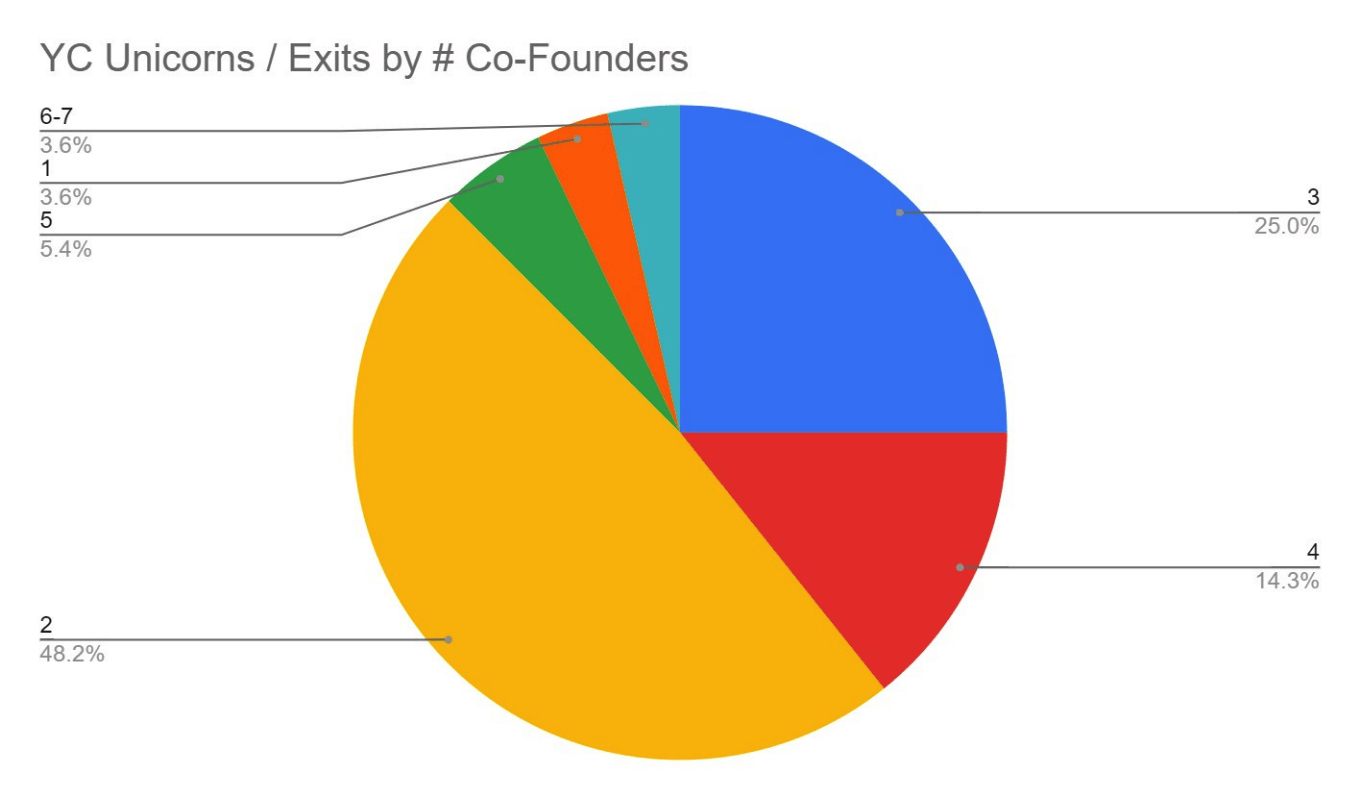
The answer, in large part, lies with their degree. Only 7.1% of co-founders did not go to university. Only 3.9% of co-founders dropped out, and all of them left well-known institutions like Harvard, Stanford or MIT; gaining admission alone sends a powerful signal of their academic abilities. The dropouts are no ordinary dropouts – they had won places at the most prestigious universities in the world and took high school extremely seriously.

As for the vast majority? You guessed it: 35% of founders went to Harvard, Stanford, Yale, Princeton, MIT and UC Berkeley, while 45% of co-founders went to an Ivy League school, Oxbridge, MIT, Stanford, Carnegie Mellon or USC. Among co-founders who started their company before the age of 25, more than two-thirds went to an Ivy League school, Oxbridge, MIT, Stanford, CMU or USC. MIT is the most common university co-founders went to, followed by Stanford and UC Berkeley.

Where else did they go? A vast majority of the Indian unicorn founders went to the Ivy League of India: the Indian Institutes of Technology. Founders didn’t just stop at undergrad degrees – 35.7% of co-founders completed some form of postgraduate education.

In my book, I offer a key explanation for this phenomenon: signaling. This is a term coined by Gary Becker, a Nobel prize-winning economist. Essentially, the labor market is so competitive that it is too costly to figure out how talented everyone actually is. As a result, venture capitalists need to use short heuristics to figure out who to bet on.

An elite college degree means a young person spent thousands of hours on academics, extracurriculars and leadership pursuits over an extended period of time and was deemed of a certain quality by an admissions panel. This acts as the signal needed for accelerators like Y Combinator to quickly sort candidates into how promising they may be.

Not every Stanford undergrad will get into Y Combinator, but the hit rate from Stanford, MIT and Harvard dwarfs that of normal universities or folks applying without this level of education.

As I went about raising growth capital from some of the world’s top investors, I would often hear investors mentioning that certain founders were “investable” and others were not. As I dug into this definition, it often revolved around how compelling the academic credentials of the founder were. Did this person seem backable, and would the fund’s institutional investors scratch their heads or be supportive?

Peter Thiel is perhaps one of the loudest advocates for dropout hysteria. He himself received an undergraduate degree and a J.D. from Stanford. In my research, it is hard to find individuals who supported the university dropout path who didn’t themselves have the buffer of an elite institution.

Founders Fund, Peter Thiel’s personal venture fund, sounds like it should be the place to be for aspiring investors without an elite college education. A closer look reveals the opposite. Of the 18 people working at Founders Fund, there are 18 elite degrees, including six Stanford undergrads, a Harvard J.D., two Stanford MBAs, a Stanford J.D., a Cornell undergrad, a Yale undergrad, an MIT undergrad, a Duke undergrad and more. One investor got close: They won an award for “most likely to drop out” – but still finished their MBA.

The best advice is followed by those who give it — only then do you know it is battle-tested. If you aspire to be a unicorn founder and rock the world through entrepreneurship, the most effective launchpad is a top-tier university degree.


Thursday, February 24, 2022

‘I need evidence yesterday’: Gesund raises $2 million to provide algorithm-validating data

It’s one thing to develop a medical algorithm, quite another to prove that it actually works. To do that, you need one crucial thing that’s hard to come by: medical data. And one startup is ready to provide that in spades, along with the tools to make validation studies easier.

Gesund, founded in 2021, emerged from stealth this week with a $2 million seed round led by 500 Global. The company has already come a long way, boasting viable platforms, 30 clients in their sales pipeline and revenue expected this quarter, CEO and founder Enes Hosgor told TechCrunch.

Gesund is basically a Contract Research Organization (CRO) for AI companies developing medical algorithms, or academics testing their own models. The same way a CRO might design a clinical trial for a drug or medical device company, Gesund’s platform curates data that allows AI companies to test their own products and creates the IT infrastructure to make that comparison run smoothly.

“I like to think of us as a machine learning ops company,” said Hosgor. “We don’t do algorithms.”

A medical algorithm is only as good as the data it’s trained on, and there is evidence that getting diverse and usable data sets can be a challenge. For example, a study published in JAMA in 2020 analyzed 74 scientific papers describing deep learning algorithms across disciplines like radiology, ophthalmology, dermatology, pathology, gastroenterology and pathology; 71% of data used in these studies came from New York, California and Massachusetts.

Indeed, 34 U.S. states did not contribute any data to the pipeline that had been used to train these algorithms, calling into question how generalizable they might be to a wider population.

The issue also exists across different types of healthcare providers. You could train an algorithm on data collected at a large, esteemed, academic hospital. But if you want to deploy that in a small community hospital there’s no guarantee it will work in that very different setting.

Taken together, the data sets used to train algorithms are, in general, smaller than they should be, according to one meta-review of 152 studies published in the BMJ. Naturally, there are some algorithmic success stories, but this is an industry-wide problem.

Technology alone can’t solve all these issues; you can’t sort or provide data that isn’t there in the first place. Think genetic studies for people of non-European ancestry, which are sorely lacking. But Gesund is focused narrowly on an issue where tech might help: making existing data easier to access and creating partnerships that open up new avenues for data sharing.

A screenshot of Gesund’s validation platform.

Gesund’s data pipeline comes from “existing data sharing agreements in place with clinical sites,” said Hosgor. Right now, Gesund is focused on imaging data collected at the University of Chicago Medical Center, Massachusetts General Hospital and Berlin’s Charité. (The company plans to extend beyond radiology in the future.)

Aggregating and delivering data for use in machine learning applications is also being done by others, like the Nightingale Open Science Project, which will freely provide clinical data sets to researchers (not affiliated with Google’s controversial “Project Nightingale”). But while the data itself is a critical piece of this, it’s really the technology stack that Hosgor sees as the company’s secret weapon.

“Everybody does ML on the cloud,” explained Hosgor. “And because your average healthcare provider doesn’t have a cloud, all that goes out the window,” he said. “We have built this technology stack that can reside on premises, inside a hospital firewall. It does not rely on any third-party managed services, which are the bread and butter of machine learning.”

From there, the platform includes a “low code” interface. In short, physicians and providers can basically drag and drop the datasets they need and test their own algorithms against that data.

“We’re about six months old, but we hit the ground running and we built this first product that allows model owners to run their algorithms against data to produce accuracy metrics on the fly, in high compliance environments where they don’t have access to cloud resources. That’s our secret sauce,” he explained.

At the moment, Gesund, somewhat like Nightingale, is providing some of its services for free. The company’s Community Edition allows academics with existing algorithms to test their algorithms for free (but they’ll have to upload their own data sets).

Meanwhile it’s the AI companies that will foot the bill for the company’s “premium” version. This, says Hosgor, will give the paying customers access to proprietary data sets. And there’s evidence they’ll pay for the data they need. At the moment, Gesund claims to have a pipeline of 30 potential clients, and expects to generate revenue this quarter.

“We were at RSNA in Chicago last November and every single AI company we talked to said ‘yes, I need evidence yesterday.’”

The $2 million pre-seed round represents all of Gesund’s funding, but Hosgor expects the company to raise again this year. In the near future the company will focus on R&D and expanding its clinical partnerships in the U.S. and Europe.


Healthcare unicorn Ro parts ways with top execs after fresh round of funding

A week after healthcare unicorn Ro landed capital from existing investors at a higher valuation, two top executives have parted ways with the company, per an internal email obtained by TechCrunch from multiple employees.

In the e-mail, CEO and co-founder Zachariah Reitano said that COO George Koveos and GM of Ro Pharmacy Steve Buck are “moving on from Ro” in the coming weeks. Koveos will be working in a new field, Reitano added, and Buck is returning to a healthcare project, but will remain “as an outside advisor to Ro Pharmacy.” Koveos had been at the company for 3.5 years, while Buck was hired in 2020 to meet pandemic demand.

The executive shakeup comes four months after former and current employees spoke to TechCrunch about rising tensions at Ro, noting its inability to monetize beyond its core brand and culture issues. Ro’s VP of communications Meghan Pianta did not immediately respond to request for comment on the departures.

It is unclear whether the executives chose to part ways with Ro or were laid off, but current employees note that shake-up comes after high churn on the care team, which was overseen by Koveos. Eight people out of Ro’s 11-person customer service operations team have quit due to culture, the majority leaving after only being at the company for five months, employees said in November. In recent weeks, Ro’s co-founders and HR team were conducting interviews with the entire operations team to better understand why so many people were quitting.

Some former care team employees tell TechCrunch that Koveos was directly responsible for them deciding to leave the company, citing “poor treatment” and “toxic culture.” After the TechCrunch story was published, Koveos took the blame internally for pushing the narrative that Ro should become the “Amazon of healthcare,” a mission that employees felt added pressure to pursue profit more than efficacy.

“We’re going to back away from that vision, we don’t want to be the Amazon of healthcare, we want to be the Ro of healthcare,” one employee told TechCrunch in that October piece. The next month, Ro hired Amazon executive JR Blaszek to be the new GM of Ro.

“With every change in leadership comes the opportunity to rethink what’s next, and that’s exactly what we’ll be doing here,” Reitano continued in the e-mail. “On a permanent basis, we see an opportunity to better align the teams that play critical roles in delivering a united Ro experience.”

The move will lead to a reorganization of the operations team, which ranges from customer support to care and sales roles. It is planning to hire a new operations leader, and Saman Rahmanian will be interim GM of Ro Pharmacy for the next two months, per Reitano’s e-mail.

Current and former Ro employees can contact Natasha Mascarenhas by e-mail at natasha.m@techcrunch.com or on Signal, a secure encrypted messaging app, at 925 609 4188.


Indian neobank Niyo raises $100 million, tops 4 million customers

India’s Niyo has raised $100 million in a new financing round as the consumer-facing neobank platform looks to add lending and insurance to its offerings and make deeper inroads in the world’s second largest internet market.

Accel and Lightrock India co-led the Bengaluru-headquartered startup’s Series C financing round. Existing investors Prime Venture Partners, JS Capital and Beams Fintech Fund also participated in the round, which brings the six-year-old startup’s all-time raise to about $150 million.

Niyo provides digital savings accounts and other banking services to largely salaried individuals in India. It works with banks to help them deliver a more modern and expansive user experience and features.

It also operates a wealth management product to help users invest in mutual funds and domestic equities. Some of its most popular features include zero percent forex markup and something called “invest the change,” which rounds up a customer’s spendings and invests a part of it.

Niyo co-founder and chief executive Vinay Bagri told TechCrunch in an interview that the startup has amassed over 4 million customers across its banking and wealth management products. Most of these customers are in their 20s and early 30s, he said.

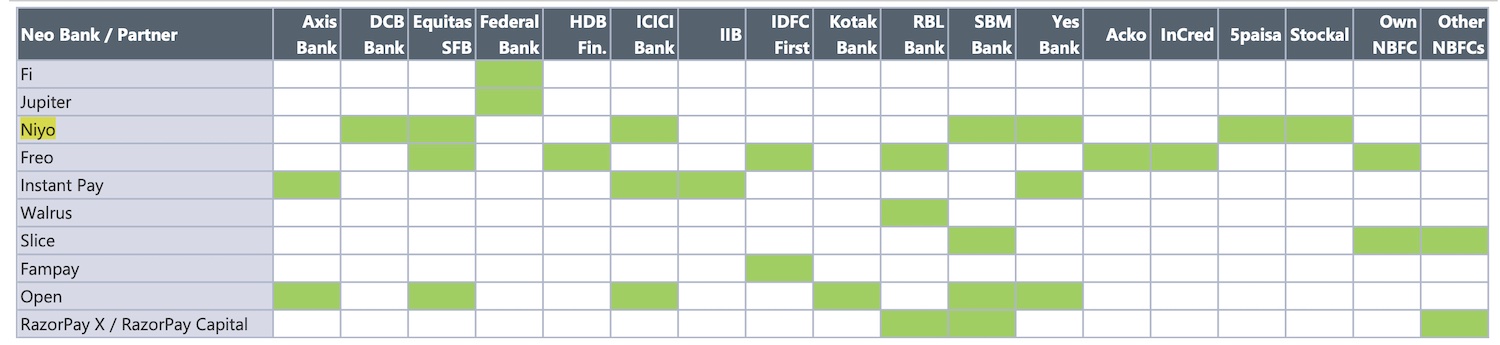
A look at neobanks in India and the banks with whom they have partnered to serve customers. (Data: Companies and Jefferies. Image Credits: Jefferies.)

The startup said it is adding over 10,000 new users each day and is processing more than $3 billion of transactions on an annualized time frame. Virender Bisht, co-founder and chief technology officer of Niyo, said the startup is seeing “massive tailwinds for digital financial products” since the outbreak of the pandemic.

“Launched less than a year ago, our first-of-a-kind product offering ‘NiyoX’ is democratizing the superior digital banking experience for users, and has witnessed tremendous user adoption,” he said.

Niyo plans to offer lending to customers starting next month. The size of the loans will be in the range of ₹70,000 ($930). As it broadens its offerings, it is also looking for inorganic growth via acquisition opportunities, said Bagri.

Scores of startups are attempting to modernize the banking experience in India. But the challenge they face is that unlike in many countries, banking is very affordable in India, which has made it difficult for them to persuade customers to make what is a considerable switch.

As an industry executive described to TechCrunch, the current generation of neobanks are largely only offering an “experience layer” to customers. But many startups are hoping that India will soon give them licence to own and operate their own digital-only banks.

“We are excited to back the fastest growing neo-bank in India, Niyo. Vinay, Viren and team have built a fantastic product with a clear value prop for customers which is reflected in their phenomenal growth. We look forward to partnering with Niyo in changing the way India banks,” said Anand Daniel, partner at Accel, in a statement.


Equity Live: A short note about the ongoing situation in Ukraine

Hello friends, and welcome back to Equity, your podcast about the business of startups where we try our best to unpack the numbers and nuance behind the headlines with you.

Today we gathered to do our live show, something that was scheduled a long time ago. Obviously, the world’s condition has changed since. So, we sat down and tore up our notes doc and put most of the show on hold. What we wound up recording was short, and frankly a little bit raw and from the gut.

But it just didn’t feel right for us to sit and chit chat about funding rounds and executive shuffles when Russia is busy invading a democracy under false pretenses. TechCrunch has some notes on the situation for the tech world in Ukraine, which is worth a read.

That’s it from us. Equity will return in short order when we have our heads on straight. Hugs, and godspeed.

Equity drops every Monday at 7:00 a.m. PST, Wednesday, and Friday at 6:00 a.m. PST, so subscribe to us on Apple Podcasts, Overcast, Spotify and all the casts.


Jeffrey Katzenberg backs the $10M seed round for HUBUC’s embedded finance API

I recently wrote about the so-called “Embedded finance” trend, citing the example of Intergiro’s recent fundraising in the space. There’s now yet another example of this trend in the shape of HUBUC.

Billing itself as “AWS for financial services” the startup — which emerged from Barcelona, Catalonia, Spain — has now raised a $10 million seed funding round co-led by WndrCo and Runa Capital.

WndrCo is a significant win for the company, since the deal brings WndrCo’s managing partner and former co-founder and CEO of DreamWorks Animations, Jeffrey Katzenberg to HUBUC’s cap table. This is a powerful ally to have.

But the list of influential investors doesn’t stop there. Y Combinator and Village Global, backed by Jeff Bezos, Kenneth I. Chenault, Abigail Johnson and Bill Gates, also participated, alongside a number of angel investors (listed below).

Founded in 2021 by a pair of fintech entrepreneurs (Hasan Nawaz, CEO, and Ignacio Javierre, COO), HUBUC says it does the heavy lifting of embedding financial services into business offerings via an API with no-code solutions. This means bank accounts, payments, virtual and physical cards as well as real-time FX rates and digital wallets can be offered HUBUC, because is sits as a layer between the financial partners it works with and the company’s product. That means it manages the contracts, regulatory requirements, AML, other integrations and risk etc.

In a statement, Nawaz said: “Embedded finance is no longer the exclusive privilege of large technology firms. Our vision is to become the platform that enables any company to embed financial services within their products. And we’re doing that by simplifying a hugely complex process and wrapping everything into one contract and one API.” He says they looked at various fintech verticals in 2017, but decided to go for an across-the-board API approach.

HUBUC says it now covers 58 territories, working with products such as travel booking payments, marketing and media spend, and employee benefits. Customers include Mastercard, Wagestream, PayFlow, OkTicket and Declarando.

Of course, they aren’t the only player. These include FIS, Temenos, Adyen and Wex. Some analysts predict that by 2025 the payments segment revenue of embedded fintech could reach $141 billion.

Katzenberg, Walt Disney Studios’ former chairman, and WndrCo co-founder said: “Embedded finance is going to disrupt banking in every single vertical market, from retail, mobility, to logistics and insurance. But to get there requires significant investment – and therefore risk – to develop and deploy. We can see the huge value HUBUC offers to its customers by delivering a full suite of services.”

Andre Bliznyuk, general partner at Runa Capital, added: “We see fintech infrastructure as one of the most promising themes for the next 10 years, as the demand for launching financial products is rapidly accelerating.”

Angels in the funding round included Sujay Jaswa (Dropbox), John Lilly (ex CEO Mozilla), Immad Akhund (CEO Mercury), Lars Fjeldsoe-Nielsen (ex VP Uber), Bo Jiang (CEO Lithic), John Bautista (Partner Orrick) and Anthony Saleh (angel investor in Coinbase and Robinhood).


How to strategically manage your startup advisor’s compensation

The best founders often attribute their success to a deep bench of mentors and advisors, but how do founders compensate these core parts of their network?

I see tons of founders being asked to compensate advisors with hard cash, and I’m immediately shocked to hear they have graciously agreed to do so. Advisor compensation is something founders find very difficult to navigate and I am often asked for my two cents.

When it comes to cash compensation, my initial response to founders is that cash at startups should be reserved for services like legal, accounting, marketing and other outsourced contractors. However, when it comes to more qualitative support and advice, the people helping founders need a more accurate alignment of incentives in the form of equity-based compensation.

The excess of capital in venture-funded startups has also attracted a litany of coaching services to the space, many of which are great. There are, however, a few operations out there that are angling to get exposure to the growth in tech startups. These coaches often position themselves as advisors to CEOs and either demand significant cash compensation or cash in addition to equity options from the company.

For good advisors who truly want to get their hands dirty and help founders succeed, a lucrative equity package based on results makes a ton of sense.

In order to create a better sense of alignment, I recommend that founders put in place certain terms that both parties must meet in order to unlock the value of that equity. For instance, founders can implement a vesting structure that requires advisors to meet certain metrics over time in order to unlock the value of their compensation — sometimes over many years.

A good example would be a partnership advisor: set goals around the number of partnerships from their network. If the advisor meets these goals, they’re eligible for the compensation. If not, then the founder can be protected from deploying that equity. Again, these coaches, advisors, mentors or whatever title they wish to hold should not be compensated in cash. That’s not because cash is more important than equity, but because it is much harder to tie to outcomes once it has been awarded.

In one of the more egregious examples of an external party taking advantage of founders that I’ve seen, an advisor offered to recruit talent for the startup. He purported to offer those founders a deal by taking a 50% reduction in cash relative to his usual rates, and the company paid him in shares to make up the difference.


Wednesday, February 23, 2022

Founders: Connect with influential movers and shippers at TC Sessions: Mobility 2022

If you’re itching to get your game-changing product out of the garage, onto the streets or into customers’ driveways, we not-so-humbly suggest that you do whatever it takes to attend TC Sessions: Mobility 2022 in San Mateo, California on May 18-19. It’s your chance to meet, mingle and network with mobility’s movers, shakers, shippers and unicorn makers under one roof at the spacious San Mateo County Event Center.

Who’s at the top of your must-meet list? Whether it’s top VCs, cutting-edge mobility companies, government policy makers, visionary engineers or tech journalists — to score coveted media exposure — you’ll find that and more waiting for you in two action-packed days at TC Mobility.

Hot tip No. 1: Early-bird savings are in play — for a limited time. Buy your pass now, before prices increase, and you’ll keep $300 in your wallet. Sweet, sweet savings.

Your all-access pass includes panel discussions, 1:1 interviews, breakout sessions and networking, plus access to our indoor AND outdoor expo area — where you’ll find dozens of innovative early-stage startups demoing their latest and greatest. More on that in a moment. You’ll also have access to our day of virtual content on May 20. Oh, plus videos on-demand following the live event.

Hot tip No. 2: If you want to place your mobility tech directly in the path of thousands of attendees — we’re talking potential investors, customers and influential tech titans — grab an Early-Stage Startup Demo Package. Don’t wait. The early-bird special saves you $200. You’ll get four passes with full access to the event, both in-person and virtually, the ability to demo on-site on May 18 and 19, and the ability to pitch during the virtual event on May 20.

Okay, let’s go back to the expo area. The huge indoor space expands into the great outdoors. You’ll find demos spanning the range of mobility tech, including the latest in scooters, e-bikes, EVs and autonomous vehicles. Test drive to your heart’s content or snag a Startup Demo Package and showcase your mobile marvel in our outdoor playground.

Take it from Jens Lehmann, technical lead and product manager, SAP, who had this to say about our last in-person mobility event back in 2020: “The most surprising aspect of TC Sessions: Mobility was just how much fun I had while learning. I can’t emphasize that enough. I got to drive the latest and greatest electric scooters, and I rode around in a VR/AR-enhanced car. That was pretty cool.”

TC Sessions: Mobility 2022 takes place live and in-person on May 18-19 in San Mateo, California, and our virtual version takes place on May 20. Buy your early-bird pass or demo package, save money and get ready to connect with the influential people you need to drive your business forward.

Is your company interested in sponsoring or exhibiting at TC Sessions: Mobility 2022? Contact our sponsorship sales team by filling out this form.


Is it time to worry about fintech valuations?

Nu, the parent company of Nubank, reported its fourth-quarter financial performance, and in response to rapid revenue growth and improving economics, the company saw its value drop 9% in regular trading today after falling sharply in recent sessions. Now worth just $8 per share, Nu is underwater from its IPO price and down about a third from its all-time highs.

It’s hardly alone in its struggles. Fintech valuations have taken a whacking in recent months, even more perhaps than the larger software market itself; SaaS and cloud shares have hardly covered themselves in glory recently, but declines in fintech stocks may take the cake when it comes to negative returns of late.


The Exchange explores startups, markets and money.

Read it every morning on TechCrunch+ or get The Exchange newsletter every Saturday.


Why do we care? Because fintech may be the best-funded startup sector. TechCrunch reported earlier this year that fintech startups collected around a fifth of venture capital dollars last year. A full one in five bucks from an all-time record venture capital year, we should add.

It’s not an exaggeration to say that as fintech goes, so too goes the startup market, and therefore the profile for venture capital returns.

So how are we to balance falling public-market valuations for fintech companies and simply bonkers-level private-market investment? That’s our question for today. To get our heads around the issue, if not the solution, let’s start with a refresh of fintech venture capital results, the fintech liquidity crunch and what has happened to fintech stocks.

Unless you own many shares of financial technology startups, this will be fun.

Venture capital loves fintech

The amount of capital afforded to financial technology startups is hard to fathom. In 2021, from a total of $621 billion of invested private-market capital generally under the venture aegis, some $131.5 billion across 4,969 deals went to fintech startups. That data, from CB Insights, also indicated that dollar volume for the sector was rising more quickly than deal volume. Which, if you run the numbers, allows for greater deal size over time.

This is from a sector that raised $49 billion in 3,491 deals back in 2020. That’s a 168% gain in a single year.

You know the names: Brex and Ramp and Airbase raised in 2021, just as Stripe did. And FTX and OpenSea. The list is replete with huge companies that help consumers and companies alike manage, invest and move money around.

Chime raised a massive $750 million Series G last August, a deal that pushed its valuation to around $25 billion. Which, you think, naturally makes the company an IPO candidate for 2022, right? Only maybe, it turns out. Forbes reports that the company’s IPO has been pushed back to late 2022, perhaps even the fourth quarter. That was before Nu reported lots of growth and its first full-year adjusted profitability and got a tenth of its value decapitated after suffering declines in prior recent trading sessions.

Does Chime want to go public in that market? Probably not, with investors casting aspersions on one of its best-known global cognates.

Why is this bad?

Nearly $400 billion has gone into fintech startups from the start of 2018 through the end of 2021. That’s an amount of money that is hard to grok, but we can better understand it as a rising pressure. The more money that goes into any particular sector’s startups, and the longer that money sits illiquid, the more that investors have anticipations for exits — which means liquidity, naturally, from things like IPOs.


5 investors discuss what’s in store for venture debt following SVB’s collapse

There are many questions around the implications of Silicon Valley Bank’s (SVB) collapse that won’t be answered for a long time. But there’s...