Wednesday, May 3, 2023

Fiverr Enterprise aims to streamline managing large groups of freelancers

In 2021, gig marketplace Fiverr acquired Stoke Talent, a startup developing freelance management tools for employers, for $95 million. The move expanded Fiverr’s business by bringing it into into new and adjacent areas of the employment market, diversifying the publicly-traded company’s offerings.

Now, after nearly two years following the acquisition, Fiverr’s unveiling a talent management product built on top of Stoke Talent’s offerings called Fiverr Enterprise. Shahar Erez, the GM of Fiverr Enterprise, describes it as a step toward Fiverr being able to accommodate larger businesses that may already have a group of freelancers but plan to further tap into the contractor workforce.

“Fiverr Enterprise is a Freelance Management System, an end-to-end software solution that gives businesses complete control over the hiring, management, payment and compliance processes of their freelance workforce,” Erez said via email. “Fiverr Enterprise provides value to businesses even when they have existing freelancer relationships that are offline or outside of Fiverr, meaning that businesses can now build their own curated freelance workforce with both online and offline talent.”

Fiverr Enterprise aims to streamline many of the processes around managing large teams of freelancers, like legal and payment paperwork and ensuring a consistent onboarding and compliance flow for workers. Drawing on Stoke Talent’s legal, tax and worker classification capabilities, Enterprise attempts to give greater visibility into an organization’s freelance workforce.

Fiverr charges a monthly subscription for Fiverr Enterprise as well as a percentage of monthly payments run through the Fiverr Enterprise platform. Customers get a single bill for all their freelancers each month.

Asked about how Fiverr Enterprise fits into Fiverr’s broader, long-term strategy, Erez said that it’s emblematic of the company’s increasing embrace of the upmarket, which (not coincidentally) began right around when Fiverr went public in 2019. He pointed to the launch of Fiverr Business in 2020 as another example, as well as the rollout of Project Partner earlier this year.

Fiverr Business allows teams of freelancers to collaborate across a range of projects, while Project Partner helps teams manage those projects.

“As the freelance workforce continues to grow, with estimates saying 50% of the U.S. workforce will be freelance by 2030, ambitious businesses understand that they need a workforce strategy that encompasses freelance and contractor talent,” Erez said. “Fiverr Enterprise offers a key solution for larger businesses who need a simple way to onboard freelance talent across the world while having full visibility of that part of their total workforce.”

Fiverr might have the advantage of a large existing customer base — it says that a group of customers from Stoke Talent including Amdocs, Similarweb, MinuteMedia and Waymo have already piloted Fiverr Enterprise. But there’s a fair amount of competition, mostly from startups, in the space for gig worker management.

Rivals to Fiverr Enterprise include Worksome, which raised $13 million in May 2021 to expand its freelance talent platform, and Wingspan, which secured $14 million in March for its all-in-one payment platform for contracts. There’s also Superside, backed by tens of millions in venture capital, which connects and manages freelance creatives working with in-house marketing and design teams.

But Erez didn’t express much concern.

“Fiverr saw a growing demand from enterprise companies looking for a solution to manage their contingent workforce and bought Stoke Talent to meet that demand,” he said. “Fiverr Enterprise is the only software-as-a-service platform powered by one of the world’s leading marketplace, Fiverr.”

Fiverr Enterprise aims to streamline managing large groups of freelancers by Kyle Wiggers originally published on TechCrunch


African startups: Apply to Startup Battlefield 200

Our global search continues, and today, we’re urging early-stage startups across Africa to apply for the Startup Battlefield 200 at Disrupt 2023. The application window closes on May 15 at 11:59 p.m. PDT.

Africa: The Startup Battlefield 200 wants your startups

SB 200 is the startup world’s preeminent competition, and it has a global reach. The inaugural cohort, which debuted last year at Disrupt 2022, included three impressive early-stage startups from two African nations.

Apply to the Startup Battlefield 200 at TC Disrupt 2023

Startups from all African nations, TechCrunch wants you — and the application deadline is coming up fast! Don’t delay. Apply to the Startup Battlefield 200 by May 15 at 11:59 p.m. PDT.

SB 200 membership has its privileges, the first of which is the highly coveted TechCrunch seal of approval. Then there’s intense (and invaluable) investor and media interest. The SB 200 founders also receive a plethora of free perks, benefits and opportunities.

Access to Disrupt — including four additional passes and VIP access to all the presentations, breakouts and roundtables.

Exclusive workshops and masterclasses — SB 200 founders will enjoy workshops in the weeks leading up to Disrupt. They also receive special pitch training from TechCrunch staff and one free year of TechCrunch+ membership.

Flash pitch at Disrupt — That special training will come in handy when you step onto the Showcase Stage and pitch in front of investors and TechCrunch editors. Receive invaluable feedback and — who knows? You might even catch an investor’s interest.

Exhibition space on the show floor — The SB 200 will be the only early-stage startups allowed to exhibit at Disrupt.

Saving the best for last — All SB 200 founders have a shot at competing for $100,000 in the Startup Battlefield pitch competition. TechCrunch editors will select 20 startups from the SB 200 to be Startup Battlefield Finalists. Founders from those 20 companies will be featured on TechCrunch, receive private pitch coaching and then pitch live onstage in front of the entire Disrupt audience. The ultimate winner takes home the $100,000 equity-free, no-strings-attached prize money and all the glory.

If you’re on the fence about applying, listen to Inside Startup Battlefield, our four-part podcast that explains why the Startup Battlefield competition remains the best place for you to launch your product. You’ll get an insider view of the benefits you could reap if you’re selected.

Africa, show us your best, game-changing startups! If you want to launch to the world on a global stage, apply to the Startup Battlefield 200 by May 15 at 11:59 p.m. PDT. We want to see you this September in San Francisco!

Is your company interested in sponsoring or exhibiting at TechCrunch Disrupt 2023? Contact our sponsorship sales team by filling out this form.

African startups: Apply to Startup Battlefield 200 by Neesha A. Tambe originally published on TechCrunch


Tuesday, May 2, 2023

Daily Crunch: Due to ‘growing concerns about security risks,’ Samsung bans workers from using generative AI

To get a roundup of TechCrunch’s biggest and most important stories delivered to your inbox every day at 3 p.m. PDT, subscribe here.

May the twoth be with you — we never did understand that joke, to be honest. Maybe one of y’all can explain it to us.

There’s still a bit of time left if you want to get your applications in for Startup Battlefield 200. Come to TechCrunch Disrupt 2023, and pitch in front of a room full of fellow startups and — definitely more importantly — investors. And don’t forget to vote for the breakout sessions you want!

Christine and Haje

The TechCrunch Top 3

  • No ChatGPT for you: That’s what Samsung is telling its employees following a leak last month where the company’s internal data was put on ChatGPT, reports Kate.
  • Oh, who are the people in your neighborhood?: Want help finding your lost dog? Nextdoor now has a new “Assistant” feature, powered of course by OpenAI’s ChatGPT, to help users of the neighborhood social network write posts that will have more positive engagement, Aisha writes.
  • Payday: Tage writes about Nomba’s recent fundraise of $30 million. The African payment service provider gives businesses tools to securely accept payments.

Startups and VC

Ann Lai, a general partner at Bullpen Capital, says she has been fired from the firm, Natasha M reports. The investor described the termination experience as “discriminatory and retaliatory” in a LinkedIn post published on Monday. Lai helped raise Bullpen Capital’s most recent $145 million fund, the first fund in which she was named an equal partner.

Today on Found, the TechCrunch podcast that gets the stories behind the startups, the team is talking with Stefan Bauer about how Marker Learning is cutting the cost of learning disability assessments by conducting them remotely, how they’ve successfully worked with school districts to help them test their required amount of students, and the potential to take Marker Learning into the prison system to assess incarcerated people and provide them with tools to learn in a way that’s better suited to their abilities.

And we have another fistful or two for you:

How to run efficient and effective early-stage board meetings

F1 pit crew working on F1 car.

Image Credits: JonFeingersh (opens in a new window) / Getty Images

Many CEOs see preparing board decks as an unpleasant chore, but done properly, it’s an opportunity for founders to hone their storytelling skills, engage their team leads and squeeze more value out of investor relationships.

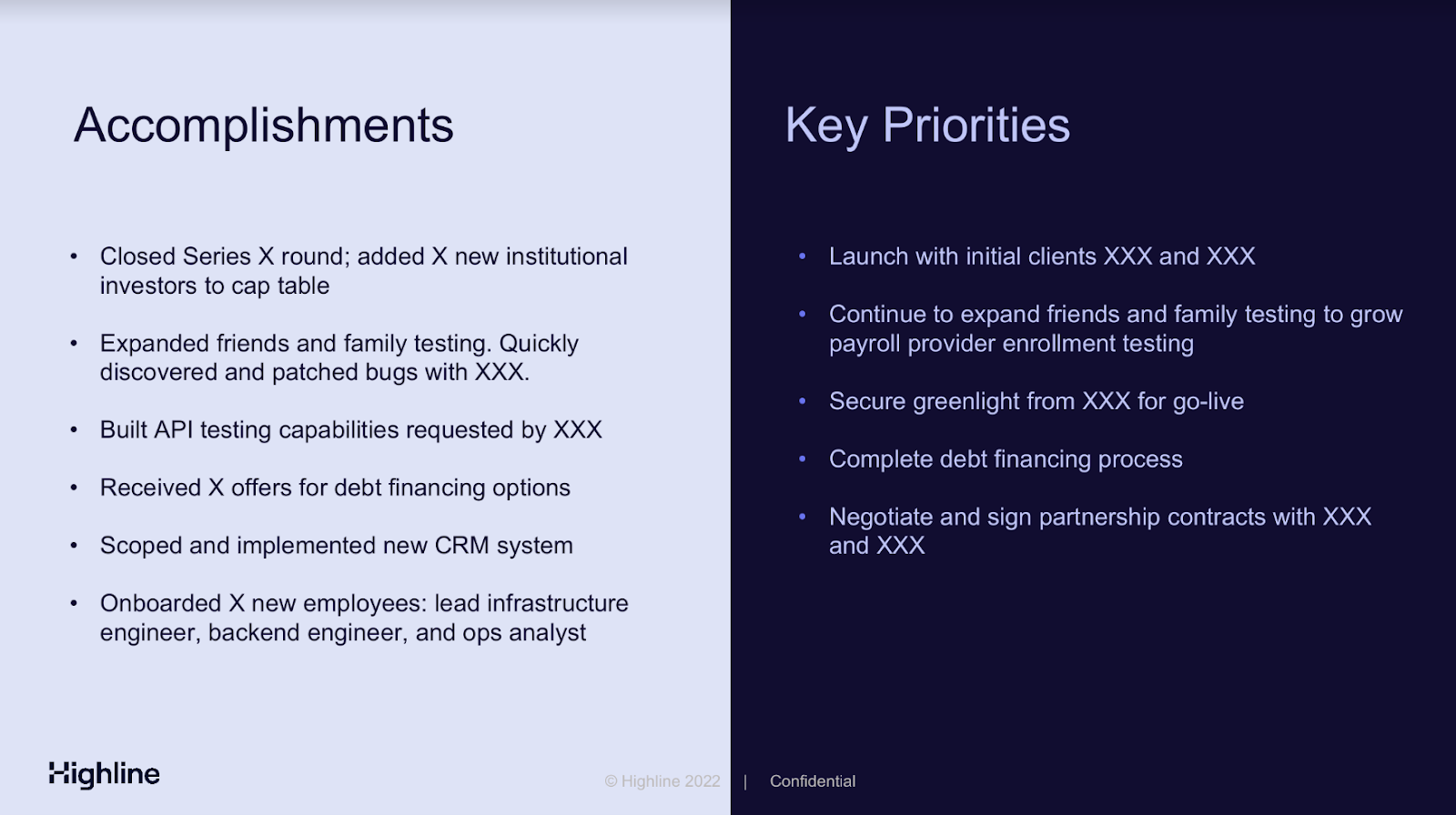
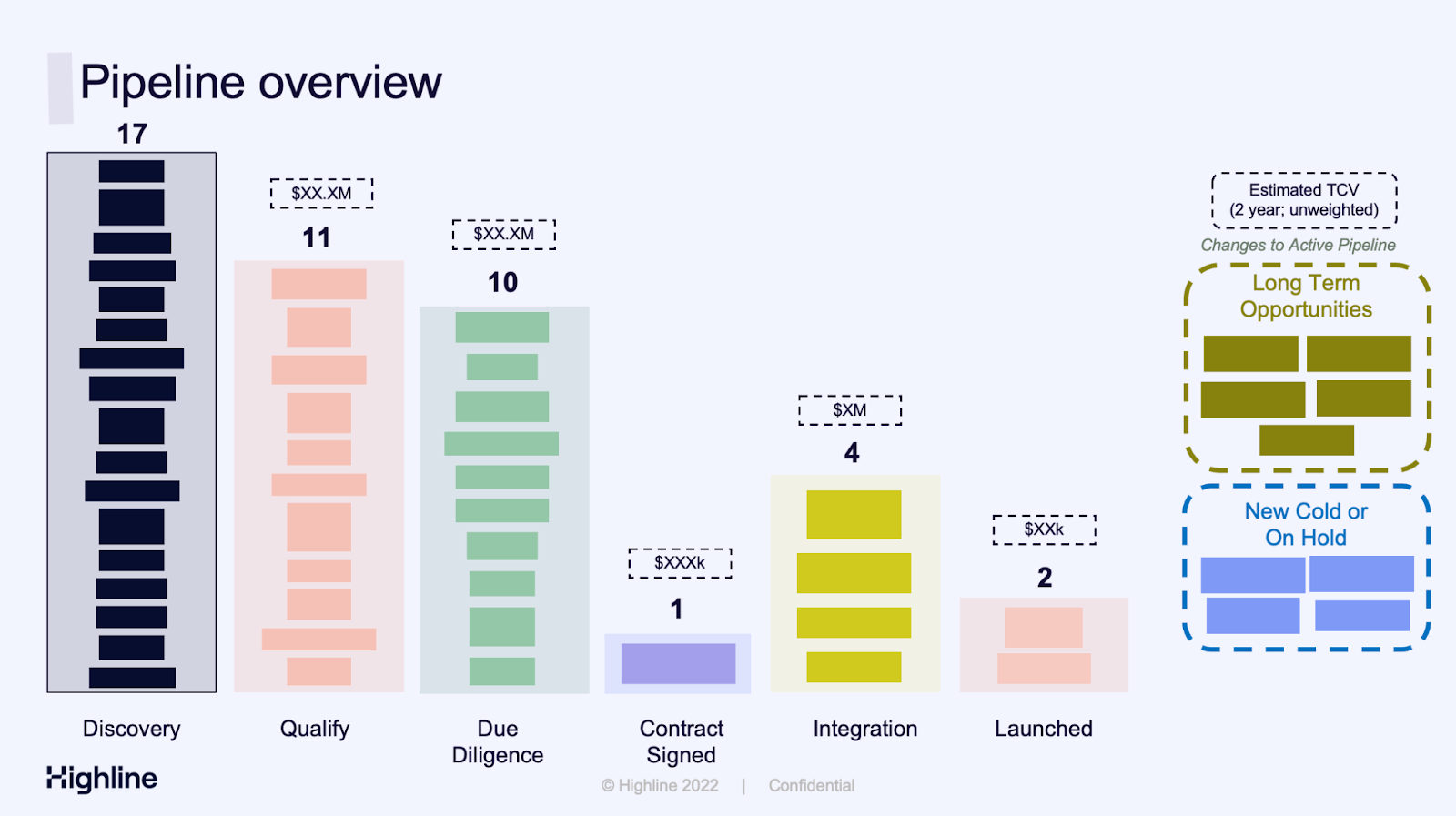
Amy Cheetham, a partner with Costanoa Ventures, shared 11 board slides with TC+ that demonstrate effective ways to convey accomplishments, product pipeline details, hiring and team growth, and other key priorities.

“The slides in this article aren’t meant to be a complete board deck,” she writes. “They are examples of real, early-stage board slides from seed and Series A stage companies that did a great job informing their boards and driving constructive discussions.”

Three more from the TC+ team:

TechCrunch+ is our membership program that helps founders and startup teams get ahead of the pack. You can sign up here. Use code “DC” for a 15% discount on an annual subscription!

Big Tech Inc.

You know what people hate more than losing things? Buying a thing-tracking device only to have them be part of something unsafe. Sarah writes that Apple and Google have teamed up to create some standard safety measures for these Bluetooth devices to curb unwanted tracking.

Speaking of companies coming together, Box is partnering with OpenAI to deliver some generative AI tools across its document management platform. Ron has more.

And we have five more for you:

Daily Crunch: Due to ‘growing concerns about security risks,’ Samsung bans workers from using generative AI by Christine Hall originally published on TechCrunch


TechCrunch Live is going to Atlanta and you’re invited!

Atlanta, Georgia has emerged as one of the buzziest new hubs in the nation, with booming enterprise, cybersecurity, and SaaS sectors, as well as a slew of investors looking to back the hot new startups coming from the city. Some well-known companies from Atlanta include Calendly, Kabbage, One Trust, and FullStory — all unicorns, by the way.

Many, like Calendly, passed through the stories of Atlanta Tech Village, which has served as an incubator for the city’s talent ecosystem since it was founded in 2012 by David Cummings.

Register here for this free TechCrunch Live event

Record labels, such as Quality Control, the musical home of the Migos, now have an investment arm, and the local HBCUs, like Morehouse, have their own entrepreneurial and innovation centers. Even the Atlanta Hawks launched their own investment firm to back early-stage talent. In fact, ATL hails itself as so committed to fostering its tech ecosystem that it appointed a chief technology officer, or, as some informally dub the role, a city Tech Czar.

Naturally, the next step was TechCrunch spotlighting the city to showcase all that is new and upcoming. Investors and founders have long expressed excitement about what is happening in the region. Last year, Atlanta startups raised around $1.65 billion, according to PitchBook; though an about 47.9% decline year-over-year, that amount is still the second-highest funding allocated to the city in recent years.

“The venture capital opportunity in the South is better than it’s ever been,” Lisa Calhoun, a general partner at Valor Ventures, told TechCrunch+ last year. “A lot of new founders are starting companies at astonishing rates; in terms of deal flow, we’ve never had so much.”

Tune in on June 7th at 10:00 ET as TechCrunch Live unpacks what is happening in the Atlanta tech ecosystem. Though much of the event is under wraps (stay tuned), we can promise an exciting slate of panels and articles to showcase the city’s culture and commitment to becoming a tech hub. Trust us, this is not an event you will want to miss, so stay posted for updates, and we hope you can join us as we officially welcome you to Atlanta.

Ps: if you are an early-stage Atlanta-based founder, please apply to pitch to our panel of guest investors judges for our live pitching competition; the winner gets a free booth at TechCrunch Disrupt this year to exhibit their company in our startup alley.

TechCrunch Live is going to Atlanta and you’re invited! by Dominic-Madori Davis originally published on TechCrunch


Vote for the breakout sessions you want at Disrupt 2023

In early 2022, you may remember, we called for experts to submit applications to present breakout sessions and roundtable discussions at TechCrunch Disrupt 2023, taking place on September 19–21 in San Francisco.

After spending dozens of late nights poring over thousands of applications and consuming frightening levels of caffeine, it’s time to reveal the Audience Choice breakout sessions competing for a slot on the Disrupt agenda. (You’ll find the list of Audience Choice roundtables here).

Audience Choice voting opens for TechCrunch Disrupt 2023

It’s time to make your voice count! Audience Choice voting opens today, May 1, and runs through Wednesday, May 17, at 11:59 p.m. PDT. Head on over to the voting site, and you’ll find all of the breakouts and roundtables, including the topic title, description, speaker and company affiliation.

See something you like? Click on the arrow in the green box next to each topic you want to upvote to Disrupt. Only the top 10 voted breakouts will earn a spot on the Disrupt agenda. Enlist your colleagues, family, friends and fans to vote and make it happen!

15 Breakout contenders for TechCrunch Disrupt 2023F

The following 15 breakout sessions are hunting for a spot on the Disrupt agenda. Go to the Audience Choice voting site, read the full topic descriptions, filter and search by topic, and upvote your favorites.

New CEO Imperative: Why You Need a Revenue-Governance Strategy

Speaker: Andy Byrne, co-founder and CEO, Clari

Building Early-Stage Products as a Nontechnical Founder: What to & Not to Do

Speaker: Andy Powell, chief business officer, Oak’s Lab

5 Ways Companies Aren’t Just Analyzing Data — They’re Making Money With It

Speaker: Barr Moses, co-founder and CEO, Monte Carlo

How to Make Your Investment FOMO Work for You

Speaker: Christine Tsai, CEO and founding partner, 500 Global

The Rise of Climate Deep Tech

Speakers: Daria Saharova, founding partner, World Fund and Joshua Western, founder and CEO, Space Forge

The New Power Duo in Capital-Efficient Growth: Marketing and Customer Success

Speakers: Jared Brickman, senior director, Marketing Center of Excellence, Insight Partners; and Ellie Wu, vice president, Sales and Customer Success Center of Excellence, Insight Partners

Ready, Set, Grow! Making the Most of Your First 90 Days With Your Investors

Speaker: Gabby Cazeau, principal, Harlem Capital

Building Guardrails, Not Gates: How Continuous Security Can Reduce Friction Between Teams, Accelerate Time to Deployment and Enhance Overall Security

Speaker: Guy Flechter, chief appsec officer, Palo Alto Networks

AI for Social Good: How Technologists and Nonprofits Can Partner to Deliver Lasting Impact

Speaker: Jen Carter, global head of technology, Google.org

Building Credibility and Trust: A Guide to Startup PR

Speaker: Jenna Guarneri, CEO and president, JMG Public Relations

Investing in Women and the Future of Families: It’s Not Charity, It’s a Multitrillion-Dollar Opportunity for VC 

Speaker: Jesse Draper, founding partner, Halogen Ventures

Product-Led Growth: Industry Buzzword or Business Game-Changer?

Speaker: Justin Bauer, chief product officer, Amplitude

Why Coastal Tech Hubs Should Pay Attention to the Innovation Happening in the Midcontinent

Speakers: Michael Basch, CEO and General Partner, Atento Capital and Nathaniel Harding, managing partner, Cortado Ventures

Defining Disability Tech: Innovations for the World’s Largest Minority

Speaker: Sandy Lacey, executive director, Howe Innovation Center, Perkins School for the Blind

Ask Sophie LIVE: Your Startup Immigration Questions Answered!

Speaker: Sophie Alcorn, founder and CEO, Alcorn Immigration Law

Don’t miss your chance to vote on the breakout sessions (and roundtable discussions) you want to see at Disrupt. Cast your votes here — and if you haven’t done so yet, buy your pass now and save. Prices go up on May 12 at 11:59 p.m. PDT.

Is your company interested in sponsoring or exhibiting at TechCrunch Disrupt 2023? Contact our sponsorship sales team by filling out this form.

Vote for the breakout sessions you want at Disrupt 2023 by Lauren Simonds originally published on TechCrunch


The era of software-defined battery startups is here

“Batteries are hard,” an expert once said.

He wasn’t kidding. Designing and manufacturing pouches, slabs or cylinders filled with volatile chemicals that are capable of recharging ever more quickly is far from easy. Just ask LG, which had to pay GM nearly $2 billion for a costly manufacturing defect that saw every Chevy Bolt recalled.

It gets even harder when you consider the realm of possibilities. There’s a range of materials that can store electrons and tweaking their amounts only expands the number of combinations.

“Whenever you have a new battery that needs to be designed, there’s a huge design space, almost limitless design space,” Kaixiang Lin, co-founder and CEO of Chemix, told TechCrunch+.

Years ago, new battery types were discovered by chemists laboring away at benches, testing different combinations. They were guided by an in-depth understanding of electrochemistry, decades of previous research and a hefty amount of intuition. They made great strides relying on that combination. But as batteries have spread throughout society, the need for new and specialized chemistries has only grown.

Enter artificial intelligence. Battery companies have started to turn to machine learning to understand how batteries degrade over time, how they might charge faster and even which combination of materials might produce a better cell. The move toward specialization is creating more niches for startups. It’s also a transition that appears to be driving parts of the early-stage battery industry to behave more like the software sector: quick to scale, and possibly, quick to fail.

Chemix is hoping that by building a company that’s entirely focused on applying AI to battery development, it’ll be able to create a moat that’s broad and deep enough to let it stay ahead of its competition.

Lin and co-founder Jason Koeller, who serves as CTO, founded Chemix in 2021 and participated in UC Berkeley’s SkyDeck accelerator. Now, the company has raised a $10 million seed round from Mayfield Fund, Ibex Investors and Radical Ventures, TechCrunch+ has exclusively learned. Chemix is valued at $37 million post-money, according to PitchBook data.

The company uses data and software to crank out novel cell designs that it hopes will allow it to serve a wide range of customers. Lin likened his company’s approach to Nvidia, which designs advanced logic chips while letting other companies (mainly TSMC) produce the physical product.

“We focus on the high value-add step that is, I would say, the most challenging step: zero to one, how to come up with a battery design because of the limitless design space,” he said. “We basically leverage AI/ML to speed up the development process to find the most optimum design.”

The era of software-defined battery startups is here by Tim De Chant originally published on TechCrunch


How to run efficient and effective early-stage board meetings

Of all the things an early-stage founder has to figure out, one of the most unexpected is how to get the most from your board. But effectively leveraging your board for guidance and support is essential. The slides you use can help you run efficient, effective board meetings that get the most out of the discussions they elicit.

A lot has been written about optimal board meeting cadence, process, and hygiene, but for the sake of completeness, at the earlier stages, often shorter (~1.5 hrs), more frequent meetings (~6 weeks) make sense.

Each board will have their preference and ultimately the cadence needs to work for everyone. You’ll want to send your materials 24-48 hours in advance to give participants time to review the material and formulate their questions. It’s also essential to include your “Head of…” functional leaders to discuss their areas of expertise.

Then dive into the material! As a CEO, your goal is to communicate the progress of the business clearly and elicit constructive feedback. So the information in your deck is more important than the visual design as you put together your board deck, although both matter.

The slides in this article aren’t meant to be a complete board deck. They are examples of real, early-stage board slides from seed and Series A stage companies that did a great job informing their boards and driving constructive discussions. [Disclosure: Costanoa Ventures has invested in Highnote and Highline.]

Showing business progress: Where the rubber meets the road

Board deck: Accomplishments and Key Priorities

Image Credits: Costanoa Ventures

This is a strong open: it briefly recaps major accomplishments and sets the stage for the company’s key priorities until the next board update. It also effectively frames the CEO’s key discussion points with the board. While ideally your board will have read slides in advance, they often won’t.

This slide helps everyone level-set up front, creating a framework for helpful discussion.Remember, that’s what a board meeting is all about: discussion, not a presentation or a read-out.

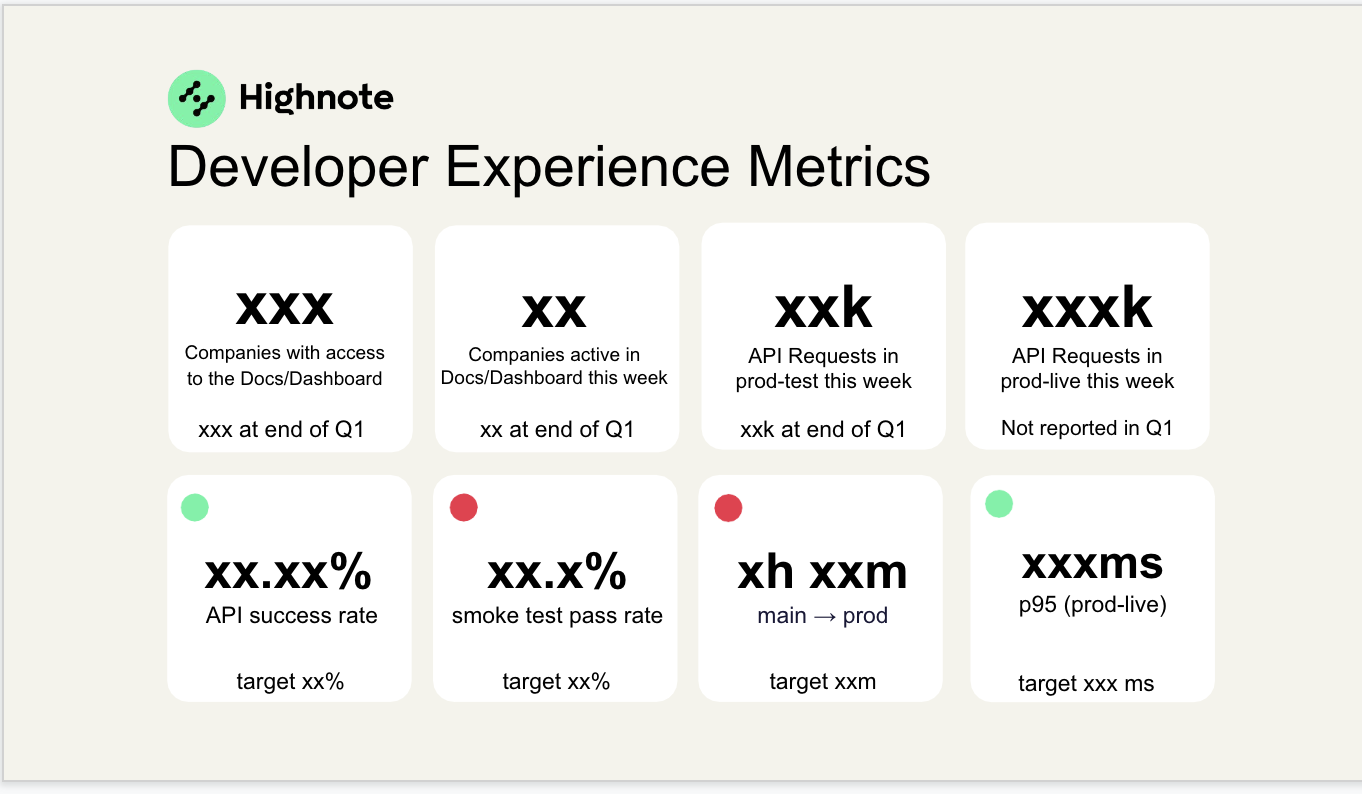
Developer Experience Metrics

Image Credits: Costanoa Ventures

Here’s another great slide: the “business metrics overview” is a snapshot of the key metrics by which the board should measure the company. Each company will have its own key metrics, but it’s good to open with a summary that sets the context for how progress should be measured.

Your board members typically work with many companies, and don’t always know the best ways to measure your company’s progress. So this is where you frame how best to understand your specific key metrics.

For early-stage companies, revenue is usually a lagging indicator, so not your most important metric. By setting out what are your key metrics, and flagging them with red or green dots, for instance, your board can quickly see what is/isn’t on track, which they always need to know. Unlike you, they don’t live and die by your plan, so you’ll need to remind them here.

Pipeline overview

Image Credits: Costanoa Ventures

How to run efficient and effective early-stage board meetings by Walter Thompson originally published on TechCrunch


Monday, May 1, 2023

Ann Lai says she was fired from Bullpen Capital after helping deliver a $145M fund

Ann Lai, a general partner at Bullpen Capital, has been fired from the firm, she says. The investor described the termination experience as “discriminatory and retaliatory” in a LinkedIn post published on Monday. Lai helped raise Bullpen Capital’s most recent fund, a $145 million investment vehicle, the first investment vehicle in which she was named an equal partner.

Before joining Bullpen Capital in September 2020, Lai was a principal at Binary Capital, co-founded by investor Justin Caldbeck. When she resigned from that firm she attributed it to the sexist behavior that she said she witnessed while there. She claimed that Caldbeck, who has been accused of sexual harassment in the past, told her he would blacklist her from the industry if she spoke up. Lai said that she filed a lawsuit – ultimately settled – to be able to break her NDA and tell others the reason behind her departure., as well as help others in the industry break past silence-guaranteeing contracts.

Her return to investing was marked by her hire as a GP at Bullpen, as the firm’s first female partner and first partner of color.

“The whole point of my original case [with Binary] is that such behaviors are not covered by non-disparagement,” Lai told TechCrunch. “I specifically carved it out of the GP agreement for Bullpen, not thinking that I was ever going to need it. “If it were like any other time the only narrative would be theirs. And then I’d have no options.”

It is TechCrunch’s understanding that Lai’s formal exit communications happened entirely through legal counsel. Lai did not accept a severance package from Bullpen Capital at the time of her termination. Asked for comment, she declined to say more, referring inquiries to her attorney Quinn Emanuel Urquhart & Sullivan’s Michael Liftik, who declined to comment beyond providing the following statement:

“Ann did not choose to leave Bullpen and she was not presented with an opportunity to stay past the end of April. We believe she was forced out, illegally, because she was not afraid to speak her mind and share her views. While robust debate was apparently tolerated among the other white male partners, this was unacceptable when it came from Ann, the only woman and minority in the partnership. Ann remains committed to the diverse founders she brought to Bullpen and the LPs with whom she shared her vision for a data-informed diligence process.”

In a comment to TechCrunch, a spokesperson for Bullpen said that they are not going to comment on personnel matters. “We are disappointed by Ms. Lai’s recent comments about Bullpen, and we strongly disagree with them.”

On LinkedIn, Lai described the partnership at the firm as an “all-white, all-male partnership” in which “‘equal’ wasn’t ever truly equal.” Of her time in the firm, she claims that she had to “defend female founders when they’re baselessly called ‘untrustworthy” or “uncompelling,’” push for male founders within Bullpen’s network to undergo standard due diligence, and stand up for herself in meetings after being called “a waste of time” in partner meetings.

The firm, through a spokesperson, said that Bullpen promotes “a collaborative culture of healthy debate and varied perspectives among our entire team, which is essential to finding unproven companies with high potential.”

Bullpen added: “Our accomplishments in this area predate and are independent of Ms. Lai joining the firm, and our commitment is as strong as ever. We are focused on moving forward without compromising on our founding vision of partnering with strong founders with the perseverance to become market leaders and generating attractive returns for LPs.” Lai’s lawyer did not have a comment in response to Bullpen’s statement.

Lai, meanwhile, told LPs in her post that she “was committed to delivering what we had marketed & promised for Fund VI. I would never quit so abruptly & irresponsibly.”

As part of her termination, Lai was not allowed to stay on the boards of her existing portfolio companies – including ChairmanMe, built by CEO Sarah Lacy, a former journalist at TechCrunch. Bullpen continues to own equity in Lacy’s company, as one of its biggest investors.

Lacy believes Lai’s experience is emblematic of a larger issue within Silicon Valley. She wrote a public LinkedIn post saying that what happened to Lai is an example of “why just hiring more female GPs has not changed this industry, about why despite the increase of women getting these jobs, the percentage of capital going to underrepresented founders has decreased. “

“Was it a feature or a bug that someone like Ann has been – once again– driven out for not playing the game?” Lacy wrote.

Lai says that Bullpen has not yet been in touch with her since she went public with her account of the termination.

If you have a tip or lead about other personnel shake ups in the venture world, you can reach Natasha Mascarenhas on Twitter @nmasc_ or on Signal at +1 925 271 0912. Anonymity requests will be respected.  

Ann Lai says she was fired from Bullpen Capital after helping deliver a $145M fund by Natasha Mascarenhas originally published on TechCrunch


Ryan Breslow’s Love health, wellness marketplace goes live

Ryan Breslow, the brazen founder and former CEO of Bolt, told TechCrunch in 2022 that he was leaving the one-click checkout company to start a new company in the health and wellness sector called Love. Well, today is not only Global Love Day, but Love’s launch.

Love previously raised $7.5 million from investors, including Human Capital and MaC Venture Capital, last year. Breslow told TechCrunch the company has since raised another tranche (to bring total funding to just under $20 million) from a group of new and existing investors that had previously backed Bolt, including MaC Venture Capital, Streamlined Ventures and Activant. The fundraising is ongoing, Breslow said.

Breslow told colleague Connie Loizos nine months ago that Love would be a “people-powered pharma” with a decentralized autonomous organization (DAO) infrastructure “where members, who buy ‘Love tokens’ with Ethereum or another reserve currency, can discuss homeopathic and other pharmaceutical alternatives, then vote on which of them should be tested in clinical trials. The DAO will then underwrite the studies.”

Instead, Love launches first as a wellness marketplace that features an initial 200 curated products, like supplements, health testing kits and essential oils, among categories including reducing stress and gut health. Love will earn a commission on the sales.

In discussing that small pivot, Breslow said that he and his founding team, which includes fellow former Bolt colleague Karissa Paddie, chief product and innovation officer, thought about starting with a crowdsourcing way to run token-driven trials and generate data on wellness products, “but we realized that there were a few steps to take place before that.” Also, it’s important to note that Breslow’s involvement in another DAO is now the subject of legal matters, Forbes reported in March.

“There is a lot that could be done,” Breslow said. “There is no aggregator, there is no marketplace in the space, so there’s no basic vetting. We had to do all of these things, including generate consumer interest, build a consumer database and collect data on which products consumers take the most interest in and then piggyback off of that in the future to pursue the earlier crypto ambitions.”

All products on the site pass a set of compliance processes and reviews developed in partnership with clinical trials company Radicle Science. For each item, there will also be two scores: a Love score and a consumer score.

There will also be both online and offline communities to connect people on “healing journeys,” for example, around mental health, and a library of digital content with well-being videos.

Now that the site is live, Love can move forward with expansion plans. It has 700 products vetted and teed up and ready to go. New products and categories will be added in stages and will also be accompanied by educational content, Breslow said. Future iterations of the site will include social commerce.

“I’m really expanding on what a review means and what a testimonial means,” Breslow said. “We will be rewarding users with points for engaging and reporting back to the community about how the product works for them. We are also integrating social commerce elements that are actually quite prevalent in Asia. We’re inspired by that and we believe social commerce can have a great role to play in wellness.”

Ryan Breslow’s Love health, wellness marketplace goes live by Christine Hall originally published on TechCrunch


Once-hot photo-sharing app Poparazzi is shutting down

Poparazzi, the once-hot photo-sharing app that hit the top of the App Store in 2021, is shutting down. The company announced the news via a Medium blog late last week, informing users that the app would be discontinued and users had until June 30, 2023 to download their content. Last year, Poparazzi’s founders at TTYL Inc. said the app had grown to 5+ million total installs and confirmed its raise of $15 million in Series A funding.

Though Poparazzi had felt at the time like an overnight sensation, co-founder and CEO Alex Ma and his brother, co-founder Austen Ma, had spent three years developing apps and pivoting to achieve the success they generated with Poparrazi’s launch. In a 2022 interview with TechCrunch, Alex said Poparrazi was actually the 11th or 12th app that was generated by those efforts. Among those was the audio social network, TTYL, a sort of “Clubhouse for friends,” which their company is also named for.

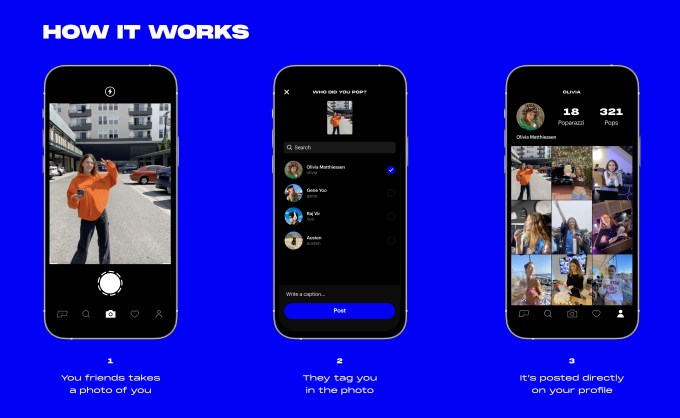
Poparrazi, however, generated a lot of hype soon after its release, climbing the charts to reach No. 1 on the App Store. The concept behind the app was a photo-sharing-focused social network that essentially took Instagram’s tagging feature and turned it into the entire experience. On Poparazzi, users could tag their friends but couldn’t post photos of their own. The idea was that this would create a more authentic type of social network, as photos wouldn’t necessarily be the polished, perfected images that fill Instagram, but rather the casual moments that make up people’s real lives.

Image Credits: Poparazzi

Last June, the company confirmed its $15 million Series A raise led by Benchmark’s Sarah Tavel, who beat out a16z for the deal. The startup had previously raised $2 million in seed funding, led by Floodgate, in a round that included other investors like SV Angel, Shrug Capital, and various angels. At the time, Poparazzi said its funds would give its team of 15 a runway of over two years.

But soon, there were signs that Poparazzi’s time could be coming to an end.

In August 2022, TechCrunch spotted the team was now dabbling with a new app, Made with Friends, that offered a twist on Poparazzi’s original concept of social networking profiles crafted by a user’s friends. Made with Friends instead asked its users to post all sorts of content to their friends’ profiles, not just photos. For example, they could post text-based content like answers to questions or prompts, as well as videos. The app had been available as a pre-release at that time, but it’s since been removed from the App Store sometime after March 26 of this year, app intelligence firm Apptopia confirmed to TechCrunch.

Usage for Poparrazi had also been slowing post-launch, the firm noted. It estimated there were 6.2 million lifetime installs for the app, but it now has only around 2,000-3,000 monthly active users (MAUs) after reaching a height of 4 million MAUs previously.

In its blog post, Poparrazi didn’t confirm its future plans, if any, only noting the impending shutdown and thanking its community and supporters.

“We’ve been incredibly blessed to work with an amazing team of passionate designers, engineers, and marketers to help bring this movement to life. And none of this would have been possible without the backing from the most supportive, world-class group of investors,” wrote Alex Ma, in the announcement. “To our community, we are so grateful for the support and belief that you have shown us throughout our journey. Your enthusiasm and passion for Poparazzi has been the driving force behind everything we’ve done. Thank you from the bottom of our hearts.”

TTYL Inc. has been asked for comment.

Once-hot photo-sharing app Poparazzi is shutting down by Sarah Perez originally published on TechCrunch


How this investor widens its net by refusing warm intros

I have often been annoyed by warm introductions. I get why investors insist on them, but it has always struck me as lazy and un-inclusive.

So I was filled with great delight and curiosity when I was introduced to GoAhead Ventures. The firm claims it will hear anyone’s pitch, no matter where in the world you are or what you are building as long as you are a pre-seed or seed company.

The catch? They insist on a video pitch. The upside? They promise to get back to you within a day to let you know if you’re through to a partner meeting. Assuming the (very light) due diligence goes to plan and they like your company, you could have the money in your bank account within a week.

This approach is different enough from most venture outlets that I decided to talk with Clancey Stahr and Phil Brady, both managing partners at the firm, to find out what life is like with the proverbial VC doors thrown wide open. I was also keen to get the inside track on what the firm looks for in investments and what founders can do to stand out.

“When we were getting started, what we were doing was very similar to other VC firms: We were trying to do some thought leadership, do some grassroots marketing around the Stanford campus; that kind of stuff. But it wasn’t until COVID that we started to differentiate and move into our current process,” says Stahr, describing the firm’s journey from 2014. “Phil created and drove that.”

COVID changed investing for a lot of firms. Gone were the days of in-person meetings and everyone had to deal with days of Zoom-induced chaos. That’s when GoAhead decided to try to rethink its processes.

“We wanted to figure out how to scale [our process] up most effectively. Now, we just have founders submit a video pitch through our platform. It literally takes about five minutes from start to finish; it’s a four-minute elevator pitch. They just fill out some basic information like their name and company name ahead of time. From the moment they submit that pitch, we let them know in three days or less if we want to invite them to a partner meeting or not,” explains Brady, revealing that the firm gets more than 3,000 pitches per year.

The company still maintains its promise of a three-day turnaround. “If we invite them to a partner meeting, we give them a final decision the next day at five o’clock. So the entire process can be done in a week. You could submit a pitch on Monday and you could have money in the bank on Friday, feasibly.”

“We get people a decision the following day, so we don’t have time to review what other firms are doing. We just state the amount of money we want to invest and the valuation cap we want to invest at.” Clancey Stahr, managing partner, GoAhead Ventures

On the face of it, it seems like a very founder-friendly way of deploying capital: Anyone can pitch and once they do, the process is transparent, quick and relatively streamlined. Most importantly, the fact that anyone can submit a pitch on its website means the firm presents a level playing field to potential investments.

“We do deals anywhere in the world. We cover all sectors. We’re completely flexible and the only ‘gating factor’ is that we are only focused on the early stage. Aside from that, we are just choosing people, so we wanted to put all founders on equal footing. We felt that most other funds ended up only inviting founders to pitch if they have some kind of warm intro or some kind of strong pedigree in their background that kind of gets them in the front door,” said Bradley.

“We love to be able to watch all these pitch videos apples-to-apples to try to decide without other extrinsic factors. So far, it has been great. We launched it around COVID and it has really skyrocketed our deal flow in ways we couldn’t have imagined. I think it’s been kind of a win-win for founders and for us.”

Picking a fight with warm introductions — replacing them with the hurdle of having to record a video — has given the firm an edge, it believes.

“There are a lot of really well-known firms. When you go to their website, it says something like ‘Find a partner for a warm introduction to the partnership.’ For us as emerging fund managers, the most frustrating thing about starting a VC fund is also fundraising. Everything about the process sucks. You need to find a warm intro to this billionaire. You need to find someone who knows someone who knows someone — the process is entirely unclear,” Stahr laments.

“You meet someone, they say, ‘Oh, this sounds great,’ and then they disappear. I know that happens to founders all the time, too, and all the fine-tuning we’ve done to our process around the top of the funnel as well as making it transparent is mainly built around our frustration with fundraising for our own funds. We just hated that so we decided to change it.”

The firm is explicitly not investing with a consensus-driven model: If one of the investors wants to write a check, they can, even if the others think it’s an awful idea.

How this investor widens its net by refusing warm intros by Haje Jan Kamps originally published on TechCrunch


Automation helps founders avoid the basis point yield trap

The recent banking sector developments that sent founders scrambling for places to diversify their cash reserves left markets wondering if the Fed would follow these events with another rate hike. As I’ve previously written, the Fed avoids surprises. Sure enough, the interest rate is now 25 basis points higher, raising a question for founders: How should this hike impact the way I manage my company’s cash?

The wrong answer is to give in to the urge to spend hours emailing different banks in search of the highest yield payout and agonize over hunting for an extra five to 10 basis points of yield. As a founder with limited time, you are better off managing other parts of the business. Cash management automation has reached a point where you and your finance team no longer have to spend hours to achieve yields that reflect the current market rate. Here’s an exercise to illustrate why you are better off spending your time elsewhere.

Let’s say you have $25 million from your recent fundraising.

Next, assume you spent four hours of your day rate shopping and ended up squeezing out an extra five basis points through an amalgam of providers. We’ll increase it to 10 to really emphasize the point. You have uncovered an additional $25,000 per year, but does this provide a net-negative impact on your organization when you consider the time you and your finance team spent generating this value?

Early on, when the Fed first began raising rates to combat inflation, it made sense to prioritize your time to implement a sophisticated treasury strategy that moved you from 1% to 4% APY – $750,000 in new value per year. However, now that you have reached competitive yield rates that reflect the current Fed funds interest rate, spending your valuable time trying to squeeze out additional value is a mistake.

Harvard Business Review built a handy calculator that estimates the resource cost of your finance team members searching for ways to increase the yield on your company cash. The first half-hour they spend evaluating cash management providers will cost $35 per $100,000 salaried employee — and this calculation only covers the initial actions of talking to your current bank or sending an email inquiry to new providers. It does not include the follow-up conversations, internal meetings deciding whom to use and the subsequent steps involved to get things moving.

These opportunity costs can snowball the more you hunt for those extra basis points, reducing the marginal benefit of that additional $25,000/year gain you uncovered. This effort also carries unnecessary risks: As we have seen in recent months, market conditions could shift dramatically, exposing your asset holdings to significant downside almost overnight, even with a provider you have painstakingly vetted.

Once you hit competitive yield levels, adding additional return might require you to invest in higher-risk assets. Your mental calculus then becomes a balance between generating extra marginal yield and putting your funds at higher risk of depreciation.

If you look back at some digital assets that provided exceptional APY last year, some eventually collapsed and companies lost some or all of their operating cash. This negative outcome points to three crucial realities of cash management that can haunt your startup if you don’t acknowledge them.

Three factors that can quash your cash management efforts

Optimizing cash stores is an essential practice in a non-zero interest rate environment. Each dollar can help offset costs and extend your company’s life, and the benefit only grows as you become more cash-flow positive. However, three factors commonly keep founders from experiencing these benefits:

Automation helps founders avoid the basis point yield trap by Walter Thompson originally published on TechCrunch


Vote for the roundtables you want at Disrupt 2023

Back in February, we started calling for content — urging startup subject-matter experts to submit applications to lead roundtable discussions at TechCrunch Disrupt 2023 on September 19–21 in San Francisco.

And by crikey, answer the call they did. Literally thousands of applications, dozens of late nights and gallons of coffee later, we narrowed down the field to 17 roundtables.

TechCrunch Disrupt 2023 Audience Choice voting opens

Now comes the part where you, dear readers, play a major role. It’s time for the Audience Choice voting round. Here’s how you can make your voice heard.

Audience Choice voting opens today, May 1, and runs through Wednesday, May 17, at 11:59 p.m. PDT. Head on over to the voting site, and you’ll find a list of the 17 roundtables, including the topic title, description, speaker and company affiliation.

Simply click on the arrow in the green box next to each topic you want to upvote to Disrupt. Only the top 10 roundtables that receive the most votes will earn a spot on the Disrupt agenda, so marshal your colleagues, family, friends and fans to vote.

17 Roundtables vying for a spot at TechCrunch Disrupt 2023

These should pique your interest. Be sure to check out the 17 roundtable session contenders below and then go to the Audience Choice voting site, read the full topic descriptions, filter and search by topic, and upvote your favorites.

Revolutionizing Retail: Using AI and Data Analytics to Drive Customer Engagement

Speaker: AnaMaria Meshkurti, head of marketing, communications and engagement, Geneva Foundation for Tech Innovation

Unpacking the Valuation Disparity: How Women Founders Can Bridge the VC Funding Divide

Speaker: Brooke Motta, CEO and co-founder, KSOC

“Impactpreneurship” and “Coopetition” — How to Run Your Business Without Ruining Yourself

Speaker: Emeka Nwachinemere, chief executive officer, Kitovu Technology Company

How to Build a Team for a Growing Startup

Speaker: Emilia Vicini, HR and talent acquisition lead, Kadre

Revolutionizing Healthcare with AI: Real-Life Use Cases and Solutions

Speaker: Eugenio Zuccarelli, data science manager, CVS Health

Navigating Cybersecurity for Startups: Beyond the Buzzwords

Speaker: Ian Garrett, CEO and co-founder, Phalanx

Social Life 3.0: The Future of Digital Connection

Speaker: KJ  Dhaliwal, chief strategy officer, Social Discovery Group

The Power of Personal Branding for Founders

Kotryna Kurt, CEO and founder, Linkedist

The State of VC Financing: What Startups Need to Know and Negotiate

Speaker: Lindsey Mignano, founding partner, SSM

Building a Strong Company Culture for Virtual Teams: Best Practices for Remote Onboarding

Speaker: Luciana Leuci Garcia, founder, trainer and mentor, Jobpont

How to Leverage Real-Time Payments to Expand Product Capability and Accessibility

Speaker: Rocio Wu, principal, F-Prime Capital

How to Establish Early Credibility in the Market and Capitalize on Crucial Momentum

Speaker: Ryan Walker, founder, R.J. Walker and Co.

War Stories with Founder Equity and Cap Tables

Speaker: Sam Wong, CEO, Fundable Startups

How the Fortune 500 Is Buying AI Software — or Not!

Speaker: Sandhya Hegde, general partner, Unusual Ventures

The Art of Choosing the Right Investor: A Guide for Startup Founders

Speaker: Sergey Gribov, partner, Flint Capital International VC Fund

How Investing in Founders and Tech in the American South Will Create Economic Opportunity and Drive Community Development

Speaker: Sevetri Wilson, founder and CEO, Resilia

How NOT to Become a Me-Too Startup in a Hyped-Up Category

Speaker: Vidya Raman, partner, Sorenson Ventures

Don’t miss your chance to vote on the roundtable discussions and breakout sessions you want to see at Disrupt. Cast your votes here — and if you haven’t done so yet, buy your pass now and save. Prices go up on May 12 at 11:59 p.m. PDT.

Is your company interested in sponsoring or exhibiting at TechCrunch Disrupt 2023? Contact our sponsorship sales team by filling out this form.

Vote for the roundtables you want at Disrupt 2023 by Lauren Simonds originally published on TechCrunch


Your site needs more than just one user onboarding experience

Many data-driven startups have uncovered that having one single user onboarding experience can ultimately make or break them. This is what I call the single onboarding misconception.

Take Twitter as a prime example of a company that has spent countless resources to perfect their onboarding flow so that it’s unique for every user.

Upon signing up, the site asks the new user to select people they are interested in following. Immediately, they can have a rich feed that’s custom tailored to their liking. This is no different for any other B2C or B2B startup.

If you’re just starting up, it shouldn’t be a top priority to customize onboarding experiences, but there are multiple low-lift items that can be initially implemented. I’ll describe how to think about the type of data needed to make onboarding unique and share some examples of how I’ve implemented this myself.

It all starts during acquisition

Experience has convinced me that without a multipath onboarding experience, startups cannot reach their full potential. Recently, I encountered various fintech cryptocurrency exchanges that ask for a customer’s “Experience Level” with cryptocurrency. What I haven’t seen as prominently is a personalized experience based on the answer to this question.

Initial data collected during acquisition through a lead form or during sign-up for a product will help fuel a multi-onboarding experience. During my time with the growth team at Coinbase, many of our lifecycle email and push campaigns were designed to be triggered based on the user’s behavior. While this wasn’t a fully personalized experience, we made sure to tailor our communications based on the in-app behaviors of the users.

If a user was a power trader (if they had a high volume of trades, for example), we would send emails on ETH staking, liquidity pools and more advanced cryptocurrency investment actions.

When thinking about the type of data necessary to bucket users into a specific journey, ask yourself this essential question:

What are my consumer personas?

Based on the response you receive to this question, you’ll be able to determine which questions are needed to help you segment users during their onboardings. Some of the foundational variables to include early on are:

  • Personal attributes
  • Past experiences
  • Use cases
  • Goals

Each startup should have its own unique flavor of questions to ask, but if you’re stuck, select from the list of examples provided above as a start. These will ultimately shed light on the question of which customer persona you’re acquiring.

Your site needs more than just one user onboarding experience by Walter Thompson originally published on TechCrunch


AI platform to analyze creative advertising raises $5.1M from investors, including a16z

In this increasingly AI-driven era, creative and media teams will probably need to employ the technology to up their game on analyzing their creative assets and A/B testing — or someone else will simply beat them to the punch.

Alison is a startup out of Israel that analyzes creative work, such as typeface characters, colors, sounds, and text. It then gives the creative team a data-driven creative brief prompt that they can use to feed either into a generative AI production platform like Midjourney or (even!) their human creative team.

The company has now raised a $5.1M, pre-seed round from investors including a16z, Crescendo Venture Partners, and yellowHEAD, among others.

While its main competitors include VidMob, Replai, and Vizit, Alison AI says it can allow advertisers to “see which creative elements had the biggest impact on their competitor’s creatives,” for instance, says Asaf Yanai, co-founder and CEO.

It does this by analyzing advertising creative elements using 10+ AI models, including text recognition, sound recognition, visual recognition, sentiment recognition, etc. to identify elements of the creative.

Yanai claims AlisonAI currently analyzes 1 billion creative elements across all social platforms.

Alison is currently supporting YouTube, AdWords, AdMob, Facebook, Instagram, Snapchat and TikTok, among other platforms.

AI platform to analyze creative advertising raises $5.1M from investors, including a16z by Mike Butcher originally published on TechCrunch


Sunday, April 30, 2023

Meet Visa, Mayfield, DuploCloud and more at Disrupt

TechCrunch Disrupt 2023 takes place on September 19–21 in San Francisco and — if you don’t already know — it’s the startup world’s big tent. It draws founders, investors, CEOs, tech professionals, scientists, policy makers, researchers and entrepreneurs. It’s where you’ll find inspiration, gain knowledge, forge new relationships and discover tools to help you build your business.

Shameless, but helpful, plug: Buy your pass now for significant savings. Prices increase on May 12 at 11:59 p.m. PDT. Who doesn’t like to save money?

Pivotal partners at TechCrunch Disrupt 2023

We’re fortunate to partner with some of the startup world’s leading companies to help make magic at Disrupt. We say fortunate because they’re passionate, thoroughly engaged and hands-on. They consistently deliver highly relevant content, educational expertise, resources and connection to the event. Their participation elevates, engages and supports early-stage founders.

Our partners also come to Disrupt to connect and explore opportunities with other companies within the startup ecosystem. They form alliances, forge partnerships, and look for potential investments, and sometimes they become a startup’s new client. Be sure to make time to meet, greet and network with our partners.

Here’s an early look at just some of our partners who will be on hand to help you move your early-stage startup to the next level. We’ll announce many more in the coming weeks.

Don’t miss out on the invaluable startup insights that Dealmaker, Helm.ai, Mayfield and Visa will bring to the stage during breakout sessions. Connect with other attendees in small group roundtable sessions with LatinX Startup Alliance, Mayfield and Otter.ai.

You’ll find plenty to discover on the exhibition floor, too, with Builder.ai, DuploCloud, Hedera, InvestHK, Platform.sh, Remote Technology Services, Yatta and others showing off their latest technologies, discussing how you can engage more with their companies and offering everyone’s favorite: swag! Plus, for the second year running, JetBlue Technology Ventures will be front and center connecting with female founders at the Women of Tech(Crunch) reception.

Oh, and if that bounty isn’t enough to whet your startup appetite, check this out. Visa will hold the finals of the Visa Everywhere Initiative 2023 global competition at TechCrunch Disrupt. Stop by to meet and greet the finalists at the TechCrunch Disrupt Pavillion on the exhibition floor.

And finally, you won’t have to worry about dead device batteries while you’re at Disrupt — just plug into one of the charging stations courtesy of Brex, and you’ll be good to go.

TechCrunch Disrupt 2023 takes place on September 19–21 in San Francisco, and our partners will help make it the best one yet. Don’t forget, prices go up on May 12 at 11:59 p.m. PDT. Buy your pass now and save.

Is your company interested in sponsoring or exhibiting at TechCrunch Disrupt 2023? Contact our sponsorship sales team by filling out this form.

Meet Visa, Mayfield, DuploCloud and more at Disrupt by Lauren Simonds originally published on TechCrunch


5 investors discuss what’s in store for venture debt following SVB’s collapse

There are many questions around the implications of Silicon Valley Bank’s (SVB) collapse that won’t be answered for a long time. But there’s...