Friday, June 3, 2022

TechCrunch Podcasts this week: Layoffs, the crypto downturn, investor offense, and Columbus, Ohio

TechCrunch is more than just a site with words. We’re also building a growing stable of podcasts focused on the most critical topics relating to the startup and venture capital worlds. To help you find the right show for your interests, we’ve compiled our audio output from the week.

Embedded below is the latest from Chain Reaction, our new and stellar crypto-focused podcast hosted by Lucas and Anita. You will also find Found, a long-form bit of work that goes deep on the real saga of company formation, from Jordan and Darrell. There’s an audio-only version of TechCrunch Live hosted by Matt that features founders and investors discussing successful pitch decks. Finally, there’s Equity, TechCrunch’s long-running, Webby-award-winning podcast focused on venture capital and the latest startup news, hosted by Natasha, Mary Ann and Alex.

And if you are more into the written over the spoken word, well we have newsletters on the above topics as well.

TechCrunch Podcast

Episode 3: Why do people keep giving Adam Neumann money? And other TechCrunch news

Welcome back to The TechCrunch Podcast where you’ll hear everything you need to know about the week’s top stories in tech from the people who wrote them. This week our host, Managing Editor Darrell Etherington, talks with Natasha Mascarenhas about the ongoing tech layoffs, Anita Ramaswamy about WeWork founder Adam Neumann moving into the crypto space with backing from a16z, And Devin Caldewey about AI-generated images.  Plus a rundown of the week’s top news on TechCrunch.

Articles from the episode:

Other news from the week:

Extras:


The TechCrunch Live Podcast

Episode 6: How Olive pivoted 27 times on its way to be worth $4 billion

Olive is a homegrown Columbus, Ohio unicorn; hear from the CEO and lead investor how the company was founded and grew into an industry leader.

Sean Lane co-founded Olive in 2012, and signed on Chris Olsen from Drive Capital as the company’s first investors. Now, nearly 10 years later, Olive has raised $856.3 million on its way to being a driving force in using artificial intelligence in the healthcare industry. But the company’s path to success wasn’t a straight line. As CEO Sean Lane explains on this special TechCrunch Live event, the company pivoted 27 times before finding its current product market fit.

Lane explains the strategy behind changing a company’s direction and the emotional toil it takes on everyone involved — from employees to executives to the investors.

Want to watch the panel: Here’s the YouTube video.


Chain Reaction

Episode 8: Outdoor Voices’ founder on scaling a new crypto startup in a downturn (with Ty Haney)

Welcome back, this week Lucas and Anita argue about Coinbase’s latest management strategies, whether Do Kwon being called the new Bernie Madoff is a fair comparison, and why the OnlyFans founder is the latest web2 entrepreneur pivoting to crypto.

In their interview this week, Anita and Lucas chat with Ty Haney. Haney is the founder of athleisure empire Outdoor Voices, though she’s recently departed the company to start a new effort around getting brands to embrace NFTs. We chatted with her about founding a crypto startup in a downturn, keeping her company well-capitalized and how she pivoted from yoga pants to non-fungible tokens.

Subscribe to the Chain Reaction newsletter to dive deeper: https://techcrunch.com/newsletters

Helpful links:


Found

Episode 60: Claire Coder, Aunt Flow

Claire Coder, founder and CEO of Aunt Flow joined us on Found Live. Darrell, Jordan, and Claire got into how she landed on a B2B model for Aunt Flow and the importance of free, accessible period products– which is something she often has to educate prospective investors or customers on. Claire also opened up about how she has grown as a leader, learned to listen to feedback from her team, and improve the culture at Aunt Flow.  And don’t forget to hear from more founders from Columbus, Ohio tun into the TC City Spotlight on June 1 at 12pm PT/ 3pm ET. RSVP here.

Connect with us:

  • On Twitter
  • On Instagram
  • Via email: found@techcrunch.com
  • Call us and leave a voicemail at (510) 936-1618

Equity

Episode 524: Sheryl Sandberg, Substack and the art of still raising money for groceries

This was another live week from the Equity crew, meaning that the towering Mary Ann, the inimitable Natasha, and the somewhat fungible Alex were all chatting in real time, thanks to Grace and Julio having the script and tech in place to allow for it. And as we were live, we also wound up taking a little bit more time per story than usual, which was good fun.

What did we get into? A lot:

  • The end of an era: Sandberg steps down from Meta COO role.
  • Deals of the Week: Affirm ties up with Stripe, Felt raises $15 million for maps, and Astro proves that quick grocery delivery is still a thing.
  • new fund is coming from an alum of Precursor Ventures, a firm that we have covered extensively on the podcast.
  • The latest from Substack, a startup that we nearly all use, but wonder about from a valuations perspective.
  • And we wrapped with notes from our recent spotlight on Columbus, Ohio!

Equity is mostly off next week, meaning no Monday show, and some pre-taped stuff the rest of the week. We’re going to breathe, and come back recharged. Hugs, and chat soon!

Episode 523: How investors are playing offense right now (their words, our two cents)

Hello and welcome back to Equity, a podcast about the business of startups, where we unpack the numbers and nuance behind the headlines.

This is our Wednesday show, where we niche down to a single topic, think about a question and unpack the rest. This week, we’re trying something new. Natasha spent a good chunk of last week at the All Raise VC summit, an annual off-the-record event that brings together some of the best and brightest in the investment community. After the summit, she sat down with Mandela SH Dixon — All Raise’s new CEO — to unpack what happened, and discuss how today’s changing venture capital market will impact diverse founders.

The first half of this episode is a conversation between Natasha and Mandela, and then we’ll bring on Alex and turn to some on-the-ground clips from the summit. Sound bytes from Freestyle’s Jenny LefcourtJanuary Ventures’ Jennifer NeundorferRethink Impact’s Heidi Patel and Union Square Ventures’ Rebecca Kaden will get the classic Equity treatment. Or, put differently, Alex and Natasha will react to top investors talking about their game plans for the next market cycle. It’s fun!

Episode 522: Faster ML models, crypto M&A, and what’s ahead for on-demand pricing

It’s Monday, which means that Alex and Grace were back as a team to cover the biggest, boldest and baddest technology news. We are once again back with your weekly kickoff! Here’s what we got into:

  • More on the potential M&A boom this week, in light of this recent CNBC piece that got my mind turning. Sure, this is kinda like the CVC story we’ve been tracking but a bit more focused.
  • China’s venture capital market is taking body-blows, albeit from recent highs. Still, it is more than easy to track the country’s regulatory crackdown to falling venture capital activity.
  • Strong Compute raised money, highlighting the fact that early-stage companies can still raise, and that there could be huge unlocks coming in ML model training. Which would be good for all of us.
  • And is on-demand pricing on the way out? Things aren’t looking good for the model that once challenged the incumbency of SaaS.

Woo! Equity is live this Thursday, so come hang with us on Twitter Spaces or Hopin, yeah? Chat then!



Thursday, June 2, 2022

LatchBio empowers scientists with a code-free platform for handling big biotech data

Biologists and other scientists are confronted these days with a deep sea of data and a bewildering panoply of tools to apply to it — many of which require a specialist to operate. Hiring one is a challenge and farming out the work may take months … but LatchBio offers an option that can have you running your data through AlphaFold and other top-tier tools in seconds. The company just raised $28 million to build out its increasingly relevant platform.

Fundamentally, the issue is just that scientists are not all data scientists.

“Biologists, as amazing as they are at biology, pipetting and lab stuff … they suck at programming,” said Alfredo Andere, co-founder and CEO of LatchBio. But the revolution in biotech is powered by the huge increase in data coming from every experiment.

It might have been feasible to process it yourself with basic tools a few years ago, but the volume has increased a thousandfold and more, and every new discovery (like cheaper genome sequencing or new ways of applying that data) balloons it further.

“If you do a CRISPR experiment, after you do the edit in the wet lab you sequence it in an Illumina machine. It gives you back a file with the RNA string and the edits you made — but it’s not one of them, it’s 10,000 of them,” Andere continued. “If you’re just a biologist, you need to learn to use CRISPResso, use the command line, install the dependencies, feed it the right data … ”

The only realistic way to handle this volume of raw data now is to hand it over to a computational biologist — a rare breed and seldom available on short notice.

“The problem we saw over and over is these people are really hard to find — it’s like 20 biologists to one computational biologist. So they send their data, and they wait, sometimes for months,” said Andere.

Andere and his co-founders, CTO Kenny Workman and COO Kyle Griffin, came from a Big Tech background but became disillusioned with the industry they were working in.

“At Google, we had these amazing data pipelines, but they were for serving ads. Then we saw these biotech companies curing disease, but they had the worst data pipelines in the world,” he said. So why not apply the same power and ease of use found in a Google-tier tool but designed for use by scientists who can’t write a line of code? That’s the intention of the company’s Latch platform, which focuses on ease of use and flexibility above all else.

“You really have to make it easy for the biologists: You need tooling that lets them upload, then fill in like three parameters and click run,” said Andere. “Like AlphaFold — it’s a very heavy model. We saw this at Berkeley; they literally spent weeks trying to install it on a GPU cluster, and they couldn’t. It’s just so complex. We gave them our platform, you put an amino acid sequence in and you run it. We had [genetic sequencing pioneer] George Church himself in the other day — in literally 30 seconds we had him running AlphaFold on the platform.”

Running AlphaFold on Latch in four easy steps: add, fill out a couple fields, hit run and done. Image Credits: LatchBio

If this all seems to infantilize scientists a bit … ask one. Biologists will likely be the first to say they don’t want to deal with code. Good scientists are smart people but they generally want to focus on what they do best not learn a new discipline just to make sense of the avalanche of data. There are other scientists whose proper job that is!

The trouble appears when you consider how diverse the fields of biology and biotech are. Every domain, like proteomics, epigenetics and the dozens of subdomains under each, has scores of unique software tools and processes. While some platforms and methods, like Jupyter notebooks and the like, have emerged as de facto standards across many fields, they’re geared toward the bioinformatics people not the ones wearing goggles in wet labs.

“Biology is so complex that you can’t have the generalizable tools we’ve built for software engineering,” said Andere. “So you have a chicken and egg situation: Biologists won’t use it if there are no workflows, and there are no workflows if people aren’t using it.”

They got out of this situation by, as he put it, buying a chicken. They built out popular workflows themselves and gave them to biologists, then used that feedback to improve their SDK so that they could go to the computational types with something easy to use.

The alternative, Andere noted, is often something like like cloning GitHub repos and other notebooks, or salvaging code from papers and personal sites. Computational biologists aren’t gluttons for punishment any more than their pipette-wielding cousins, so anything that makes it easier on them is welcome. Adding their process to Latch using the SDK means the scientists filling up their inbox can do it themselves.

The hope, and one of the main goals of this fundraise, is that the comp bio community will continue to engage with LatchBio’s platform, allowing the company to move upstream from more popular workflows to making existing biotech infrastructure more accessible. Many companies have their own tools and stacks, but like the rest they are often only operable by experts. If that could change, it frees up those valuable data experts to build rather than simply implement.

“A 50,000-person company isn’t a customer right now because they have a hundred or 200 computational biology people. But if only those companies can build it, and smaller companies can’t, that’s the opportunity,” said Andere. “We get Series A and B companies that can’t do it themselves, and we work closely with them. We’re growing quickly and soon that Series D company starting to build its own will be like, ‘why do it when LatchBio works?’ Companies will pay a lot to not have to build this in-house.”

The LatchBio founders dancing in dark clothes.

The LatchBio founders in the lab. Image Credits: LatchBio

The company expects ARR of $1 million by the end of the year, and contracts are stacking up. But Andere emphasized that the platform will always be free for academics (even though their licensing situation can be a pain), who as a rule prefer to wait a month over spending five figures.

The $28 million A round was co-led by Coatue and Lux Capital, with Hummingbird Ventures, Caffeinated Capital, Haystack and Fifty Years participating.

Andere said they hope to not just build out the product but hire the best software engineering team in biotech. “I think young people are tired of working at optimization and quantitative companies — there’s no company in biotech that represents being among the best software engineers in the world, while also working on world-changing problems,” he concluded. Naturally LatchBio aims to be just that.


Pinterest acquires AI-powered shopping startup The Yes, co-founded by former Stitch Fix exec

As Pinterest sets its eyes on improving the online shopping experience on its platform, the company announced this afternoon it’s acquiring the AI-powered shopping service for fashion known as The Yes, founded by e-commerce veteran and former Stitch Fix COO Julie Bornstein and technical co-founder, Amit Aggarwal. Deal terms were not disclosed, but the acquisition will help to establish a new strategic organization within Pinterest to help drive the company’s shopping efforts, including the development of features for both shoppers and retailers, the company says.

The Yes arrives at a time when Pinterest is attempting to navigate a shift in how people shop online. While users once relied on Pinterest’s pinboard of images to find inspiration, today, they’re more drawn to creator content, video and highly personalized feeds. The Yes may be able to help with the latter, given the technology it runs under the hood.

Founded in 2018, The Yes built a personalized daily shopping feed that learns a user’s style as they shop from across hundreds of fashion merchants. Primarily focused on women’s fashion — including apparel, handbags and accessories — the app was different from Bornstein’s earlier efforts at Stitch Fix, which had included human stylists picking out items to ship to more passive shoppers who wanted to be surprised by new finds in their monthly boxes.

The Yes, on the other hand, catered to those who actually browse and shop online in a more active manner. It also offered a broad selection of brands ranging from Gucci, Prada and Erdem to contemporary brands like Vince and Theory to direct-to-consumer brands like Everlane and La Ligne to everyday brands like Levis, as TechCrunch previously reported.

Of interest to its new acquirer, The Yes had also built out an extensive fashion taxonomy that used human expertise and machine learning to power its fashion-finding algorithms. Pinterest learned this system could be developed further to expand beyond apparel in order to reach other categories that are popular across its site — like home, beauty, and food.

This all likely ties in, too, to Pinterest’s growing efforts to attract creators to its platform who now publish videos and livestreams designed to encourage Pinterest’s users to shop the products they’re recommending. As users watch content and then turn to Pinterest’s feed, they could discover more products and the algorithm would get smarter as they browse.

Upon the deal’s closure, Pinterest says Bornstein will report directly to Pinterest co-founder and CEO, Ben Silbermann, and will be tasked with leading shopping vision and strategy across Pinterest in her new role as senior vice president of Shopping at Pinterest. This will also involve the creation of a new organization dedicated to taste-driven shopping efforts on Pinterest. In addition, The Yes’s 40-person team will also join Pinterest following the transaction’s close.

“The Yes team are experts in building an end-to-end shopping experience,” said Silbermann, in a statement. “They share our vision of making it simple to find the right products that are personalized for you based on your taste and style. We’re very excited about The Yes’s talented team and technology as we build dedicated shopping experiences on Pinterest,” he added.

Pinterest saw this deal as a way to bring a combination of top talent, expertise and technology to help accelerate its vision to make Pinterest a new home for taste-driven shopping, the company told TechCrunch.

“I’ve spent my career at the intersection of shopping, fashion and technology and have seen firsthand the valuable impact of building technology that enables brands to join a platform with ease while enabling customers to share their preferences,” Bornstein said. “Joining forces with Pinterest to broaden our reach utilizing such an inspirational platform is an exciting and ideal next step for our team and technology.”

As a result of the acquisition, The Yes will shut down its app and site and will focus solely on Pinterest.

The company expects the deal to close in the second quarter of 2022.


Athleisure icon Ty Haney raises $9.8M in fresh funding for her blockchain rewards startup

Outdoor Voices founder Ty Haney made a name for herself by making sportswear the hottest trend among non-athletes. Now, the 33-year-old entrepreneur is betting she can bring together another underrated duo — consumer brands and crypto.

Haney joined TechCrunch’s Chain Reaction podcast this week to talk about her latest venture, Try Your Best (TYB). The startup uses blockchain technology to help brands build customer loyalty without having to rely on buying up pricey ads on third-party social media platforms, Haney explained.

Brands use TYB, which is built on the Avalanche blockchain, to build their own on-chain communities of loyal customers, Haney said. Through TYB, these brands can reward their customers for participation in the community with virtual coins, similar to loyalty points, that they can redeem in exchange for physical products.

“We’re allowing brands to create an owned community channel, where they’re bringing in whatever amount of people from their existing audience into this channel,” Haney said. In contrast, when brands use platforms like Instagram to build communities, they don’t own the relationships with their customers and can be acutely affected by platformwide changes to ad pricing and user interface.

On the Chain Reaction podcast, Haney announced for the first time that her new company was about to close its second institutional funding round. Since we recorded the episode, TYB has closed on the $9.8 million round with new investors Unusual Ventures and Sogal Ventures leading the funding alongside existing investor Castle Island, a spokesperson for the company told us.

Haney, who left Outdoor Voices in 2020 amid mounting losses and internal disagreements with the then-chairman of the company’s board, first launched TYB in pilot mode this past spring. TYB came out of the gates with $2 million in funding from blockchain-focused Castle Island, a relatively modest sum compared to the $60 million-plus in venture capital dollars Outdoor Voices raised since its inception in 2014. Haney has since commented on some of the lessons she learned from running Outdoor Voices in the past, saying that the company grew too fast and fundraised too quickly.

With TYB, Haney hopes to apply some of those lessons in building a new company that leverages her experience building strong relationships with customers. The platform has already debuted with a sold-out NFT drop for one of its partners, Joggy, a wellness brand launched by Haney herself that sells CBD-based wellness products. Each Joggy collectible sold for $250 to 500 founding customers total, Haney said. These 500 customers will have access to 5% of Joggy’s revenue as it continues to grow and will eventually receive a free product and friends and family discounts, Haney said.

Haney designed these perks with a key takeaway in mind that she said she gleaned from her time running Outdoor Voices. “From a brand-building perspective, community really works,” Haney explained, but she added that most consumer companies don’t have the right toolkit to make the most of their community. At Outdoor Voices, managing thousands of customer relationships across a fragmented set of channels, including Slack, SurveyMonkey and Google Docs made the strength of the community difficult to measure and made customer feedback challenging to collect, she said.

The second big insight she’s bringing to her new startup is that traditional customer acquisition channels for consumer brands are too expensive and ultimately “not netting valuable customers.” Outdoor Voices recognized four times as much value from customers it brought in through high-touch, experiential strategies such as local events compared to online advertising, Haney added.

“[Outdoor Voices] would spend 30% to 40% of our dollars raised directly to the big [social media] platforms. I think it makes much more sense to take, let’s say, 5% of that and distribute that directly to the people who are going to continue spending dollars at your brand,” Haney said. She learned that bringing customers into the product development process and letting them choose colorways and prints for the brand’s new designs often led to high-converting collection drops and resulted in the stickiness of its most popular styles, including the iconic Exercise Dress.

The community channels for each brand TYB works with will be exclusively available to customers who hold those brands’ NFT collectibles, Haney explained. Once customers are part of the community, they can earn loyalty points that work differently based on each brand’s preferences, such as Joggy’s revenue-based rewards program. TYB has also created a play-to-earn mechanism called a “rep card” wherein a brand can set a specific mission or goal for its customers to increase engagement and can reward them based on their progress toward that goal — for example, an athletic-wear brand working with TYB could reward its customers for exercising seven days in a row, she said.

For now, Haney said TYB’s main focus is providing experiential features to its NFT collectible holders rather than expecting the assets to accrue value based on brand recognition alone.

“We are not optimizing for the flip or the secondary market of a collectible. We are really focusing on brands introducing collectibles that have utility. And so I intentionally use the word collectible, because I do know that NFTs kind of have baggage, and we do have to reintroduce what this technology can do that that people will be more willing to adopt,” Haney said.

TYB is working with 30+ brands in its pilot program, Haney said, including Hill House Home, creator of the viral “nap dress,” and jewelry company Vada. She added that the company has around 300 potential customers in its pipeline, which isn’t limited to just companies with a DTC model.

“There certainly are companies that already have a very enthusiastic, engaged fan base, and we’re starting there,” Haney said, noting that she wants the first few launches to achieve demonstrable success.

Unsurprisingly, Haney has her sights set on more ambitious long-term goals for TYB.

“I’m very passionate about bringing this younger, in particular, younger female audience into the web3 space because of the potential for real financial upside,” Haney said. “And for me, there’s no better way to do that than by the brands that they love.”

Chain Reaction podcast episodes come out every Thursday at 12:00 p.m. PDT. Subscribe to us on AppleSpotify or your alternative podcast platform of choice to keep up with us every week.


What connects the stock market contraction to startup valuations?

In an analysis of the market, Justin Kahl and David George of Andreessen Horowitz showcase data on how public companies have seen their revenue multiples shrink by an average of 60%, with large sector variability.

They use this central data point to suggest how startups should navigate the downturn, with the primary objective of climbing back to their previous valuation. But are valuations really down? For all startups? If so, why, and what can we expect in the short and mid-term?

What connects stock market contraction to startup valuations?

Startup valuations are only loosely connected with the stock market. Risky, early-stage companies acting on a non-significant number of customers have little correlation with the bigger picture. However, there is still a link, and it is worth analyzing.

Valuations are, or should be, a reflection of risk and return. These parameters are only slightly affected by the erratic and unpredictable behavior of the stock market. The main factors affecting the sell-side (startups) during a market downturn are greater difficulty in closing enterprise customers and lower likelihood of a large exit through a corporate sale.

But when we look at the buy-side, things are more dramatic, which explains why lower stock prices are a more pressing concern for investors than for startups.

Startup valuations are only loosely connected with the stock market.

On the buy-side, the companies that invest in VC funds generally have their shares traded on an exchange or are a pension or mutual fund, which see the value of their holdings diminish significantly due to lower share prices.

This is the most critical impact of downturns: Venture capital funds will have a more challenging time raising money to invest, which translates into less capital being available to founders.

However, it will take months (probably up to a year) to see the impact of this on the startup market.

Of course, knowing this, VCs will adjust their portfolios and try to invest less per ticket in the hope of benefiting from being the only ones with available capital when things get tight.

Let’s take a second and look at these two sides in depth, starting with the buy-side.

The buy-side

Corporate venture capital

The first money that disappears as stock prices fall is that of corporate venture capital. Already under pressure from shareholders, public companies will withhold long-term bets on the startup sector.


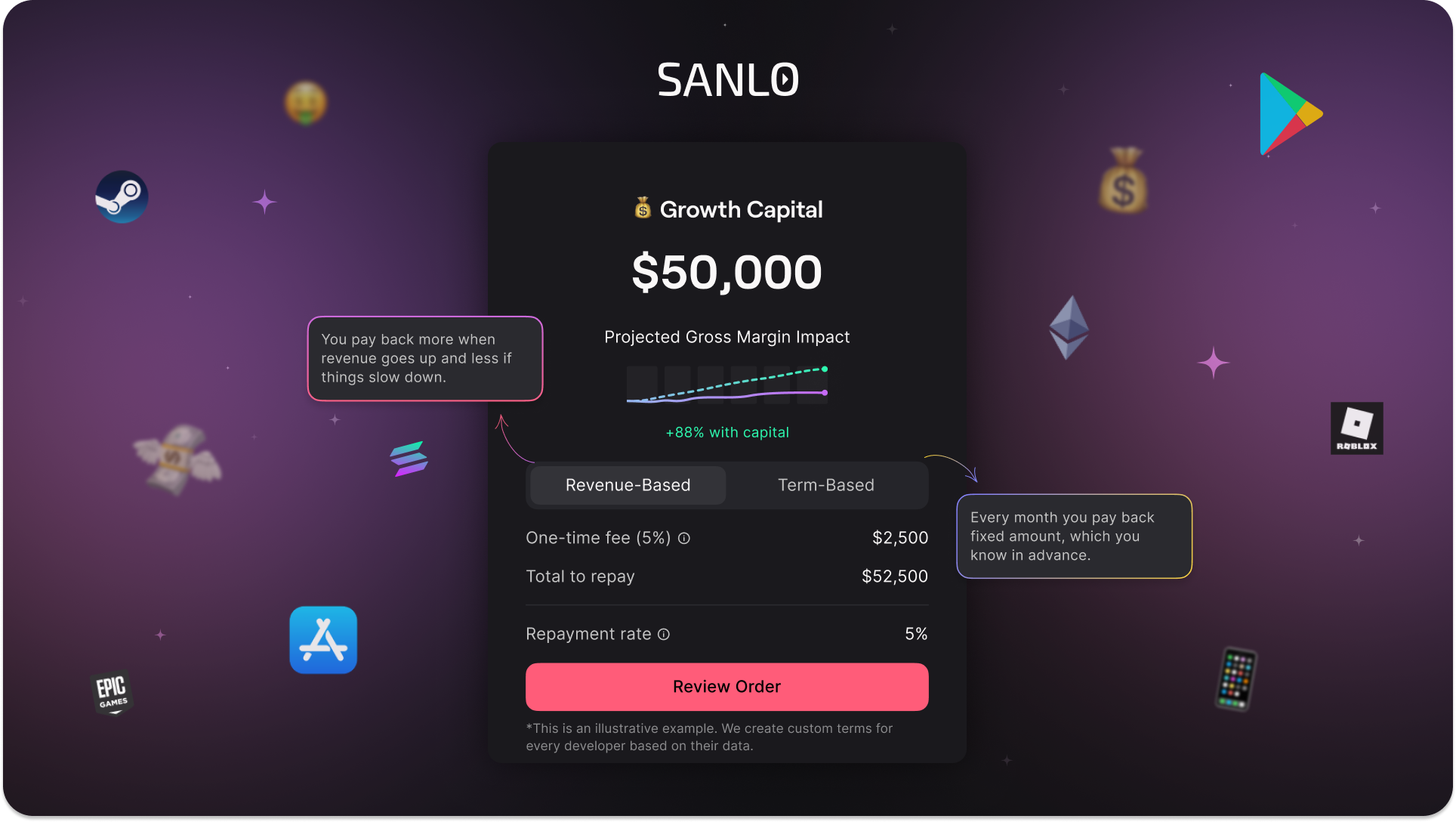
Sanlo, a startup that offers app and game developers access to financial tools and capital, raises $10M

Sanlo, a San Francisco-based fintech startup that offers small to medium-sized game and app companies access to tools to manage their finances and capital to fuel their growth, has raised $10 million in Series A funding led by Konvoy.

The startup was founded in 2020 by CEO Olya Caliujnaia and CTO William Liu, who both have backgrounds in fintech and gaming. Sanlo offers businesses access to technology, tools and insights that aim to help them achieve scalable growth. When Sanlo determines that the business could benefit from the deployment of capital, the startup assists by offering financing. Sanlo notes that it’s not a VC fund that takes equity in exchange for funding or a lender that charges compounding interest. The amount of financing provided varies, but it’s non-dilutive capital, which means that Sanlo takes no ownership stake in the companies it finances.

Caliujnaia told TechCrunch in an interview that one of the ways that Sanlo differs from other fintech companies is its focus on gaming and app developers. She noted that although there are other companies that are focusing on other verticals in ecommerce or SAAS, Sanlo is focused on gaming and consumer apps.

“We’re a technology company, not a fund,” Caliujnaia said. “That allows us to move quickly and be transparent about how we work and how we arrive at the products that we build and offer to customers. We’re also building a full stack of products, it’s not just about growth capital. Developers have other options via publishers, VCs and banks, but those usually involve complex and lengthy processes.”

To get started, Sanlo asks companies for certain types of data, including product data about how well the app or game monetizes. Sanlo also gets information about customer acquisition and retention, as well as marketing data and a subset of financial data. Its predictive algorithms then continually monitor the company’s growth trajectory to surface insights to identify where and how the business can grow. Sanlo then provide companies with access to capital.

sanlo

Image Credits: Sanlo

As for the new funding, Caliujnaia said Sanlo will use the money to create more products for developers and to bring on more people to grow its 15-person team.

“The plan is to build out more products and to build out the team,” Caliujnaia said. “We’re looking for passionate people to help us build better and faster. We’re working with people primary in North America at this point, but we’re open to talented people in other places around the world.”

The funding round included participation from existing investors, including Initial Capital, Portag3 Ventures, XYZ Venture Capital, London Venture Partners and Index Ventures. The funding round also included participation from new investors, including Fin Capital, GFR Fund and a number of angel investors. Sanlo’s Series A funding comes a year after it announced $3.5 million in seed funding co-led by Index Ventures and Initial Capital.

As part of the funding announcement, Sanlo also revealed that it has partnered with HCGFunds to expand its pool of capital to $200 million to provide funding to the developers it works with.

Sanlo has spent the past 12 months onboarding select developers and is current working with dozens of companies. Caliujnaia said the company carefully selects businesses to work with and regularly checks in with them to allow for close collaboration. In one instance, Sanlo says it helped a large game publisher that was looking to consolidate and gain visibility into cash flows from multiple platforms. The company has also helped a subscription consumer app developer that wanted additional financial bandwidth to bring economy designers on board to tighten monetization. In another case, Sanlo helped another game developer that was looking for predictable non-dilutive capital to finance the development of their expanding portfolio of games.


Indonesian hyperlocal social commerce app Super gets $70M led by NEA

Super, the Indonesian social commerce startup focused on small towns and rural areas, announced today it has raised an oversubscribed $70 million Series C. The round was led by NEA with participation from Insignia Ventures Partners, SoftBank Ventures Asia, DST Global Partners, Amasia, B Capital, TNB Aura, Bain Capital chairman Stephen Pagliuca, Goldhouse, and Xendit CEO Moses Lo.

This brings Super’s total raised so far to $106 million since it was founded in 2018. TechCrunch last covered the startup at the time of its $28 million Series B in April 2021.

Steven Wongsoredjo, the co-founder and CEO of Super, says that Indonesia’s Tier 2, Tier 3 and rural area’s gross domestic product is three to five times lower than Jakarta, yet the cost of consumer goods there is higher by 20% to 200% thanks to supply chain issues. Not only that, but more than 30% of Indonesia’s GDP comes from East Java, Kalimantan and East Indonesia, making those places a valuable source of potential revenue for fast-moving consumer goods. By streamlining the supply chain and giving FMCG brands an easier way to reach consumers in rural areas, Super is also able to lower the costs of goods.

The startup plans to use its funding to expand into Kalimantan, Bali, West Nusa Tenggara, East Nusa Tenggara, Maluka and Papua over the next few years.

Super currently works with third-party logistics providers to create a hyperlocal logistics platform that it says can deliver consumer goods to thousands of agents within 24 hours of an order. The company’s agents, or resellers, can either be individuals or local shops called warungs.

Super says it currently has thousands of community agents, and aggregates and distributes millions of U.S. dollars worth of goods to communities each month. It now operates in 30 cities in East Java and South Sulawesi, primarily targeting areas that have a GDP per capital of $5,000 USD or lower.

Part of the funding will also be used to apply machine learning to the SKU’s in Super’s warehouse, to help the startup understand what sells best and where, so it can better determine the kind of inventory it holds. It is launching two private-label brands, including in cosmetics, and will create an app feature for agents that will let them track end-consumer transactions.


Wednesday, June 1, 2022

Poparazzi hits 5M+ downloads a year after launch, confirms its $15M Series A

Poparazzi, the anti-Instagram social app that hit the top of the App Store last year, is today, for the first time, detailing the growth stats for its business, its future plans and its previously unconfirmed Benchmark-led Series A round. The L.A.-area startup now reports its iOS-only has seen over 5 million installs in its first year, with users primarily in the Gen Z demographic.

The startup says that 75% of its users are between the ages of 14 and 18 and 95% of users are between 14 and 21. Most of its users are U.S. based, and to date, they’ve shared over 100 million photos and videos on the app.

While the startup positioned itself as an Instagram alternative where friends create your profile, the app’s competition today is not really the established tech giants. Instead, it’s the newer set of “alternative” social media apps that are targeting a younger crowd, like Yubo, Locket, LiveIn, HalloApp, BeReal and others. In general, this group of apps shares a thesis around how big tech is no longer the best place to connect with your real-life friends. With differentiated angles, they all claim to offer that opportunity.

Some of these are already outpacing Poparazzi. Yubo says it’s seen 60 million sign-ups to date. BeReal, which has declined press, has an estimated 12.3 million global downloads, according to app intelligence firm Sensor Tower. The firm also reports that Locket has seen about 18.7 million worldwide installs to date, while LiveIn has hit a little more than 8 million installs. (Sensor Tower also sees 4.6 million downloads for Poparazzi, which is largely in line with the startup’s claims, as these estimates aren’t an exact science.)

This heated competition among alternative social apps could explain why Poparazzi is taking to its blog today to share its metrics and confirm its financing after a year of silence. (Or it could be that it’s hiring.)

Image Credits: Poparazzi

Though Poparazzi appears to be an overnight viral sensation, it’s actually taken 3 years to get to this point, explains co-founder and CEO Alex Ma. He, along with his brother, co-founder Austen Ma, went through several pivots to get to Poparazzi, he told TechCrunch.

“Poparazzi was maybe the 11th or 12th app that we built,” Alex says. Among those was the audio social network TTYL, a sort of “Clubhouse for friends.” But, says Alex, 9 months into TTYL the team realized that things weren’t working and they made the decision to wind it down.

The co-founders understood that most social apps fail and had decided the best thing to do was to keep building and experimenting until one hit. At other points, they tested a live texting app called Typo and many other social experiences. But when they built Poparazzi, they knew from day one it was something special. The app blew up, primarily among high schoolers, who were testing the app via TestFlight.

The app’s idea was, effectively, to turn one of Instagram’s core features — photo tagging — into a stand-alone experience. But in its case, photo tagging wasn’t an afterthought; it was the full focus.

Image Credits: Poparazzi

On Poparazzi, users can create social profiles for photo-sharing purposes, but only your friends are allowed to post photos to them. That makes your friends your own “paparazzi,” of sorts — which is how the app got its name.

“It started off almost like a novel, dumb idea — like, what if you could build Instagram but didn’t let people post photos of themselves?” Alex says. “But the more we thought about it, the more we realized we were actually fundamentally changing the engine of what drives social today. And that was the big bet.”

To its credit, Poparazzi perfectly executed a series of growth hacks to generate buzz for its app that drove downloads at launch. The app launched on May 24, 2021, and quickly shot to the No. 1 position on the App Store.

Like many apps now, it smartly leveraged the TikTok hype cycle to drive App Store preorders. This helped to ensure the app would hit the Top Charts as soon as it became publicly available, given how the App Store ranks apps based on a combination of downloads and velocity, among other factors. Poparazzi also implemented a clever onboarding screen that used haptics to buzz and vibrate your phone as its intro video played — something that helped generate word-of-mouth growth as users took to Twitter to post about the unique experience.

But the app also bypassed some best practices around user privacy by requesting full access to users’ address books to get started. This allowed it to instantly match users to their friends based on stored phone numbers and quickly build a social graph.

However, it overlooked the fact that many people, particularly women, store the phone numbers of abusers, stalkers and exes in their phone’s contacts, so they can use the phone’s built-in tools to block the person’s calls and texts. Because Poparazzi automatically matched people by phone number, abusers could gain immediate access to the user profiles of the people they were trying to harass or hurt.

Alex says Poparazzi has since taken steps to address this, but explains the thinking around the original decision.

“It’s really hard to compete with Facebook, Snapchat and Instagram for the social graph,” he says. “So the starting point for building a social app typically is the address book because that’s the place where we can get information.” Plus, he adds, “I think the value of the app is close to zero without that initial friend graph.”

Image Credits: Poparazzi

The app also rolled out other new features over the past year, including the ability to block and report users, and it’s invested in machine learning–powered content moderation for detecting things like nudity or hate speech. It’s added the ability to upload from the camera roll; provided support for video, messaging, comments and captions; and introduced in-app challenges that encourage participation — like “pop a friend eating ice cream,” “pop a friend at a mall,” or “pop a road trip.”

It’s now working to allow users to set their profiles to private and is planning an Android version. Longer term, it may monetize via events or merchandise, not ads — but this is still largely to be determined.

Prior to today’s update, the broad strokes of Poparazzi’s A round were already known.

In May 2021, Newcomer scooped the news that Benchmark partner Sarah Tavel had led Poparazzi’s “approximately $20 million” Series A, beating out Andreessen Horowitz for the deal. Alex says the round was actually a $15 million Series A, and confirmed Tavel joined its board.

This is on top of the company’s $2 million seed round closed in late 2018, before Poparazzi was developed. That round was led by Floodgate and included other investors like SV Angel, Shrug Capital and various angels. (Disclosure: unbeknownst to us until now, former TechCrunch co-editor Alexia Bonatsos was among them.) Floodgate’s Ann Miura-Ko joined the board with that fundraiser.

The funding gives Poparazzi, now a team of 15, a runway of over 2 years, Alex says.

And although some of the competition may be ahead of it for now, the startup believes in its potential largely because its premise is unique. Unlike every other social app on the market, it’s not for performative social media.

“We’re very different in the sense that it’s not about yourself,” Alex points out. “We’re putting the attention on the people you’re physically with, and the people that are in your life, rather than on yourself.”


SureImpact wins the TC City Spotlight Columbus: Pitch-Off

I’m excited to announce SureImpact won today’s City Spotlight: Columbus pitch-off! Winning a free exhibition space and a spot in TechCrunch Startup Battlefield 200, the Ohio-based company pitched alongside Skuld and Healia Health on TechCrunch Live earlier today.

Founder and CEO Sheri Chaney Jones, pitched to two fantastic judges – Anna Mason (Managing Partner, Rise of the Rest Seed Fund at Revolution) and Parul Singh (General Partner, Initialized Capital).

In four-minutes, Sheri explained how SureImpact modernizes the social service and social impact sectors. With a case-management based integrated platform, SureImpact SaaS platform allows both the organization and its funders to clearly understand key impact metrics and ROI – real time and with less demand on the non-profit.

Historically, organizations relied on top level impact metrics to share with those that contribute into the organization. With the increasing demand in real-time social impact data, non-profits are required to elevate their tracking and reporting capacities. SureImpact solves the technology gap with automated data collection and impact evaluation capacity, that connects all players in the social impact ecosystem.

Sheri says, non-profits no longer need to “waste time manipulating reports for their funders, and wasting funders time by having to wade through grant narratives and aggregated data to understand their collective impact.”

The company says it developed the product with 10 paid beta customers, paying $15,000 annually. After launching in February 2020, the company touts a whopping 220 organizations on its platform, across 50 US markets. SureImpact has raised approximately $1.6 million in funding from a variety of angels and VCs.

An expert in her own right, Sheri has over 20 years of experience in the non-profit sector, as a serial social impact founder and working directly with mission driven organizations.

Special thanks to the wonderful judges and the founders who took the stage with fire and pitch mastery.


Daily Crunch: Buick unveils Wildcat concept car as company shifts to EV-only lineup

To get a roundup of TechCrunch’s biggest and most important stories delivered to your inbox every day at 3 p.m. PDT, subscribe here.

Extra, extra, read all about it — Sheryl Sandberg surprised us this afternoon and said she was stepping down as Meta COO. We’re still figuring out the details, so stay tuned for more. And oh Hai! Or rather, Ohio — more specifically, Columbus, Ohio. Today, we’re doing our City Spotlight, and we’ve been exploring who’s building in Columbus, and how it became the tech hub of the Midwest. We also dove into why Intel chose the city to build its $20 billion manufacturing facilities. — Haje and Christine

The TechCrunch Top 3

  • Buick going full EV: If you are into electric vehicles, you will love today’s Daily Crunch. First up is Buick, which is full of surprises today — not only did the company say it is transitioning to electric vehicles only, but after a few years of focusing on SUVs, Buick is going back to its coupe and sedan roots. The Wildcat looks like a sweet ride. If it wasn’t already evident, the U.S. is getting more serious about EVs, per Tim. Speaking of a sweet ride, the 1980s are indeed back in style. Jaclyn also wrote about the new DeLorean, which is being reimagined as an electric vehicle. Sorry, no flux capacitor on this one, but thankfully you won’t need the plutonium or the 1.21 gigawatts.
  • Tiger gets its claws into Slice: Getting a bank account can be easy; getting credit, not so much. Slice is an Indian fintech company working to change that and is now buoyed by a new Tiger Global–led $50 million round that Manish reports has the company in unicorn territory. Slice is bringing credit to the masses in that country by bringing technology to the underwriting process and is issuing hundreds of thousands of cards per month, putting it at the top of its game in the South Asian market.
  • A “Netflix for education”: Spain-based Odilo has a catalog of nearly 4 million educational items and today brought in $64 million to keep hidden. No, really, as Ingrid writes, the “white-labelness” of the company means businesses can build their own customized e-learning offerings, but customers may only see the education portal it’s powering as the front-facing brand, like, ahem, Google, which we talk about a lot today in the Big Tech Inc. section.

Startups and VC

Every time I explain what a SPAC is to someone, they go, “Wait, how is that legal?” It seems like some folks in government agree, Connie reports, with Sen. Elizabeth Warren planning a new bill to tame the wild, wild west a little. The law may be a little late — interest was on the wane already, when the SEC warned in March last year that SPACs weren’t accounting correctly for investor incentives called warrants.

The other thing we want to celebrate is irreverence and joy. Haje needed wafting with palm fronds after getting a little excited about a new photo-forward book about electronics, and Amanda lost her marbles over a couple of new Pokémon, including one called Lechonk.

Other things to get excited about:

Dear Sophie: How do we qualify for each of the O-1A criteria?

lone figure at entrance to maze hedge that has an American flag at the center

Image Credits: Bryce Durbin/TechCrunch

Dear Sophie,

Our startup will be sponsoring my co-founders and me for O-1A visas.

How do we qualify for each of the O-1A criteria?

— Extraordinary Entrepreneur

(TechCrunch+ is our membership program, which helps founders and startup teams get ahead. You can sign up here.)

Big Tech Inc.

We promised above, and now we are delivering all of the delicious Google-ly goodness. Let’s start with some news that will make you smile — Google is expanding its program aimed at providing job readiness and digital skills for formerly incarcerated people. The company will also invest $4 million in reducing barriers for these individuals to become gainfully employed. Next is a report showing that Chrome still edges out Apple’s Safari for users, though Apple should still celebrate reaching 1 billion users. Not to be undone by:

Not much of a surprise with this next report, but it seems the U.K.’s new social media watchdog group Ofcom has found that social media giants are not taking women’s safety seriously. Its study of some 6,000 people found that even though women spend a bit more time than men online, they still don’t feel like they can express their opinions as freely as their male counterparts. In turn, Ofcom is urging social media companies to do something about it, namely make their platforms more welcoming.

Cryptocurrency has not been feeling the love lately, what with the whole TerraUSD thing, among others, and today the sector takes another hit as one of its own is arrested. Formal charges were made against former OpenSea head of product Nate Chastain for ​​“wire fraud and money laundering in connection with a scheme to commit insider trading.” Chastain was fired from his job last year after being accused of “front-running purchases of NFT collections that he knew were about to be featured prominently on the homepage of OpenSea.”

Please enjoy these other morsels:


This is the beginning of the unbundled database era

Thanks to the cloud, the amount of data being generated and stored has exploded in scale and volume.

Every aspect of the enterprise is being instrumented for data, so new operations are built based on that data, pushing every company into becoming a data company.

One of the most profound and maybe non-obvious shifts driving this is the emergence of the cloud database. Services such as Amazon S3, Google BigQuery, Snowflake and Databricks have solved computing on large volumes of data and have made it easy to store data from every available source.

The enterprise wants to store everything they can in the hopes of being able to deliver improved customer experiences and new market capabilities.

It’s a good time to be a database company

Database companies have raised over $8.7 billion over the last 10 years, with almost half of that, $4.1 billion, just in the last 24 months, according to CB Insights.

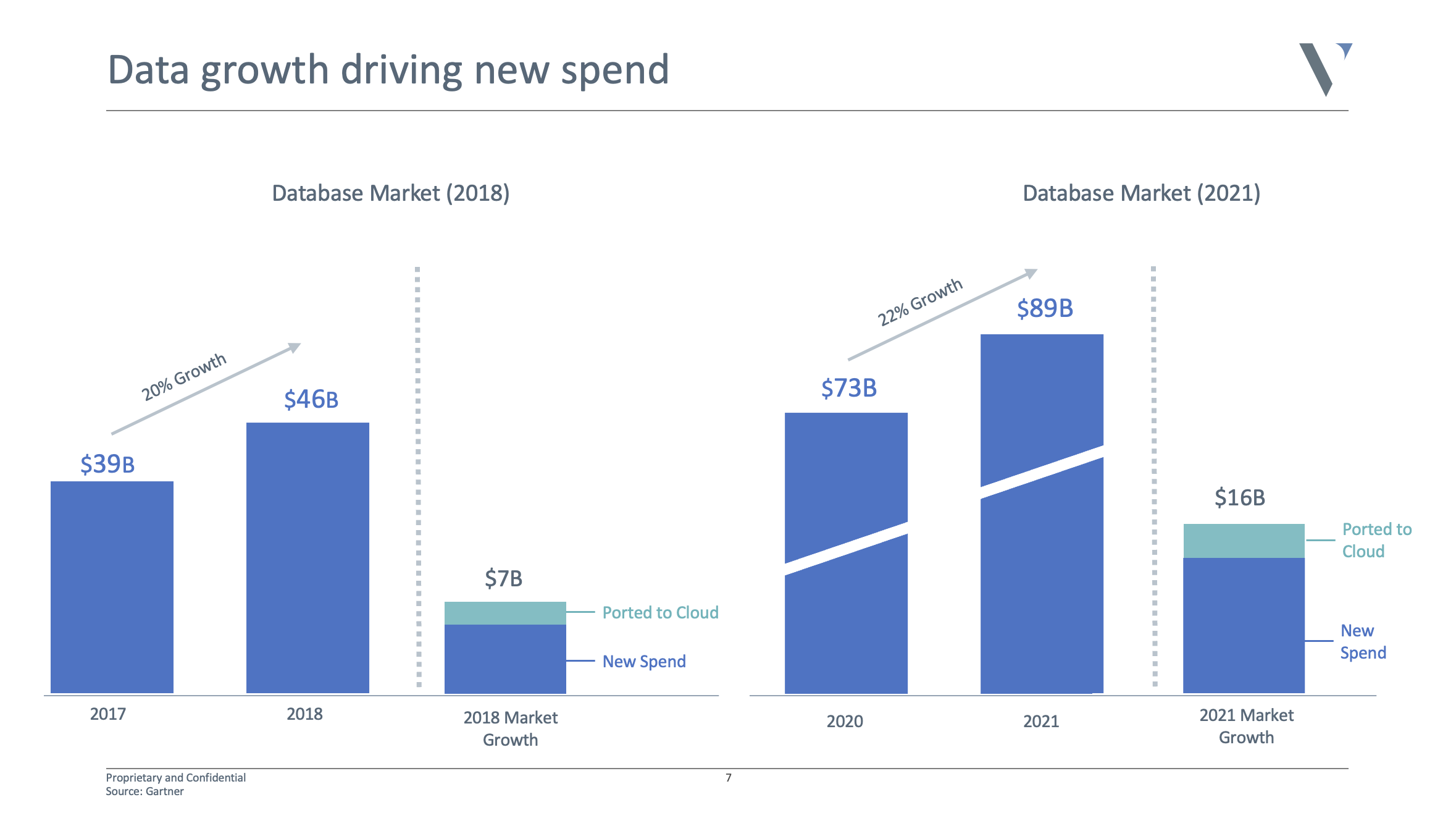
It’s not surprising given the sky-high valuations of Snowflake and Databricks. The market doubled in the last four years to almost $90 billion, and is expected to double again over the next four years. It’s safe to say there is a huge opportunity to go after.

See here for a solid list of database financings in 2021.

Database growth is driving spend in the enterprise

Database growth is driving spend in the enterprise. Image Credits: Venrock

20 years ago, you had one option: A relational database

Today, thanks to the cloud, microservices, distributed applications, global scale, real-time data and deep learning, new database architectures have emerged to solve for new performance requirements.

We now have different systems for fast reads and fast writes. There are also systems specifically to power ad-hoc analytics or for data that is unstructured, semi-structured, transactional, relational, graph or time-series, as well as for data used for cache, search, based on indexes, events and more.

It may come as a surprise, but there are still billions of dollars in Oracle instances still powering critical apps today, and they likely aren’t going anywhere.

Each system comes with different performance needs, including high availability, horizontal scale, distributed consistency, failover protection, partition tolerance and being serverless and fully managed.

As a result, enterprises, on average, store data across seven or more different databases. For example, you may have Snowflake as your data warehouse, Clickhouse for ad-hoc analytics, Timescale for time-series data, Elastic for their search data, S3 for logs, Postgres for transactions, Redis for caching or application data, Cassandra for complex workloads and Dgraph* for relationship data or dynamic schemas.

That’s all assuming you are collocated to a single cloud and you’ve built a modern data stack from scratch.

The level of performance and guarantees from these services and platforms is on a very different level compared with what we had five to 10 years ago. At the same time, the proliferation and fragmentation of the database layer are increasingly creating new challenges.

For example, syncing across different schemas and systems, writing new ETL jobs to bridge workloads across multiple databases, constant cross-talk and connectivity issues, the overhead of managing active-active clustering across so many different systems, or data transfers when new clusters or systems come online. Each of these has different scaling, branching, propagation, sharding and resource requirements.

What’s more, we now have new databases every month that aim to solve the next challenge of enterprise scale.

The new-age database

So the question is, will the future of the database continue to be defined as it is today?


Why more funding equates more peace of mind for TRIPP and its users

LA-born startup TRIPP doesn’t want the metaverse to be a mere “shopping mall for virtual consumers,” its founder Nanea Reeves told TechCrunch.

Instead, Reeves’ company is envisioning a metaverse experience that can “deepen connection to self, facilitate mental well-being and enable personal and collective transformation.”

TRIPP’s vision for a mindful metaverse is already a (virtual) reality: Its wellness-centered experience can be accessed through multiple platforms and devices. This includes AR smartglasses and VR headsets, but also smartphone apps — collectively referred to as XR, or extended reality. Reeves expects mobile, AR and VR to eventually converge, “in the same way as lots of devices came together into our phones.”

If this sounds a bit abstract, look no further than EvolVR, the VR meditation community whose acquisition TRIPP disclosed last February. TRIPP/EvolVR’s group meditations can be experienced live on several platforms, such as Microsoft’s AltspaceVR and Meta’s Horizon Worlds.

TRIPP’s product itself offers a range of experiences, from breathing exercises and binaural audio to guided visualizations and worldscapes, some of which users can customize through TRIPP’s Composer feature.

TRIPP has recently acquired another company, cross-service world-building platform Eden. “The acquisition will enable users to further customize their TRIPP experience, explore artworks and soundscapes while connecting with users from across the globe,” the company said.

Reeves worked in several senior roles in the video gaming industry before founding TRIPP and is focused on creating a full experience that goes beyond watching and listening. She surrounded herself with talent that also shares this vision, including the employee who was originally working on Eden as a side project.

Eden’s acquisition is funded by an $11.2 million Series A extension led by gaming-focused investment firm BITKRAFT, Reeves said. Other participants include Qualcomm, Amazon Alexa Fund, HTC and Pokémon GO maker Niantic, as well as existing investor Mayfield, which has been backing TRIPP for a while. Indeed, the firm had participated in a $4 million capital injection into the startup in 2017, before co-leading its Series A round in mid-2021 alongside Vine Ventures.

The genesis of this round was a LinkedIn message from BITKRAFT, followed by an offer she couldn’t say no to, Reeves said. Talking to TechCrunch, she also emphasized how excited she was about having new investors willing to support TRIPP in broadening its reach across multiple platforms. It didn’t hurt either that they came from gaming, immersive technology and web3, as the company hopes to further engage with creators.

Reeves’ decision to take this extension capital despite still having money left from its last round is also in line with a lot of the advice we have been hearing from investors lately. For instance, Y Combinator told its startups that in the current downturn, extending the runway should be a priority.

TRIPP isn’t in a position where it needs to cut costs, and it is still hiring, but not at the pace it originally planned. “We do want to be cautious with the current unexpected market conditions,” Reeves said. “In the next months,” she predicted, “a lot of companies are going to have a challenging time.” In contrast, she said, TRIPP now has “a lot more cushion” and a strong team to execute on its plan.

TRIPP’s focus on mental well-being in the metaverse is timely. First, because the metaverse shouldn’t be yet another place to get groped and harassed. Second, because things are looking bleak for mental health. According to the World Health Organization, the prevalence of anxiety and depression globally increased by 25% in the first year of COVID-19.

Mental health is the core focus of PsyAssist, which TRIPP acquired in 2021. A standalone offering, it provides clinics and patients with tools “to support the psychological healing journey of patients undergoing psychedelic assisted therapies.”

TRIPP’s main focus is more on the B2C side of things, but this too could have benefits for mental health. Its investors hope so. According to HTC VIVE vice president, Pearly Chen, TRIPP’s platform “represents an important step toward normalizing the broader discussion around technology’s role in mental health.”


SoftBank co-led $66 million round for blockchain-focused InfStones

Despite shaky markets, a steady stream of investors continue writing big checks for blockchain infrastructure providers.

InfStones, which aims to help clients build applications across a number of blockchain platforms, closed a $66 million round led by SoftBank Vision Fund 2 and GGV Capital, the company announced on Wednesday.

Other investors in the raise include INCE Capital, 10T Fund, SNZ Holding and A&T Capital. This funding round follows shortly after its $33 million Series B three months ago and brings its total funding to $111 million. InfStones didn’t disclose an exact valuation, but said it was “near unicorn-status.”

“The funding will help us with product development consistent with our product strategy and road map, move into new markets, expand our team, and advance web3 adoption,” Zhenwu Shi, CEO of InfStones, said in an email to TechCrunch.

In the past, Shi said InfStones aims to be the web3 version of Amazon Web Services in order to make onboarding into the space easier so clients can quickly build applications on different blockchain platforms.

The company was founded in 2018 and has customers ranging from centralized crypto entities like Binance and Circle to decentralized scaling platforms like Polygon. It provides services for institutional clients globally and supports infrastructure for over 50 blockchains, including Ethereum, Polygon, Solana and Chainlink, among others.


5 investors discuss what’s in store for venture debt following SVB’s collapse

There are many questions around the implications of Silicon Valley Bank’s (SVB) collapse that won’t be answered for a long time. But there’s...