Saturday, October 2, 2021

A serial entrepreneur on what makes and breaks a new business

Shirish Nadkarni is one of few serial entrepreneurs who can say he has exited successfully from every startup he has ever launched.

His first company, TeamOn Systems, was an early pioneer of the SaaS model, providing customers with business-grade email and calendaring in the cloud. Although not everyone understood the value of the idea in 1999, and the company later had to pivot to a slightly different product, it went on to be acquired by BlackBerry a few years later.

In 2007, Nadkarni founded Livemocha, the first language learning company to adopt a conversational approach to teaching. Although it was never profitable, Livemocha quickly accrued millions of users and was eventually snapped up by Rosetta Stone.

Finally, there was Zoomingo, a mobile app that helped shoppers identify stores running sales in their local area. At one point, the app managed to climb into the top ten in the Apple App Store (and top 25 on Android), and it too was acquired.

However, Nadkarni suggests his shining report card doesn't necessarily paint a full picture; he made many fundamental mistakes along the way. And while an exit is the goal of almost all entrepreneurs, Nadkarni never enjoyed the luxury of selling on his own terms, precisely when he wanted to.

An education at Microsoft

Nadkarni came to the US in the early 1980s to study computer science, which wasn’t taught widely back home in India. “I was fascinated by computers; what you could do with them, what you could build,” he explained.

After graduating from the University of Michigan, he undertook an MBA at Harvard Business School, with an eye on entrepreneurship. He hoped to learn how to blend technical skill with business know-how, a formula that was being applied to great effect in Silicon Valley.

However, Nadkarni suggests his education only truly began after he landed a job at Microsoft. It was here he gained practical experience and an appreciation for the qualities that separate a brilliant idea from a mediocre one.

“I learned a lot at Microsoft,” he said. “I learned how to build, launch and market great products, and I understood the business models. So I had a really good grounding that I could use to become successful in the startup environment.”

It’s hard to imagine, but Microsoft was itself a startup when Nardkarni first joined, with only roughly 1,000 employees. At the time, the company was looking to branch out into new product areas, beyond hardware, office software and its Windows OS.

Initially, Nadkarni was brought in to help launch the company’s first email product, Microsoft Mail, but he ended up working on a wide range of major projects during his twelve-year tenure.

In 1997, Nadkarni took charge of Microsoft’s first foray into the search market. After some discussion, the company took the decision to partner with a third-party, Inktomi, instead of building its own search engine in-house. Nadkarni says he attempted to convince Bill Gates to invest more resources into search, but Gates “wasn’t ready at that point”. It’s fun to imagine what might have been, had his decision been different.
MSN

(Image credit: Microsoft)

Around the same time, he architected the launch of MSN.com. Microsoft was late to the party and looking to close the gap on the likes of Yahoo! and Excite, but Nadkarni had a trick up his sleeve: the $500 million Hotmail acquisition, Microsoft’s largest purchase at the time.

The rationale was that Hotmail, the first service to allow users to access their inbox via web browser, would give people a reason to return to MSN time and again. “We wanted to create a sticky solution that would keep users coming back. And email is a very sticky application; people check their email multiple times a day,” he explained.

Eventually, MSN grew to become one of the world’s largest web portals, and so it remains today. But it wasn’t just the strategic value of Hotmail that got Nadkarni excited - he had fallen in love with the product too.

“I thought Hotmail was a brilliant idea; providing web-based email for consumers. So I thought, why not offer enterprise-grade email in the cloud?”

At the height of the dotcom boom, Nadkarni waved a fond farewell to Microsoft to start a business of his own: TeamOn Systems.

Misconceptions and mistakes

Although Nadkarni has now retired from entrepreneurship, he is kept busy by a new pursuit: writing. His first book, called From Startup to Exit, aims to provide a complete resource for first-time founders.

Many startup manuals focus on one specific aspect, Nadkarni says, but very few unpack each step of the entrepreneurial journey. One of the first barriers, of course, is deciding to start a business in the first place.

“There are many misconceptions about what makes an entrepreneur; you don’t need to have started a business by the age of 15, or be a visionary leader like Bill Gates or Elon Musk,” Nadkarni said.

He concedes that leadership skills are important, but says there are other equally indispensable attributes: a knack for product, sales ability and doggedness in the face of adversity.

“In some respects, entrepreneurs are all cut from the same cloth, because they share a common pool of traits. But you can be quiet and successful, so long as you compensate in these other areas.”

Asked about the most common mistakes new founders make, Nadkarni told us that many people approach business from the wrong direction, by creating a product before they have a problem to solve with it.

Bill Gates

Bill Gates, under whom Nadkarni worked at Microsoft (Image credit: Shutterstock / Paolo Bona)

“Often, technologists will build a solution and find out whether there are customers only later. But the most exciting businesses today - the likes of UiPath, Apptio etc. - are all built around specific problems identified by their founders,” he explained.

This is a mistake Nadkarni admits to making himself. He says he was convinced a cloud-based email system would prove immensely popular with businesses, but he failed to do the necessary market research. “I was the typical arrogant technologist.”

This backwards approach to product design also has a tendency to create further problems down the line, especially when it comes to fundraising. It’s all well and good to present venture capital firms with an attractive piece of technology and to spin a compelling story, but without evidence of traction they are unlikely to invest.

Nadkarni thinks that many startups attempt to raise capital too soon. Launching a new business has a lot to do with timing, he says, and the same can be said for knowing when to leave one behind.

To sell, or not to sell

When Nadkarni speaks about the sale of TeamOn Systems and Livemocha, two landmark achievements in his entrepreneurial career, it’s with a surprising hint of wistfulness.

Many business veterans have written about the difficulty of knowing when to sell but, in practice, plenty of founders discover the decision is effectively made for them. Such was the case for Nadkarni, who found he was always at the mercy of circumstance.

In the case of TeamOn Systems, the dotcom bubble had burst and the company had to make a choice between accepting an unfavorable offer of funding or selling to BlackBerry.

A few years later, the sale of Livemocha was made necessary by the financial crash. Although the company had built up a large user base, it was not yet turning a profit, which made raising funds in the new climate all but impossible.

Over the last eighteen months, meanwhile, many other founders will have found themselves in equally difficult positions, courtesy of the latest black swan event: the pandemic. And plenty of them will have had no decision but to shutter their businesses entirely.

The silver lining, Nadkarni suggests, is that from the ashes of an event like the pandemic a new wave of innovation almost always rises up. Specifically, he anticipates a surge in the adoption of automation and other AI-powered technologies, a permanent shift away from full-time office work and the continued rise of direct-to-consumer ecommerce models.

Right now, Nadkarni spends the majority of his time helping other people kick start new businesses. Asked whether he might start another business himself one day - perhaps to capitalize on these new trends - he chuckled and shook his head. “But I’m certainly working on another book.”


Friday, October 1, 2021

Watch out - that Android security update may be malware

The creators of FluBot have launched a new campaign that uses fake Android security update warnings to trick potential victims into installing the malware on their devices.

In a new blog post, New Zealand's computer emergency response team Cert NZ has warned users that the message on the malware's new installation page is actually a lure designed to instill a sense of urgency that tricks users into installing FluBot on their own devices.

The new FluBot installation page, that users are led to after receiving fake messages about pending or missed package deliveries or even stolen photos uploaded online, informs them that their devices are infected with FluBot which is a form of Android spyware used to steal financial login and password data from their devices. However, by installing a new security update, they can remove FluBot from their Android smartphone.

The page also goes a step further by instructing users to enable the installation of apps from unknown sources on their device. By doing so, the cybercriminals' fake security update can be installed on their device and while a user may think they've taken action to protect against FluBot, they've actually installed the malware on their smartphone themselves.

Changing tactics

Until recently, FluBot was spread to Android smartphones through spam text messages using contacts stolen from devices that were already infected with the malware. These messages would instruct potential victims to install apps on their devices in the form of APKs that were delivered by attacker-controlled servers.

Once FluBot has been installed on a user's device, the malware often tries to trick victims into giving it additional permissions as well as granting access to the Android Accessibility service that allows it to run in the background and execute other malicious tasks.

FluBot is capable of stealing a user's payment and banking information by using overlay attacks where an overlay is placed on top of legitimate banking, payment and cryptocurrency apps. As mentioned before, the malware will also steal a user's contacts to send them phishing messages to help spread FluBot even further.

While FluBot was mainly used to target users in Spain at its onset, its operators have since expanded the campaign to target additional countries in Europe including Germany, Poland, Hungary, UK and Switzerland as well as Australia and Japan in recent months.

Via BleepingComputer


Meet the world’s first sub-$100 1TB portable SSD: here's what it means to you

Specialist Japanese data storage company, Buffalo Technology, is probably the last SSD vendor we’d expect to release the first external SSD with a 1TB capacity costing less than $100. 

And yet, the outfit, better known for its expensive high end Terastation NAS devices, has lined up the SSD-PG1.0U3B.  

How much does it cost?

Its marquee price of $99.99 is valid only on Amazon.com for US customers.

However, Amazon sells it at a premium to pretty much anyone worldwide who has an Amazon.com and that includes both UK and Australian customers for a far less enticing price of $163.49 (or local currency equivalent). 

The price includes delivery (and courier fees) but not local taxes, which in the UK will add another 20% to the price.

What do you get for your money?

The drive is pitched as the perfect complement to the Sony PS4 and Sony PS5 gaming consoles. The box contains a USB Cable (Type-A), a USB Type A-to-C adapter, a quick setup guide with a warranty statement  and a game console guide.

Speaking of warranty, it comes with a two year warranty that can be extended to three years once you register with Buffalo. We’re unsure why this is setup this way other than to collect the user’s information.

The drive itself is fairly compact at 11.7 x 7.5 x 1.3cm and weighs just over 90g. It appears to be made of hard plastic and claims to come with a shock-resistant, rugged design with improved drop protection. Buffalo has essentially converted an internal SSD into an external one. Clever! The use of shock absorbing material explains why it has passed the stringent U.S. MIL-STD 810G 516.6 procedure IV test, allowing it to withstand drops from four feet high.

It is not waterproof though, so no IP67 or IP68 rating. It contains no bundled software (no cloud storage, file sync, no antivirus or Adobe Creative cloud trials). The SSD-PG1.0U3B is exFAT formatted so can be used with Windows out of the box. 

Just bear in mind that it uses a flat USB connector rather than a more recent USB Type-C connector and there’s a good reason for that.

What’s the catch?

There is a fairly big catch and that’s the fact that it is a relatively slow external SSD drive with top read speeds of 340MBps, which is far less than what rivals can reach (more on that later). 

Write speeds are likely to be even lower than that. By itself, that is not bad (and significantly faster than even the fastest external hard drive). 

Just make sure that your expectations are, well, adjusted. One minor aspect is that its formatted capacity is around 930MB, rather less than the headline 1024 (or 1000) GB. Still, the $100 per TB barrier has been shattered and that’s what counts.

How does it compare to the competition?

Well, there is plenty of competition between the $100 and $110 price range and most of them are objectively better than Buffalo’s 1TB external SSD. 

Inland, the own-brand from popular US retailer Microcenter, is the next cheapest at $101.99; it has a smaller form factor and is about 60% faster. Pioneer is next at $103.99 (for a marginally smaller 960GB drive and Silicon Power, at $104.99, completes this trio of affordable alternatives. The PNY Pro Elite is our preferred low cost top dog though with a tiny footprint and almost three times the performance of its Buffalo rival.

If you want to go even further down the per TB price point, then large capacity external SSDs are the way forward. Netac is the current price champion with a barely believable $91 per TB. 

What comes next?

While other core components (processors, GPUs and memory) have seen their prices go up (and up) because of the ongoing chip shortage, SSDs are one of the few that have seen a downward trend, one that we believe will continue, especially as Black Friday, Cyber Monday and the holidays approach. 

We wouldn’t be surprised to see price parity between low capacity internal SSD and hard disk drives

Analyst firm Trendforce reported in September 2021 that “shipments have been below expectations for consumer electronics such as smartphones, Chromebooks, and TVs during this second half of the year. At the same time, demand remains sluggish for retail storage products including memory cards and USB drives” before adding that “contract prices of client SSDs will drop by 3-8% quarter-over-quarter”.


Office 2021 release date and features revealed - here's all you need to know

If you prefer paying for your office software the old fashion way where you pay once for a lifetime license, you're in luck as Microsoft has revealed new details about Office 2021.

Unlike Microsoft 365 which uses a software-as-as-service (SaaS) business model where users pay annually for the right to use Word, Excel, PowerPoint, OneNote and Outlook, Office 2021 is the next standalone version of the software giant's office suite.

It's been three years since Microsoft released Office 2019 and for a bit, it looked as if the company wouldn't be releasing another standalone version of Office. Now though, the software giant has released brand new details on Office 2021 including its price, updated features and more.

Office 2021

Office 2021 will be available worldwide on Tuesday, October 5 which is a date that Windows users likely already have marked in their calendars because it's also the release date for Windows 11. While Windows 11 will be available as a free update for Windows 10 users, those looking to test out the new features in Office 2021 will have to pay for the privilege to do so.

Office Home and Student 2021 will cost $149.99 and includes Word, Excel, PowerPoint, OneNote and Microsoft Teams for PC and Mac while Office Home and Business 2021 will cost $249.99 and will include everything in the Home version, Outlook for PC and Mac and the rights to use all of Microsoft's office software for business purposes.

Although Office 2021 won't use a subscription model for its pricing, the latest standalone version of Office will also be getting many of the collaboration features available in Microsoft 365 including real-time co-authoring, OneDrive support and Microsoft Teams integration. The new software has been designed to fit in with the rest of the apps available on Windows 11 and as such, it will have a refreshed ribbon interface, rounded corners and a neutral color palette.

Interested users can check out this support document from Microsoft which details all of the new features in Office 2021 and even includes a few videos so you can see the next standalone version of Office in action.

  • We've also rounded up all the gear you'll need to work from home successfully

Via The Verge


FCC unveils its methods to stop SIM swapping scams and robocalls

The Federal Communications Commission (FCC) has laid out its plans to stop both SIM swapping attacks and robocalls in an effort to protect US smartphone users from fraud and identity theft.

For those unfamiliar, SIM swapping is a technique used by an attacker in which they convince a mobile carrier to transfer a victim's phone number from their SIM card to one they own and control. Once in control of a victim's number, the attacker can receive two factor authentication (2FA) messages to take over their online accounts.

The FCC's Notice of Proposed Rulemaking puts forward a number of ways to address SIM swapping  such as amending the Customer Proprietary Network Information (CPNI) and Local Number Portability rules so that mobile carriers would have to authenticate that a customer really is who they say the are before redirecting their phone number to a new SIM card or device. At the same time, the notice proposes requiring mobile carriers to immediately notify customers whenever a SIM change or port request is made on their accounts.

In addition to SIM swapping, these new changes will also address port-out fraud which occurs when an attacker poses as a victim and opens an account with another carrier in their name. They then arrange for the victim's phone number to be transferred or “ported out” to the account with the new mobile carrier which they control.

Robocall Mitigation Database

In order to combat robocalls, the FCC set a deadline for June, 20 of this year for large mobile carriers to implement the STIR/SHAKEN protocols while smaller mobile carriers have been given an extension to do so until June of 2023. As part of these efforts, mobile carriers were required to certify that they have implemented STIR/SHAKEN though they also had to submit a detailed robocall mitigation plan with the FCC. 

Beginning today though, if a mobile carrier's certification and other required information is not in the FCC's Robocall Mitigation Database, other mobile carriers and intermediate providers will be prohibited from directly accepting that providers traffic. This means that if a mobile carrier hasn't submitted the necessary paperwork, other carriers won't be able to send calls from its network to their customers.

The deadline seems to be working though as 4,798 companies have filed in the Robocall Mitigation Database and all of the largest mobile carriers in the US have certified their implementation of the SHIR/SHAKEN protocols.

Acting FCC Chair Jessica Rosenworcel provided further details on how the government agency is fighting robocalls in a press release, saying:

“The FCC is using every tool we can to combat malicious robocalls and spoofing – from substantial fines on bad actors to policy changes to technical innovations like STIR/SHAKEN. Today’s deadline establishes a very powerful tool for blocking unlawful robocalls. We will continue to do everything in our power to protect consumers against scammers who flood our homes and businesses with spoofed robocalls.”


How JBL built the PRX ONE for professional audiophiles

A DJ is only as good as their gear. An entertainment venue is nothing without a decent sound system. And even the most insightful keynote is meaningless if nobody can hear it. 

Whether you're a corporate presenter, an entertainer, a musician, or a venue manager, audio tech is foundational to your profession. 

Whatever sound system you use has to be powerful enough to reach your full audience without sacrificing clarity or quality. It must be compatible with a wide variety of other AV equipment, with a setup process that doesn't involve several hours of troubleshooting. And lastly, it must provide you with granular control over acoustics and volume levels. 

Finding a speaker that provides all of this without breaking the bank tends to be extremely challenging. But thanks to audio maker JBL, it just got a great deal easier. The recently-released JBL PRX ONE Column PA not only offers crystal-clear, high-impact sound, it does so with a lightweight, stylish form factor perfect for everything from gig work to permanent installation. 

Weighing in at just above 55 pounds and standing a little over two feet tall, the PRX ONE has some impressive tech under the hood. It sports a column array consisting of 12 2.5-inch, high-frequency drivers with copper-capped poles to minimize distortion. This array outputs an impressive 130 dB of full-bandwidth sound, delivered across a consistent area thanks to JBL's proprietary AIM array shading technology, while one-touch ducking keeps speech comprehensible.  

The PRX ONE also includes a 12-inch bass-reflex woofer, extending its low-end response to 35 Hz. JBL also hasn't skimped on channel count, with an integrated dual-mode, 7-channel digital mixer that provides full control over both input faders and individual channels. This mixer is further augmented with four high-efficiency, low-noise microphone preamps and two channels of +48v phantom power.  

The PRX ONE's Class D amplifier is equally impressive.  With a peak of 2,000 watts, the fully-bridged unit is designed with both high-linearity inductors and power factor correction. This allows it to provide superior headroom, low THD, and voltage spike protection. 

Guitarist plays show at cafe next to PRX ONE

(Image credit: Harman)

JBL has also built DriveRack technology directly into the PRX ONE, providing unrivaled dynamic control over your sound. More importantly, it does so without requiring you to haul around a cumbersome rack of gear. All you need is the speaker. 

Factor in sophisticated crossover management and triple-tier DSP control, and the PRX ONE is every audio engineer's dream. That's not the best part, either. Given its advanced functionality, it would be easy to justify a steep learning curve. 

The PRX ONE doesn't suffer from that shortcoming, however. 

The unit can be set up in a matter of minutes, and enables seamless speaker expansion and recording via XLR Pass Thru. The speaker’s Lexicon Effects Engine makes it easy to add effects such as reverb, delay, and sub synth. And with eight user presets for each function, it also supports effortless instant sound optimization. 

JBL Pro Connect App

(Image credit: Harman)

All this functionality is accessible through either the PRX ONE's full-color LCD screen or the JBL Pro Connect companion app, which is capable of managing up to 10 units via Bluetooth 5.0. Available for Android and iOS smartphones and tablets,  the app is essentially a professional soundboard directly in the palm of your hand. 

With personalized workflows, the ability to control groups of speakers and devices, and app-exclusive features such as snapshots and tap tempo, Pro Connect lets you shape your sound with surgical precision and elevate your stage to entirely new heights. 

There was a time when working with audio tech meant having to cart around a full van of gear. With the PRX ONE, JBL has proved beyond any shadow of a doubt that those days are behind us. Whether you're a DJ looking for some new gear, a sound engineer prepping for an important keynote, or a venue manager replacing outdated audio tech, this speaker is the answer. 


7 takeaways from Rivian’s IPO filing

Rivian, the electric automaker backed by Amazon, Ford and a cornucopia of heavy-hitting institutional investors like T. Rowe Price Associates and Coatue, finally made its once-confidential IPO filing public. 

The company, which started in 2009 as Mainstream Motors before adopting the Rivian name two years later, has exploded in terms of people, backers and partners in the past few years. Rivian operated in secret for years before it revealed prototypes of its all-electric R1T truck and R1S SUV at the LA Auto Show in late 2018. Since then, Rivian has raised about $11 billion ($10.5 billion of which was raised since 2019); expanded its Normal, Illinois, factory; hired thousands of employees; landed Amazon as a commercial customer; and, most recently, filed confidentially for an IPO. 

Now, its S-1 is revealing more details about the company and its operations. According to its IPO filing, Rivian is officially based in Southern California, a detail that, believe or not, wasn’t so clear a few months ago. The company’s headquarters previously were listed as Plymouth, Michigan. 

As of June 30, 2021, Rivian had 6,274 employees across the United States, Canada, and Europe, according to its filing. The company has told TechCrunch more recently that it employs more than 8,000 people, an indication that its growth is accelerating. In addition to the Illinois factory and Plymouth office, Rivian has facilities in Palo Alto and Irvine, California as well as Arizona, Vancouver, Canada, the Netherlands and the U.K.

Media reports indicate that the company could pursue a valuation as high as $80 billion in its debut.

Certainly, there are a host of backers hopeful that that number – bandied about today as pre-IPO pricing numbers often are in companies that attract significant media attention – becomes reality. The TechCrunch crew has executed an initial dive through the company’s IPO filing, looking for intricacies, gems, and possible headaches now that we’ve digested the news itself.

So, let’s talk just how expensive it is to build an EV company, why market size estimates are bullshit, what sort of voting structure Rivian intends to sport post-debut, how Amazon is a blessing and a sticking-point for the company, why services matter, and where Tesla crops up.

Sound good? Let’s have some fun.

It’s expensive to build an actual EV company, despite what SPACs will tell you

Folks love to say that it’s cheaper and easier than ever to found, and build a startup. They are talking about pure-play software companies. It’s still incredibly difficult and expensive to build an EV company.

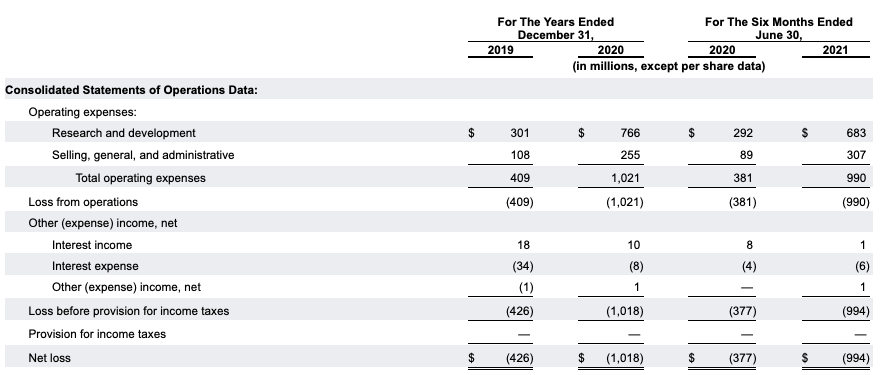
Evidence of that fact can initially be spotted in the sheer scale of capital that Rivian raised while private, just to get to the point when it has started to manufacture vehicles. But the company’s income statements shared in its S-1 filing are even more illustrative of the point.

Here are the company’s operating results for 2019, 2020, and the first two quarters of both this year and the last:

No, we didn’t make a mistake and miss the revenue line from the above graphic. It doesn’t exist since. Because Rivian has essentially zero historical revenues to report; that of course makes sense because Rivian it is just starting to deliver the first R1T trucks (revenue yay!) to customers. You can spy a dribble of income in the interest section, but that’s effectively it; Rivian has only made money thus far from simply having lots of cash, some of which generated a paltry return. 


Rivian’s IPO filing is now public

Electric vehicle startup Rivian, which started deliveries of its R1T pickup truck in September, released its filing to become a publicly traded company in the United States.

The S-1 document, which was filed Friday with the U.S. Securities and Exchange Commission, does not include terms for its offering.

The company filed confidentially for its IPO in late August, just two months after it had closed a $2.5 billion private funding round led by Amazon’s Climate Pledge Fund, D1 Capital Partners, Ford Motor and funds and accounts advised by T. Rowe Price Associates Inc. Third Point, Fidelity Management and Research Company, Dragoneer Investment Group and Coatue also participated in that round.

Inside the S-1

The S-1 document provides a first look at Rivian’s financial data and other insights into the company as well as the risks and opportunities it faces.

Rivian reported a net loss of $426 million in 2019. Those losses more than doubled to $1 billion as the company built out its factory in Normal, Illinois, prepared to begin producing its R1T pickup truck and R1S SUV and expanded its workforce. The company now employs more than 8,000 people across several facilities in California, Michigan, Illinois and the U.K.

Developing ….


A Mars secret solved, a colossal comet, and mind fractals all in this week's science news

A lot of mysteries were solved this week in the science world, while new ones seemed to present themselves.

First, we might have finally found what's responsible for all those the ancient trench valleys on Mars that have long puzzled scientists, and the cause is about as violent as befits an ancient Greek god.

Then, there was news that a long-elusive intermediate black hole has finally been found, all on account of its voracious appetite. 

Looking deeper into our own mind, researchers discovered that our thoughts might actually have a kind of geometry all their own, and that it isn't all too dissimilar from fractals.

Then, out beyond the orbit of Neptune, a new comet so large that it was originally mistaken for a dwarf planet is being watched as it enters our solar system, and some scientists think that yet another planet might be lurking out there in the Kuiper Belt – which is a totally different one than the proposed Planet Nine that everyone's been looking for over the past few years.

Mystery of Martian trenches solved

A colored topographical image showing river valleys on Mars.

A colored topographical image showing river valleys on Mars, with the white line representing a deeply-carved trench with the black lines being softer, more gradually eroded river valleys. (Image credit: NASA/GSFC/ JPL ASU)

Mystery of Martian trenches has a violent solution

This week, researchers at the University of Texas at Austin (UT) published a paper analyzing 262 craters on Mars that were once believed to house ancient lakes or seas, and discovered that these may be the key to understanding Mars' heavily scarred surface.

According to the paper, these crater lakes would exert so much pressure on the walls of the crater, which extended high above the surrounding region, that eventually these walls would rupture, dumping out nearly the entirety of the water contained within them in fast-moving, violent floods.

"They greatly varied in terms of their volumes," Tim Goudge, an assistant professor at UT's Jackson School of Geosciences and lead author of the paper told us earlier this week, "but some were the size of small seas on Earth (e.g., Caspian Sea)."

These massive lakes or seas would empty out in a soon as a few weeks, and the amount of sediment the rushing waters carved out of the Martian surface was incredible.

“When you fill [the craters] with water, it’s a lot of stored energy there to be released,” Goudge said. “It makes sense that Mars might tip, in this case, toward being shaped by catastrophism more than the Earth.”

Intermediate-Mass Black Hole Finally Found?

A black hole tearing apart a star in a tidal disruption event

(Image credit: NASA/JPL-CALTECH)

An intermediate-mass black hole has finally been found when it got caught snacking on a star

We've long known that black holes come in at least two sizes: stellar-mass black holes that are 15 to 100 times the size of the sun, and supermassive black holes, which are a million times the size of the sun or even greater. 

But we've long wondered if there were any black holes in between, a so-called intermediate-mass black hole, and now we know that they do indeed exist after catching one tearing apart a hapless star that got caught in its gravitational tendrils.

A team of researchers at the University of Arizona (UA) analyzed records of a previous flare from a tidal disruption event – where a star gets torn to shreds by the gravity of a black hole and emits powerful X-rays in the process – and were able to deduce both the spin and the mass of the black hole that caused it. According to their calculations, the black hole weighed in at about 10,000 solar masses.

"The fact that we were able to catch this black hole while it was devouring a star offers a remarkable opportunity to observe what otherwise would be invisible," said Ann Zabludoff, a professor of astronomy at UA and co-author of the paper. "Not only that, by analyzing the flare we were able to better understand this elusive category of black holes, which may well account for the majority of black holes in the centers of galaxies."

Is the human mind made of fractals?

A geometric fractal known as a Mandelbrot set drawn in black against a deep blue background

(Image credit: Wolfgang Beyer / Wikimedia Commons)

The human mind bears a strong resemblance to mathematical fractals

Even though it has been studied since antiquity, there is a great deal we simply don't know about the human mind, but new research is giving us some insight into what happens when we think.

Dartmouth College researchers had volunteers listen to a 10-minute short story and analyzed the patterns of activity in the brains network of neurons and found that these patterns looked a lot like fractals.

"To generate our thoughts, our brains create this amazing lightning storm of connection patterns,” Jeremy R. Manning, assistant professor of psychological and brain sciences at Dartmouth and the paper's senior author, said. “The patterns look beautiful, but they are also incredibly complicated. Our mathematical framework lets us quantify how those patterns relate at different scales, and how they change over time."

Yet another hidden planet beyond Neptune?

Artist conception of new planet OGLE-2005-BLG-390Lb in orbit around a red dwarf star

(Image credit: ESO)

Yet another planet might be hiding out beyond Neptune, this one a rocky world the size of Mars

Everybody's probably heard by now that scientists are hard at work looking for a possible ninth planet out beyond the orbit of Neptune, but we might need to add one more to the mix.

Astronomers, using powerful computer simulations, now say there is about a 50% chance that a rocky planet was dragged out of the inner solar system by the outer gas giants and effectively used as a gravitational foothold for the gas giants to achieve their current positions and orbits – and shoving the rocky Mars-sized planet out into the Kuiper Belt, if not out of the solar system entirely, in the process.

"Our simulations found that in about half of the cases, all of the Mars-scale planets in the outer Solar System were ejected into interstellar space,” said Scott Tremaine, of the Institute for Advanced Study in Princeton, New Jersey. “But in the remaining half, one ‘rogue’ planet was left in an orbit similar to that of the detached population of Kuiper Belt objects."

Whether such an object can be found will be tricky, but if true, then there could be even more mysteries out in the Kuiper Belt than we originally thought.

Largest comet ever found heading for the sun

An illustration of the Bernardinelli-Bernstein comet making its way into the solar system

(Image credit: NOIRLab/NSF/AURA/J. da Silva)

A colossal comet once mistaken for a dwarf planet is making its way towards the sun

The comet Bernardinelli-Bernstein is making its second trip through the solar system after about a 3.5-million-year hiatus, and it's the largest comet we've ever seen.

First discovered in June 2021, Bernardinelli-Bernstein is believed to be somewhere between 60 and 120 miles wide (about 100 to 160 km) and was originally thought to be a dwarf planet when it was first spotted in the vicinity of Neptune from an image taken in 2014. 

Now closer to Uranus, the comet has already sprung a tail, the farthest comet to ever be seen doing so. The fact that it is so large indicates that this might be one the second time the comet has made its way through the solar system.

"It's very rare to see big comets basically because unless you're catching it in its first or second passage, most of its material would already be gone," Bernardinelli said.

The loss of material comes from their approaching the sun. Since comets are effectively gigantic snowballs in space, getting close to the sun melts the ice around their core and produces their spectacular tails. This melting though also reduces their mass each time they pass through the inner solar system.

The nearest Bernardinelli-Bernstein will come to Earth will be about 11 AU, or 11 times the distance Earth is from the sun, which puts it just outside the orbit of Saturn and far enough from us that it isn't a threat to us, at least not this go around. If it were to hit us though, boy howdy, Earth would be in for a world of hurt.


Here’s all 10 companies from IndieBio’s latest New York cohort

Most big accelerators tend to dedicate some of their resources to dauntingly hard science problems and the companies taking them on… but for SOSV’s IndieBio, it’s the primary focus.

Last time we checked in with IndieBio, their companies were working on everything from lozenges to treat gum disease, to vertical farms for the sustainable production of shrimp, to saving the bees.

While IndieBio’s next Demo Day is still a few months out, the companies in their next New York batch have been selected and are already chipping away at a whole new set of problems — things like battling opioid addiction, improving crop yields amidst climate change, or making better/safer leather alternatives from stuff we’d otherwise throw away.

I hopped on a call with IndieBio NY’s Chief Science Officer Julie Wolf, who told me a bit about what each company in this latest New York batch is working on. Here’s my understanding of each company in the new class, in alphabetical order:

Ceragen: Making a microbe-based “inoculant” that improves crop production in hydroponic greenhouses, using beneficial bacteria to help plants increase heat resistance, battle root rot, and more. The team says they’ve seen yield increases of up to 20% in tomatoes (think more fruit, not bigger fruit.)

HelEx: Building what they call an “an intelligent GPS for gene-editing” to enable faster, safer development of CRISPR-based gene therapies.

Inso Bio: Built by a team out of Cornell, Inso is working on dramatically simplifying the process of genomic sequencing and sample processing — taking what Wolf calls a “multi-step, high touch” process that “requires a lot of lab personnel” (and is thus often backlogged for months within any given lab) and turning it into a piece of hardware that handles it all.

Image Credits: Kinoko

Kinoko Labs: Whole cut meat alternatives (think steaks and cutlets instead of nuggets and burger patties) grown/made from fungus, using fungal mycelium to create a meat-alternative with taste/textures more like that of actual meats. The company currently has both chicken and steak prototypes in development.

Kutanios: Working on a peptide-based product that, when applied topically, would help prevent damage/aging caused by the sun — all while being biodegradable and safe for the environment. One of the founders is Dr. Norman Miller, a scientist best known for co-authoring a 1975 hypothesis on HDL’s role in protecting against heart disease — in other words, for discovering that there’s such a thing as “good” cholesterol.

Kyomei: Wolf tells me that this team is working on growing meat proteins (myoglobin) within plants at scale, which could be extracted and added to plant-based meat-alternatives to “give them that umami taste.”

Pannex Therapeutics: Looking to combat the ever-worsening opioid epidemic, Pannex is working on what it expects to be a non-addictive painkiller. The company’s website says its drug (PNX3) “docks to Pannexin 1 channel and blocks it” — regulating one of the ways the brain processes excess ATP as pain.

RizLab Health: Antibiotic-resistant “superbug” bacterial infections are terrifying, and the overuse of unnecessary antibiotics only makes the situation worse. A spin-off out of Rutgers, RizLab is working on in-office/portable machine for rapid CBC tests that can help a doctor quickly determine if an infection is viral or bacterial — thus, hopefully, halting the tendency to throw antibiotics at everything.

Image Credits: TomTex

TômTex: Leather alternatives made from seafood waste — they’re turning things like crab or shrimp shells into chitosan, a biodegradable polymer which they’re then able to turn into cheaper yet more sustainable alternatives to leather. The team has already won a number of awards from groups including LVHM (the holding co. behind companies like Louis Voitton, Fendi, Christian Dior, etc.)

Upright: Working on “oatmilk as nutritious as dairy”, using concentrated oat protein (rather than more commonly used things like pea protein or soy protein) to keep it hypo-allergenic.


A colossal comet once mistaken for a dwarf planet is headed to our solar system

Scientists are getting a better look at Bernardinelli-Bernstein, the largest comet ever discovered, as it slowly makes its way back into the solar system after 3.5 million years.

The comet, officially designated C/2014 UN271 and discovered in 2021 by Pedro Bernardinelli and Gary Bernstein, might be as big as 100 miles (160km) across, making it much larger any other comet we've discovered. In fact, when it was first discovered, the astronomers mistook it for a small dwarf planet or similar trans-Neptunian object. 

And even though some more recent observations suggest it might not be that large, it has already sprouted a tail, even as it is about as far away from the sun as Neptune, making it the farthest a comet has ever been seen to do so.

As our colleagues over at LiveScience point out, the comet poses no threat to Earth, and its perihelion – its closest approach to the sun – will be at about 11 AU, or 11 times the distance of the Earth from our star. This will put it just outside Saturn's orbit when it makes its nearest approach in 2031.

The comet is believed to have entered the inner solar system only once before, making it an especially "young" comet in that regard, since it still has so much of its icy material. "It's very rare to see big comets basically because unless you're catching it in its first or second passage, most of its material would already be gone," Bernardinelli told Space.com.


Analysis: What the heck, here's what would happen if it hit Earth!

While there is literally no chance of this comet coming anywhere close to hitting Earth, we here at TechRadar like to play with calculators and who doesn't like a little doomsday scenario to start off month of October? 

We did a quick work up on the consequences of a Bernardinelli-Bernstein impact event with the Earth, and while these calculations should in no way be considered authoritative, here's what we found. Assuming a density of 0.6g per cubic centimeter (roughly that of the comet Hale-Bopp), a speed of about 53 km/s (typical for a comet), and an impact angle of about 75 degrees from horizontal (the comet's orbit is nearly perpendicular to the ecliptic), well, let's just say we would really be in for it here on planet Earth.

The impact would release an energy equivalent to about 440 times the energy released during the K-T Impact Event that wiped out the dinosaurs 65 million years ago, which itself released about a 100-million-megaton blast that created firestorms across the entire planet. 

The impactor itself would leave behind a crater about 540 miles / 874 km across and just over 135 miles / 218 km deep, which is about 10 times deeper than the Earth's crust is thick.

In every sense of the word, this comet would be an absolute planet killer if it hit Earth. Fortunately, it's not coming anywhere near us, so if you have a powerful amateur telescope at home (or can get one in the next decade), enjoy the show as Bernardinelli-Bernstein makes its comeback tour in 2031.


Google says the most searched-for term on Bing is....Google

Users of Microsoft's search engine Bing are searching for “Google” more than any other search term according to a lawyer representing Google's parent company Alphabet in an EU antitrust case.

As first reported by Bloomberg, lawyer and partner at the Brussels-based law firm Garrigues, Alfonso Lamadrid revealed that “Google” is the most common search term on Bing when trying to get Google's $5bn antitrust fine overturned.

In a recent statement to an EU court, Lamadrid made the case that people use Google due to the convenience of its search engine and not because they're forced to, saying:

“We have submitted evidence showing that the most common search query on Bing is by far Google. People use Google because they choose to, not because they are forced to. Google’s market share in general search is consistent with consumer surveys showing that 95% of users prefer Google to rival search engines.”

Google vs Bing

Back in 2018, Google was fined a record $5.1bn for abusing Android's dominant market position to drive more users to its search engine according to EU competition chief Margrethe Vestager.

According to a blog post from the popular SEO tool maker Ahrefs, “Google” took the top spot with over 40m searches on Bing worldwide in 2021 alone followed by “YouTube”, “Facebook”, “Gmail” and “Amazon”. Meanwhile in the US, “Google” was the third most searched for term on Bing so far this year.

The most likely reason that Google is the most searched for term is due to the fact that Bing is the default search engine on both Windows 10 and Microsoft Edge. Windows users setting up a new laptop or desktop PC often use Microsoft's browser first before installing Google Chrome using their search engine of choice, Google Search.

As to whether or not Lamadrid's argument will help Google get its $5bn EU fine overturned, that will be up to the case's judge to decide.

  • We've also highlighted the best VPN services

Via The Verge


The first win: Getting early customers to take a chance with you

New companies face innumerable challenges around fine-tuning their product and constructing the appropriate revenue model. You may be looking ahead to raising some funds and trying to juggle the administrative aspects of running a business, but before all that, the purpose of your company is to sell your solution and generate revenue.

But to do that requires customers, so how do you get someone to take a chance with you?

To answer that question, we convened a panel of three technology industry veterans at TechCrunch Disrupt 2021 last week. The panel included Kate Taylor, head of customer experience at Notion; Pablo Viguera, co-CEO and co-founder of Belvo; and Vineet Jain, CEO and co-founder of Egnyte.

Beyond their body of experience in helping build successful startups, each of these panelists’ companies have taken a very different approach to generating revenue. Egnyte, a content storage and management platform, is more of a straight enterprise sale, while Notion, a collaboration and content organization tool, uses the freemium model and then upsells to paid subscriptions with additional features. Belvo, for its part, is a financial services API provided to developer organizations and is monetized when the API is added to products and people use them.

Viguera says you shouldn’t try to do too much with the product initially. Get something out the door and get customers to tell you what they think. “In the early days, the v1 that you’re shipping, that you’re building, will hardly be anything like what you have two years down the road or 10 years down the road. So focus on getting a lot of feedback, not only in the early days, but over time. Really build in those feedback loops and be really deliberate about seeking feedback, even if it’s a complex business,” he said.

At the same time, Taylor says, you can’t let customer feedback push and pull you in too many directions. You have to find a set of committed users and let that core help you guide the product. “[You have to] manage the distractions, because there are a lot of different ways that you can take the product, and a lot of different feedback that you’ll hear. So find those engaged voices, and the people you’re going to bring in the circle that are helping you understand where to grow,” she said.


TechCrunch+ roundup: Alternative financing, Web3 adoption, India’s hot Q3 fundraising

Web3 is still taking shape, so it is hard to define.

At TechCrunch Disrupt, Houseparty founder Ben Rubin emphasized decentralization as Web3’s central feature. In today’s Web 2.0, individuals give money and personal data to network operators in exchange for access to information.

“In Web3 there is a possibility — not saying that it’s going to actually 100% gonna happen — but there is a possibility where the network owns the network,” said Rubin. “And that’s, I think, the simplest way, the shortest way I can explain it.”

In conversation with reporter Taylor Hatmaker, Rubin said NFTs show that individuals can benefit from Web3 adoption, while decentralized finance and cryptocurrency trading are more commercialized forms.


Full TechCrunch+ articles are only available to members
Use discount code TCPLUSROUNDUP to save 20% off a one- or two-year subscription


“It’s not going to be perfect, but it’s going to be a better incentive alignment than we have right now. And that will create competition on incentive alignments with their users,” said Rubin.

It’s an interesting discussion that helped me better understand the topic, although I will admit that the notion of public networks where everyone is presumed to be trustworthy is still a bit of a mind-bender.

We have many more Disrupt recaps to come in the next few days, so stay tuned.

On a personal note: I celebrated my second anniversary at TechCrunch yesterday, and I’d like to thank the incredible team I work with for making all of this possible!

Thanks very much for reading,

Walter Thompson
Senior Editor, TechCrunch+
@yourprotagonist

Early Q3 indications show India’s startup ecosystem is going gangbusters

It’s the beginning of Q4, so Alex Wilhelm couldn’t help but get an early start on parsing Q3 data. For Thursday’s Exchange, he looked at preliminary data out of India and China.

“The trendlines appear clear,” he writes.

“One more great quarter from India and a modest decline in China could see the former dethrone the latter for second place in the global startup market fundraising ranks.”

Scaling across Series A to C

Young man jumping between rocks

Image Credits: Mike Powell (opens in a new window) / Getty Images

It’s hard to find actionable, proven advice for scaling startups.

That’s because only 7% of the startups that raise seed rounds are able to grow their companies enough to land a Series C investment, according to a Dealroom study.

To create a framework for founders who are charting a path from $1 million to $25 million in annual revenue, Arthur Nobel, a principal at Knight Capital, conducted 47 interviews with founders and investors who’ve taken startups from Series A to C.

More than an overview, the article offers approaches for navigating the challenges of T2D3 (triple, triple, double, double, double) growth, specific hiring recommendations and other strategic insights.

As a bonus, the post also includes steps and visualizations you can use to create your own scaling roadmap.

“The takeaway is to initially figure out in which stage your company and departments are in and only do what is required for that stage,” writes Nobel.

Which form of venture debt should your startup go for?

Choosing a path, two doors, two roads

Image Credits: Olemedia (opens in a new window) / Getty Images

Startup founders have more options than in years past when it comes to fundraising, thanks in large part to a surplus of liquidity. Besides traditional VC, crowdfunding, venture banks and venture debt funds are all viable options.

In a detailed overview of venture debt options, Andy Weyer, managing director of technology at Runway Growth Capital, shares three use cases depicting how debt capital can benefit borrowers hoping to retain leverage for future rounds or access working capital.

“Think of capital availability as a spectrum, from low risk and low return (venture banks) to high risk and high return (venture capital), with venture debt funds sitting somewhere in the middle,” advises Weyer.

3 questions startups must answer before taking on their largest competitors

Three question marks surrounded by pencils on grunge background

Image Credits: benjaminec (opens in a new window) / Getty Images

There is no level playing field in capitalism, but it is easier than ever for a scrappy startup to go head-to-head with industry leaders.

Warby Parker is reshaping consumer expectations about eyewear, just as Poshmark and ThredUp made a direct run at eBay and the luxury resale market.

In a world where customers are more loyal to value than branding and 18-month roadmaps are the norm, startups that develop solid competitive plans have an advantage, says Sudheesh Nair, CEO of business intelligence company ThoughtSpot.

“Successful startups will inevitably draw the attention of powerful incumbents in their industry,” he writes for TechCrunch+. “They will fight you, but if you are positioned well for the challenge there has never been a better time to prevail.”

The death of identity: Knowing your customer in the age of data privacy

Magnifying glass on a large group of people

Image Credits: alphaspirit (opens in a new window) / Getty Images

End users and regulators are increasingly unhappy about how tech companies slice and dice our personal data. Many countries and regions have been enforcing new privacy guidelines, and consumers are embracing privacy features that make it harder to track them for targeted advertising and market research.

According to Ted Schlein, a general partner at Kleiner Perkins who focuses on cybersecurity and enterprise software, companies should consider shifting to pattern analysis.

“Thanks to rapid advances in artificial intelligence (AI) and machine learning (ML), companies can process and interpret first-party data in real time and develop actionable behavioral intelligence,” he says.

“Real-time analysis can help companies identify patterns of behavior to understand how customers engage, and why — all while protecting their privacy.”

What Amplitude’s direct listing says about IPO pops (and how startups can avoid them)

Alex Wilhelm could not be more clear about the audience for this edition of The Exchange:

“What follows is a dive into the IPO pricing issue and how startups are looking to get around the matter through alternative listing mechanisms,” he writes, adding that the column closes with notes from an interview with Amplitude CEO Spenser Skates.

“If you care about the value of private companies and how they are priced, this is for you. If you do not, please read anything else; you are going to be bored out of your socks.”

NBA Top Shot creator on the NFT craze and why Ethereum still isn’t consumer-friendly

Roham Gharegozlou has been betting on the potential success of NFTs for years. This year, it happened.

Gharegozlou and the team at his startup, Dapper Labs, shipped the blockchain world’s first popular game, CryptoKitties, back in 2017.

The startup then launched NBA Top Shot late last year, and it promptly caught fire and brought worldwide attention to the crypto collectibles space.

Lucas Matney caught up with the Dapper Labs CEO at TechCrunch Disrupt 2021 last week to discuss the challenges facing the crypto space, the future of Ethereum and how quickly NFTs blew up this year.

“I knew it would be fast, but NBA Top Shot went from 4,000 to 400,000 users in a matter of weeks,” Gharegozlou said.

Employers are consumer edtech’s next beta test

Top view of African American adult woman laying on ground and using laptop at home

Image Credits: Nadasaki (opens in a new window) / Getty Images

Two things are true: Edtech companies are looking for ways to grow their valuations, and a strikingly high percentage of employees are dissatisfied in their current jobs and hope to make a change.

“Employers are under fresh pressure to retain talent, which has made some turn to more comprehensive and creative benefits,” writes Natasha Mascarenhas in an article about new offerings from MasterClass and Outschool meant to help workers develop soft skills.

“Think a class on the art of negotiation by Chris Voss, former FBI hostage negotiator, or a lesson on effective and authentic communication by Robin Roberts, a ‘Good Morning America’ anchor,” she reports. “The value proposition, therefore, is more about complementary skills that could develop or upskill a workforce.”

Warby Parker makes it clear that direct listings are unicorn-friendly

Image Credits: Warby Parker

Alex Wilhelm takes a look at direct-to-consumer eyewear company Warby Parker, which direct listed this week.

“The company not only listed, but did so at a price point that was above its final private-market valuation, and its shares appreciated rapidly during its first day of trading,” Alex writes.

“For the DTC market, the results partially combat the odor that 2020’s ill-fated Casper IPO left lingering around the startup business model category.”

Dear Sophie: Any advice for getting media coverage for my startup?

lone figure at entrance to maze hedge that has an American flag at the center

Image Credits: Bryce Durbin/TechCrunch

Dear Sophie,

I’m an entrepreneur working on building up my qualifications for the EB-1A green card (or maybe an O-1A).

Toward that goal, I’ve been trying to get media coverage about my startup, but it’s competitive out there! Any advice?

— Craving Coverage

Startups have more options than ever to lower their reliance on venture capital

Following last week’s TechCrunch Disrupt event, Alex Wilhelm and Anna Heim considered startups’ various options for fundraising beyond venture capital.

They pulled notes from a Disrupt panel on revenue-based financing “to help frame our thinking around venture capital investment, and when startups may want to pursue other methods of funding.”

“With alternative capital concerns like Pipe attracting top talent while expanding to new markets, and Clearbanc rebranding to Clearco while raising $100 million earlier this year, it’s clear that the market for funds outside of traditional venture checks is maturing. Let’s talk about it.”


5 investors discuss what’s in store for venture debt following SVB’s collapse

There are many questions around the implications of Silicon Valley Bank’s (SVB) collapse that won’t be answered for a long time. But there’s...